
After long last, ICP covers one of the most celebrated of medieval Imperial figures, the great sovereign, Krishna Deva Raya.
Though many reams have been written about him, both literally and digitally, political and parochial agendas have been polluting his immense legacy. In general, we have, heretofore, sought to avoid regional controversies and caste claims, but the outright calumny against the Emperor, can no longer go unanswered. Sepoys have sullied his history, long enough, meriting our individuated and selective coverage of the Vijayanagara Empire.
Introduction
The grand old man of Vijayanagara, indeed the near embodiment of it, has found himself in recent years being minimised by declasse serials and questionable re-tellings. Indeed, as with other sovereigns, there has been a palpable attempt to eclipse him with his more scholarly subjects, be it the brilliant Tenali Ramakrishna or the more mired in controversy Thimmarasu.
It is said that success has a thousand fathers and failure is an orphan. There is no doubt that those with more than 1 father have long been tinkering with our history, and long before the british or the turkics invaded. It is long past time that Vaidikas themselves begin to introspect about contradictory strains within their own recorded histories. One can find it even with the origin of Vijayanagara, as well as its tutelary founders.
However, history must above all centre itself on the truth. It should be a studied and methodical art of retelling the important events surrounding a people, a civilization. And perhaps that is the first mistake with most efforts (genuine and motivated) to tell the tale of Andhra Bhoja (or Kannada Raaja Ramana, if you prefer). It is that casteists, regionalists, and factionalists all forget that though there were many provinces (be it Aandhra, Kunthala or Karu Desa), Vaidikas still saw themselves as one ethnic nation (and Hindus, Buddhists, and Jains, as one civilization). On this basis, one can then cast aside the colonial and casteists claims that belie the traditional history.
We will commence by first clarifying the origin of Vijayanagara before crystallising the ancestry of the Tuluvas.
Background
“The country was divided into certain well-marked territorial divisons, e.g. Kuntala, Andhra, Tondainaad, Chola, Paandya and Chera, and the people of each division tended to develop and cherish separate traditions and habits of their own. These…did not by any means prove an obstacle to the formation of larger political units, as happened under the Chaalukyas of Baadaami and Kalyaani, the Raashtrakootas, the Cholas and VIjayanagar; and they played a great part in mitigating the evils which resulted from the break-up of the larger units” [2, 284]
The basic events surrounding the founding of the City of Victory are now known to most Hindus (and many Moslems) North and South of the Vindhyas. It remains very much a tale of Dharma and Defiance and the intelligent preservation of a civilization.
Here is the summation by Sewell of the 5 theories of origin, the Tuluvas as Tulu claim notwithstandin:
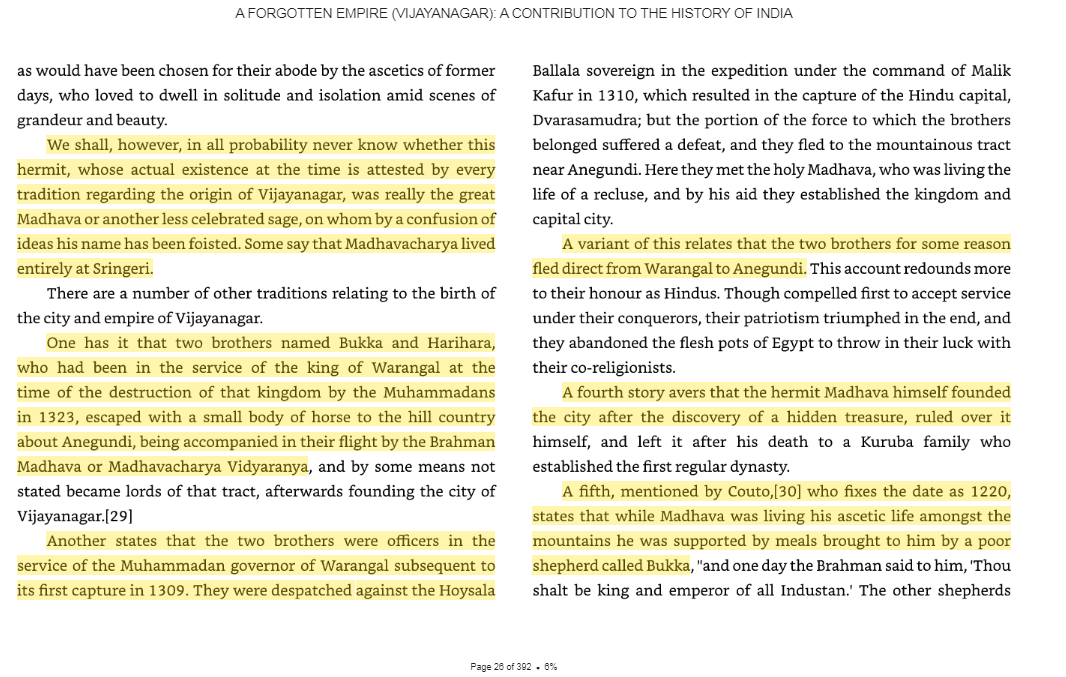
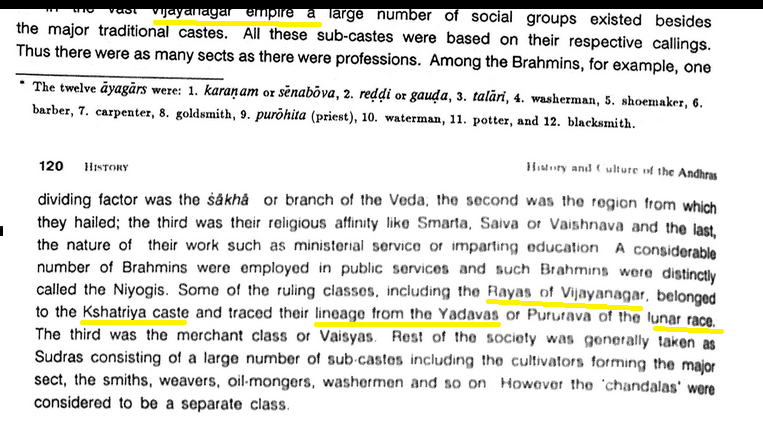
On this basis, it can be asserted that whatever their region, the founding Rayas were certainly Kshathriya. As example, the very name Aandhra comes from Andhra Nripati, descendant of Yayati. Incidentally, the Tuluvas also claim connection with this lineage. The onus therefore would now be on Kannadigas and Tulus to proffer such orthodox Kshathriya origins for their respective claimant communities.
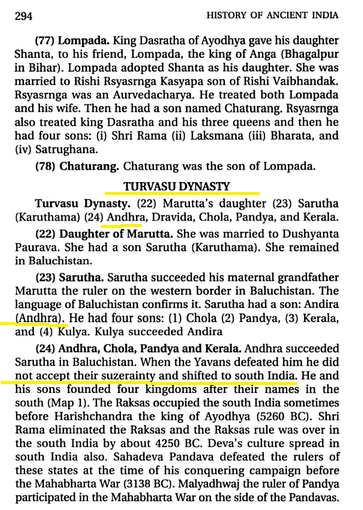
“On the identity of Vidyaaranya with Maadhava, there appears a doubt, for there is an indication of a contrary view that Saayana and Maadhava composed Vedabhaashya and other works at the behest of Vidhyaaranya.” [4, 228a]
Karnataka Samraajya is erroneously credited to Madhava Vidhyaranya. Indeed, modern historians such as Sewell condemn Sringeri itself for manufacturing history in its archives. But the british themselves were some of the all-time greatest corrupters of history, taking forgery of documents and coins to the next level—even manufacture and destruction of inscriptions per Pandit Chelam‘s protestations. Whilst these allegations must be studied, and though neither Kanchi nor Sringeri peetthas lesser residents have behaved beyond reproach, one need not sully oneself by besmirching the venerable Vidyaranya Svami. He is indeed Vijayanagara-sthapanacharya, that is, the Founder of the City of Vijayangara—but not the Empire.
Karnataka Samraajya was so named because it was founded in Karnataka, with its first capital at Anegondi.This routinely evidenced in Indic history as evidenced by the Telugu Cholas were called “Telugu”, only because ruled Trilinga desa—their origins were in the Tamil/Chola desa. Similarly the Eastern Chalukyas originated in the West (i.e. Karnataka). As such, most authorities agree that due to the great Telugu confederacy assembled by Krishna Nayak/Kapaneedu, the Heroes of the Empire would move from Warangal to Kampili to Dvaarasamudhra. This also explains their bitter rivalry with the Ballala ruler, and their alliance with the “Rai of Telingana”. The Sangama brothers Harihara (Hakka) & Bukka, were 2 of 5 survivors of the terrible Turkic invasions of the South. They crossed paths with Vidhyaranya, asking for advice given the middling success of their Anegondi kingdom. Vidhyaranya, who himself hailed from Aandhra desa, advised them to re-found their kingdom at the ancient site of Vijayanagara.
“Vidyaranya accordingly stopped at Hampe where he met later Harihara and Bukka, who had been defeated by the Ballala king. With his blessings they attained success. The spot for the construction of a capital city was indicated by a hare turning on hounds during a royal hunt south of the Tunga-bhadra. Vidyaranya after careful study and calculations built a city there and installed Harihara and the throne there. He also foretold the history of that city and kingdom, its rise, fall, and revival under Vira Vasanta to Harihara and this account compiled under orders by the ascetic Bharatikrishna. The first three kings at VIjaya-nagar ruled with his favour. The first thirteen Kings were devotees of god Virupaksha and had deep reverance for Vidyaranya and his disciple Kriyasakti…Kriyasakti was a Salva teacher of the Kalamukha School. Madhava-mantri, Governor of Chandagutti, etc., speaks of him as his guru in 1347.” [4, 228c]
Thus, from the very beginning one can see the seeds of Vijayanagara’s rise and fall being sown. The Shankaracharya of Sringeri, Vidyaranya on the one hand, and the Kalamukha adviser to Saayana and Madhava Manthri (thereby explaining questionable bovine interpolations of Dharmasaasthra).
“During this time, two persons named Sayana and Mayana came to me and begged me to bless them with offspring. But I told them that they were not destined to get children. At this they became sad and begged me to make use of the large sums of money earned by them for performing Dharma (charities) and enable them to on death the regions reserved for those who have sons. Thus entreated I made them my disciples and I composed and got composed by them works named Sayaniya and Madhaviya dealing with various sastras.”
“Vidyaranya was a desciple of Vidyasankara called also Vidya-thirtha. He calls himself a follower of Sankaracharya. He was the author of numerous works on various sastras which are attributed to the brother Sayana and Madhava, including Vedabhashya. He was given to much travelling and went to Benares to mee the sage Vyasa to get his Vedabhashya revised. On the way, he met Sringing a Brahmaraksasa in the Vindhya Mountain. From Vyasa, Vidyaranya learnt all the mystic lore and on going to Hampe to pay his respects to god Virupaksha he was bidden to revive the ancient city of Vijaya-nagar which had disappeared and to set up a kingdom there. This would enable the god Virupaksha to receive proper worship and offerings and help Sringin to be fed to his heart’s content. We find a temple for Sringin called Malayala-brahma set up near the Matt in Sringeri and it is said that without propitiating him no entertainment or feast could be organised at Sringeri.” [4, 228b-228c]
Tuluva Dynasty
Tuluva Narasa Nayaka 1491-1503
Viranarasimha Raya 1503-1509
Krishna Deva Raya 1509-1529
Achyuta Deva Raya 1529-1542
Sadashiva Raya 1542-1570
Tuluva dynasty gets its name not from Tulu, but from Turvasu→Turuvasu→Tuluva. This is the claim of the dynasty itself. KDR was son of Nagamamba, w/o Narasa. Narasa was s/o Ishvara, who claimed to be Yadava Turvasu descendant, hence Tuluva. Tuluva Ishvara Nayak’s wife was Lakkamamba.

This claim is validated in contemporaneous chronicles and poetic literature:

It explains why Krishna Deva Raaya’s father was likely an Aandhra Kshathriya . It should be noted that scholars adumbrate that “Tuluva Nrsanayaka had three wives—Thippaji, Nagalamba and Obamamba. Krishnaraya was born as Nagalamba’s only son.” [8, 20]
“Thirumalamba, the eldest daughter who wrote under the pseudonym of Mohanagi. In the introductory verses of this work [Marichiparinayamu], she clearly gives the date of Krishnaraya’s birth as Salivahana saka 1393, vikriti samvatsara, pusya bahula dwadasi sukravara, which then converted into terms of Christian era turns out to be 17-1-1471.” [8, 21]
Krishnaraaya is said to have grown up in modern Andhra Pradesh, around the fort of Chandragiri. This is due to the campaigns of Emperor Saluva Narasimha, imperial overlord of his father Tuluva Narasa naayaka. [7, 21] Though according the portuguese traveller Paes, KDR is said to have had 500 women in his harem, he nevertheless kept 12 wives, with 3 principal wives. The chief queen was Thirumala Devi. “She was one of the daughters of Veerapoddeya, who ruled Srirangapattana.” [1, 25] “But generally held opinion among historians that she was the daughter of the scion of the vodeyars of Ummattur may not be correct. The clan, the place of origin, his relation with the other dynasties are not known. Her dynasty is probably indicated by Nuniz when he says the wife of the emperor was a most beautiful lady of ‘the family of Nsymgua’ meaning Salva Narasimha. This fact is again corroborated by the now familiar Vagata inscription which says that Krishnaraya was the son in law of Salva Immadi Narasimharaya.” [8, 27]
Krishnaraaya did have a courtesan-lover in his youth named Nagadevi, whom he duly married as a secondary-wife (Thirumaladevi being his Mahishi or chief Queen). Perhaps this is the reason for the confusion in primary sources about his mother (Nagalamma), or at least in the interpretation or interpolation of them.
The Odia Gajapati dynasty (itself unorthodox being adopted by the actual Suryavanshi Eastern Ganga dynasty), insulted Krishna Deva Raaya as dhaasiputhra on this account—but she was not a “slave”, and rather was possibly from the Soodhra-origin Naayakas of Aandhra, and was indeed married to Narasa Naayaka, his father.
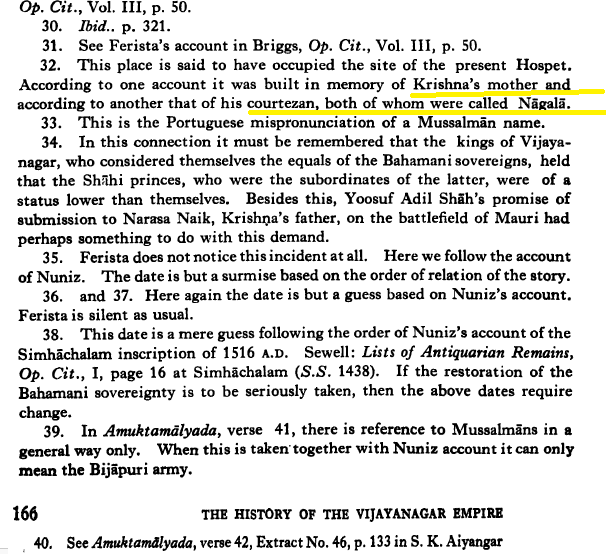
However, Southern parochialists must stop willy-nilly claiming every warrior group as kshathriya (the Sangh has added to this damage). This only makes Rajputs and other ritual-status Kshathriyas irritated and insecure in their claims, and naturally agitated. We have been clear that the Pratiharas were called Gurjara because they were high-caste Rajputs from Gurjara desa. In the Kali Yuga, Hindus who have earned it on the battlefied and become kings, may initiate as Yagnik Kshathriyas, but Pauranik Kshathriyas (Agni & Naagavamsa) and Vaidik Kshathriyas (Surya and Chandravamsa) are clearly-by-birth, and should be respected as distinct. Conflating and competing claims only leads to conflict.
Kannada claims centre around Kurubas (that is shepherds), when inscriptions and traditional history are consistent that all 4 dynasties were Kshathriyas of either Somavamsa (Sangama, Saluva, & Tuluva) or Agnivamsa (Araveedu) extraction. Demoting the multi-lingual Empire to a “Kannada Kuruba Kingdom” on the basis of consonance and KKK mentality, only deprecates the sparkling Expansive period that Karnataka experienced under the Chalukyas, Western Gangas, and Hoysalas. Such small-mindedness is more apparent in the South than the large-hearted (albeit overly haughty North). Raajya means kingdom, Samraajya means Empire. It was called the Karnataka Samraajya for that reason.
Having tended to this matter, we may now move on to the Pesonality at hand.
Outset
Immediately preceding the Rise of Krishna Maharaya, was a difficult and dangerous political situation. Due north was the collapsing but ever-more danger bahmani ruler. Rather than expunging, this breakup resulted in a hydra-headed head monster, seeking ever to devour its southern neighbor.
To the East was the implacable Gajapathi Empire. Built on the commandeered foundations of the admirable Eastern Ganga dynasty, it had all of the military but none of the nobility.
To the South was the recalcitrant vassal Raajas and myriad rebellious chieftains. These principalities rarely got it into their thick-heads precisely what the stakes were facing Vaidika society in particular, and Indic Civilization in general. All they could think of was expanding their own petty power.
Rise
“Krishnaraya has been eulogised for over a century now by historians as a brilliant military strategist. Less known and much less appreaciated is his prowess as a political strategist.” [8, 31]
The story about Krishna Deva Raya’s rise is one the is traced to the decline of his step-brother Tuluva Veera Narasimha. It is stated that the latter desired to place 1 of his 2 sons on the throne, but the “Thimmarasu saves the day again…” line has been wearing thin for some time now, as is the story of goats’ eyes. Indeed, there are inscriptions and proclamations indicating KDR ruling as yuvaraaja alongside his elder brother. This would be line with the Empire’s tradition of elder-younger brother successions starting with the Imperial Founders themselves, Hakka & Bukka.
Indeed, there are questions about Thimmarasu himself. Was he an Aruvela Niyogi related to the Nadendla family, or was he Saluva Narasimha, whose surnamed matched the preceding dynasty of Saluva Narasimha, thereby making him a Kshathriya Raju (actually qualified to be ministers per varnashrama dharma). This and other questions must be relegated for later.
One thing is clear: Krishna Deva Raya’s rise was and success was through his own effort. In this, he was assisted by many ministers, lieutenants, and court poets/advisers. But the Emperor was a man of sterner-shrewder stuff than them all. Nothing makes this more evident than the adversity he faced from the moment he took full control of throne.
“Krishnaraya was careful enough to take several steps to smother any opposition right in the bud. Nuniz candidly admits this when he says that the Raya packed off the contenders viz., his half brother Achyutharaya, Ranga and nephews Sadasiva and unnamed sons of Viranarasimha, under tight security to the royal prison of Penugonde. There they remained until Raya died in 1529.” [1, 31]
From there, he would inaugurate a lifetime of Warfare and Struggle against the deadliest enemies in Dakshinapatha.
First Bijapur War
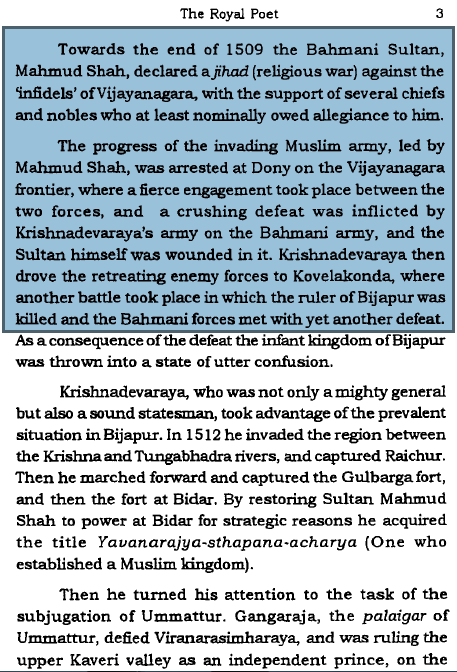
Regardless, a prudent Tuluva potentate settled matters to his overwhelming benefit, and turned his attention to recalcitrant chiefs.
Southern Campaign
Siege of Ummatur
Though “the Raya had killed Yusuf Adil Shah of Bijapur in January 1510″, a jehad would be declared against him by all the Shahis in 1513. In the intermittent lull, he had to crush the spirit of rebellion brewing in his Southern vassals. The first was strike was toward Kanchipuram, where crushed rebel Pandya and Chola vassal kings. From there he moved to Sivanasamudra, possession of the Ummataru chief Gangaraja. The fort fell in 1512, and the rebel ruler fell into a gorge rather than face chastisement from his Imperial overlord. The town of Ummatur was razed to the ground the island sown with castor seeds.
One of the gnawing problems of Southern Kshathriyas was the sour grapes approach they took after being magnanimously restored to the throne as feudatory/vassal. Time-and-again, the Cholas, Pandyas, and in this case, the Ummattur princes (said to be of Saluva Kshathriya extraction) failed to take stock of the wider change on the political and indeed geo-political landscape. No one likes to smart under subordination or even suzerainty, but get a basic survival sense.
“The surviving members of the ruling family of Ummatur were divested of all power. The ummattur fiefdom was broken into several small regions. Officers from outside the area were appointed for each region. Thus Kempegowda of Yelahank who later built he present city of Bengaluru, was given Sivanasamudra and Srirangapattana went to Veerappodeya.” [8, 43] From there he punished and pardoned the ruler of Karkala/Kalasa, before finally bringing Ikkeri to heel.
As a result, Krishnadeva Raya implemented the Amaranaayaka system, and promoted loyal Soodhra barons to administer these abolished principalities and Nayakdoms. Vijayappa Nayak sent to retake Thondamandala. Took vellore & gave Jinji to Krishnappa
1st Golkonda War
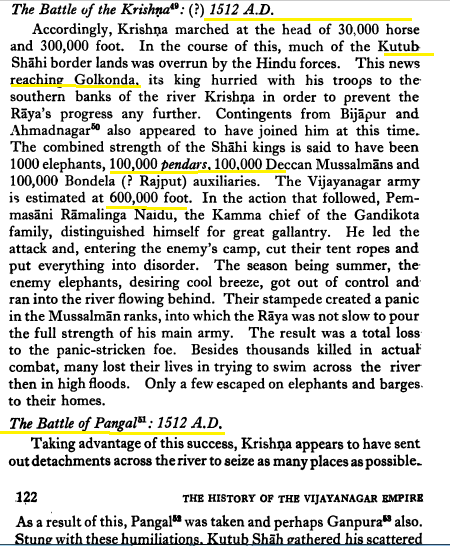
The Golkonda Qutb Shahis have been undergoing a something of pr-revival of late. Nevertheless, their early rulers were no slouches in the bigotry department. They were highly active in the defeated Holy Wars against Vijayanagara. However, they were spectacularly defeated—not for lack of trying.
Second Bijapur War—Destruction of Kulbarga
Krishnadeva Raya is often criticised for taking the title “Yavanarajya samasthapanacharya meaning ‘the establisher of the kingdom of the muslims’“. However, this was due to the particular nature of moslem polities. Though they had bitter rivalries amongst each other, they were religiously commanded to unify against infidels like Vijayanagara. What’s more, whilst they were carving out their own kingdoms, they were still nominally required to show obedience to the bahmanis of Bidar. 1512 CE was still very early in Krishnaraya’s reign (~1509/1510-1529). He faced revolts in the Canara country and Dravida desa.
What’s more, each time the Maharaya’s schemed to devour one of the Sultanates, the others would threaten to aid the enemy. This included not only the 5 deccan sultanates, but also those of Gujarat and Malwa. Even the later mughals just scarcely missed interacting with the final Emperors of Vijayanagara. One wonders what if Talikota never happened, and whether the Emperors of the South and North would have repeated an epic clash like Pulakeshi II & Harshavardhana.
It is sometimes said that Vijayanagara’s destruction 1565 was in revenge for Kulbarga’s plunder. But this is incorrect. The impatient Vijayanagaran forces had camped out in the conquered city waiting for the craven Kulbarga ruler to “kiss the foot” of Krishnaraya, as he had promised. In a fit of absent-mindedness, some soldiers of Vijayanagara broke the dam for the water tank, in order to gain building materials. The resulting hydrogenous disaster ruined the city’s habitability. What’s more hundreds of thousands of Hindus had been slain or sold into slavery by the Sultanates, by their own admission (see Ferishta). The wanton destruction and massacre far-and-away exceeded the sacking and deluging of one city (itself restored later). In contrast, the sheer paroxysm of violence inflicted on Vijayanagara smacked of iconoclasm and religious bigotry. The capital of the Maharayas had been purposefully razed.
2nd Golkonda War
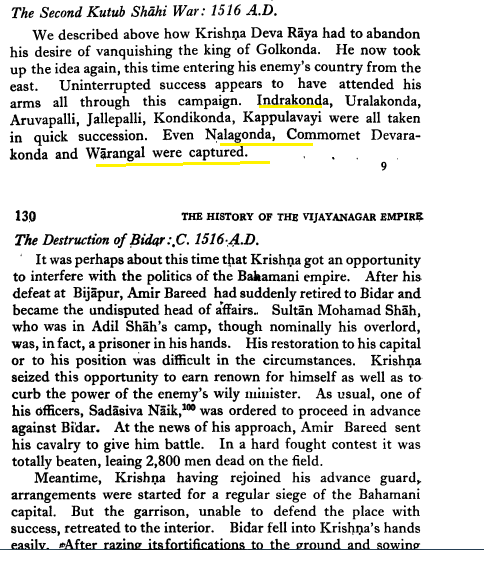
The forts of Panugal, Warangal, and as per some attestations, Golkonda itself, were said to have been taken for a time. Although they were quickly recovered, Kondaveedu and Kondapalli would long be out of their grasp. Repeated battles on the Krishna Godavari Doab would repeat the Raichur Doab’s frequent changing of hands.
Odisha War
The vainglorious rulers of Odisha were in fact usurpers of the throne of the noble Eastern Gangas. The latter had long defended Utkala-Oddhra-Kalinga from the depredations of the Delhi Turks. The Gajapathis, despite their Suryavamsa pretensions, were merely legatees and adoptees of the Ganga Kings. Despite being of questionable provenance themselves, they usurped the rule of nobler men and waged voluntary war with Vijayanagara.
Many modern commentators question why the Hindu Empire of Vijayanagara could not united with the Hindu Empire of Odisha—well it was not for lack of trying. But a relationship that is one-sided, is ultimately doomed to fail. The Eastern Ganga Dynasty of Odisha consisted of wise leaders who often competed with the Kakatiyas, but gladly gave military aid when the latter faced Delhi Turkics. Their Gajapathi adoptees, however, usurped the throne and allied with the bahmanis against Vijayanagara. It was this alliance (however brief and opportunistic) that permitted the Odias to conquer large tracts of Eastern empire.
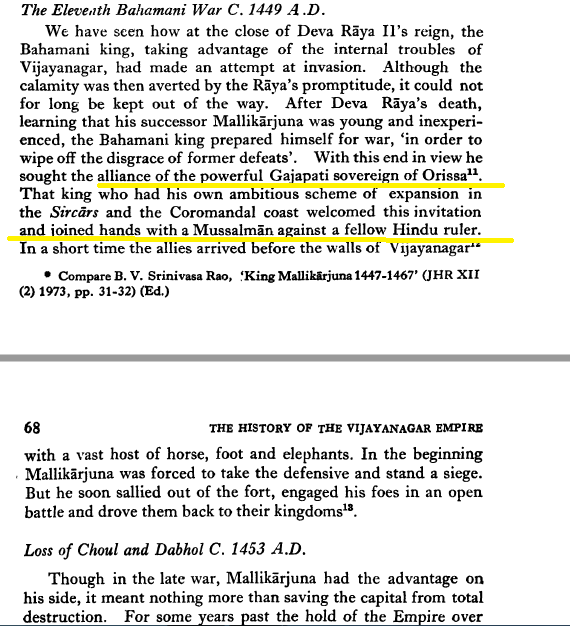
To add insult to injury, after investing (but failing to take the mighty city of Vijayanagara) they defeated Saluva Narasimha in the field and carried off his daughter. Though after some dilatory missives, Purushottama Gajapathi eventually married this princess, the intended humiliation was not lost on Vijayanagara.
Odia naysayers may demur, saying bahmanis frequently allied with Vijayanagara against each other; however, the reality is one group was facing civilizational extinction on home turf—the other was not. Dharma in this case was clear and the crime was clearly committed by the Gajapathis who time-and-again refused to ally with Vijayanagara and chose to mock and injure it instead. Despite eclipsing them in empire, the Odia Gajapathis clearly fell from the admirable legacy of of their Odia Eastern Ganga predecessors. The question is, who had “guided the Gajapathis...”?
The “Odda empire reached its greatest extent at this time, its influence being felt from the Ganges to the Kaveri. But unlike the Telugu districts, which became part of the empire of Orissa for some years, the southern lands did not pass out of the control of VIjayanagar, and the Oriya invasion of the south was only a sudden raid followed by speedy withdrawal. The sovereignty of Vijayanagar was upheld by its powerful nobles ruling in almost complete independence of the emperor Mallikaarjuna, such were Saaluva Gopa Timma, also known as Tirumalaideva Maharaaja who held Trichinopoy, Tanjore and Pudukkottai, and Saaluva Narasimha, equally prominent in the centreand in the eastern parts of the empire.” [2, 247]
Krishna Deve Raya decided it was time to settle accounts.Though he had during the reign of his brother successfully measured swords with his rival to the North, it was a defensive action. [3] After years of meticulous preparations, he declared war on the insolent Gajapathis who had insulted Saluva and Tuluva alike.
“The campaign that took off in April 1513 was a protracted one. It lasted from 1513 to 1521. Because of the hugeness of the incursion, it was planned in several stages and executed with great precision. In fact, it is acclaimed to be one of the most elaborately planned and meticulously executed military campaigns in medieval South India.” [8, 47]
Udayagiri
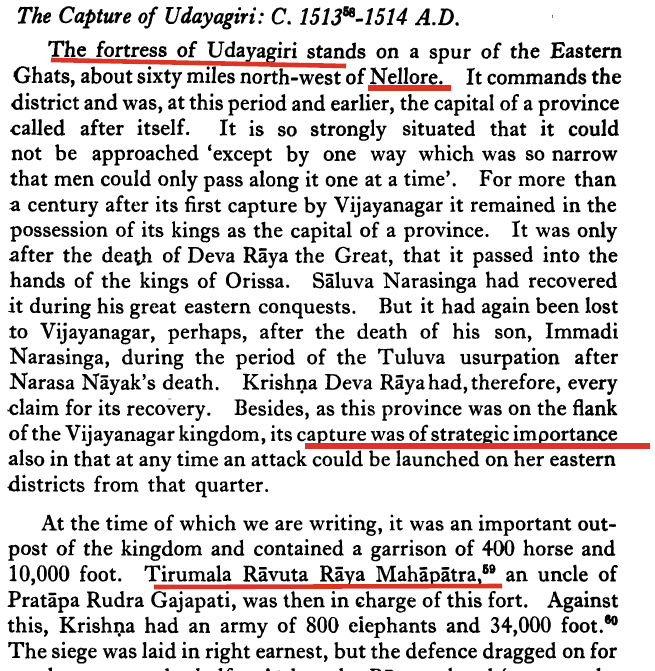
Rayavachakamu describes the immense host gathered by the Maharaya, numbering it at 800,000 foot soldiers, 36000 horse, 1700 war elephants and countless campfollowers and pack animals. It was launched in 2 prongs after initial action in Southern Andhra. Udayagiri was the first target.
Serving as the regional capital of Kalinga, Udayagiri was 350 km away from Vijayanagara. The massive boulders blocked the path to the imposing fortress. Blasting them away with mining experts, Krishnaraaya invested Udayagiri, defended by Prathaaparudhra’s uncle). Thirumala Rattaraaya, the commandant of the fort, was then captured after the fort was stormed, causing avuncular distress to the Odia ruler.
The murthi of Balakrishna was then carried off and reconsecrated at Krishnaraaya’s capital.
Next came Kondaveedu.
Siege of Kondaveedu
Kondaveedu Fort is famed in the annals of Aandhra history. It served as one of the three capitals of Andhra’s Reddi Rajyam, long since split between the Gajapathis and Vijayanagara. It guarded the gates to north Aandhra.
However, this fortress, much like the ‘City of Victory’ could not be taken without tending to the peripheral forts that guarded the approach to it: Addanki, Vinukonda, Nagarjunakonda, and Bellamkonda. The Southern Imperial Forces did precisely that.
Nevertheless, the investment soon declined to a protracted Siege. Saluva Thimma, who had been assigned this objective, was superceded by the Maharaaya himself as Field commander. In true Krishna Deva Raya style, the fort of Kondaveedu was then stormed (after taking due precaution with the minework). As part of the fortress’ treasure was the Gajapathi Crown Prince Veerabhadhra, as well as one of Kalinga’s Queens. They were taken prisoner, but treated with expected dignity. It is said that Prince Veerabhadhra was rather haughty, and felt humiliated when asked to demonstrate his famed swordsmanship in a duel with a lower caste soldier. He took his own life, further demoralising the Odisha ruler.
Siege of Kondapalli
VIjayawada soon fell to Vijayanagara’s forces, some time around 1515. Then came Kondapalli’s turn. This important for city was the last major obstacle to the open path of Kalinga country. At that point it would be a straight shot to Cuttack (Kataka).
The unbowed Gajapathi Emperor then descended upon Kondapalli to give battle with a half a million strong army. He attempted to cutoff KDR’s supply lines—critical aspect given the 600km to his capital. The Maharaaya outmaneuvred him then waited 2 months for the attack. Seeing his adversary choosing to defend the bank of the Krishnaveni, KDR then launched a furious attack. In this sanguinary action, tens of thousands of men, horses, and elephants lay on the field of action or were swept away. The Narapathi of Vijayanagara had worsted the Gajapathi of Odisha, who skulked back to his capital in defeat.
It is said that in the interim, War with Golkonda took place, and the town itself was taken, if not the fort itself. Whether or not that was the case, Krishnaraaya’s armies certainly took Warangal for a time. It is likely he left these only after settling the border at the more defensible Krishnaveni river.
Shitab Khan
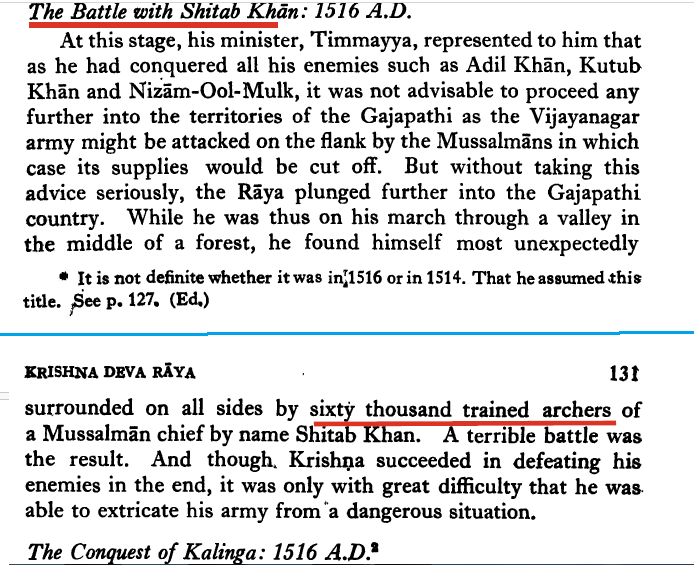
A curious character known as Shitab Khan (known as Sitapa) then faced Krishnaraaya. The name was infact a title of turkic commanders, who would administer the fort of Warangal.
He attacked Vijayanagara’s armies on behalf of his defeated liege-lord, with 60,000 archers. This refractory action was soon stymied. This forced the Gajapathi vassal to then to retreat to Oddhra desa. [8, 49]
At Simhachalam, KDR erected a pillar of victory that was referenced by Nuniz. It notes mockingly how the Raya waited in vain for the ruler of Gajapathi to give battle.
Following the battle of Kondapalli, Krishna Deva Raya gave effusive thanks to his tutelary deities. He then invested Kataka itself. There is some descrepancy again as to whether he was able to easily take the Odia capital of Cuttack or whether the summoning of the Gajapathi’s 16 powerful Mahapathras put the victory at risk. Nevertheless, be it defeated by strategem or not, Kataka was taken, which forced Gajapathi Prathaaparudhra to finally accept defeat and sue for peace.
Per the terms of the Treaty, Krishnadeva Raya would return the wife of the Gajapathi with honour. He would proceed to marry the latter’s daughter Jaganmohini. This marital pact was to seal the peace between the Eastern and Southern Imperial powers. However, as demonstrated later, Prataparudra was a sore loser (like most casteists today). Smarting from this comprehensive defeat and humiliation, he would make desultory but defeated attacks towards the end of Krishnaraaya’s reign. He was utterly unwilling to comprehend the existential danger posed by the bahmanis against Hindu kingdoms on account of their repeat jehads.
Rumours in fact abound as to whether he was responsible for the premature death of child-king Thirumalaraaya. Suspicion was underscored by the estrangement of Krishnaraaya and Jaganmohini—who spent her remaining days in a Telugu temple town.
No doubt a united alliance of Oddhra and Karnataka Samraajyas would have uprooted the deccani sultanates, but alas, it takes 2 hands to clap.
Despite this monumental achievement in campaigning and logistics, Krishna Deva Raya’s most spectacular victor was yet to come.
Final Bijapur War
The final war with Bijapur was provoked by more intrigue. A merchant named Syed Mercar was deputised to purchase horses on behalf of the Empire. Rather than fulfill the transaction he transgressed the borders of the Empire and escapted to Bijapur with an estimated 40,000 gold varaahas. With the Bijapur king unwilling to extradite his co-religionist, War for Raichur resumed.
Krishnadeva Raaya’s battle-hardened army of 730,000 infantry, 550 elephants, and 326000 cavalry was spoiling for battle. Raichur was besieged. Adil Shahi, who had grown arrogant with the power of his artillery then gave battle and blasted his way into the vanguard of Vijayanagara’s Imperial forces.
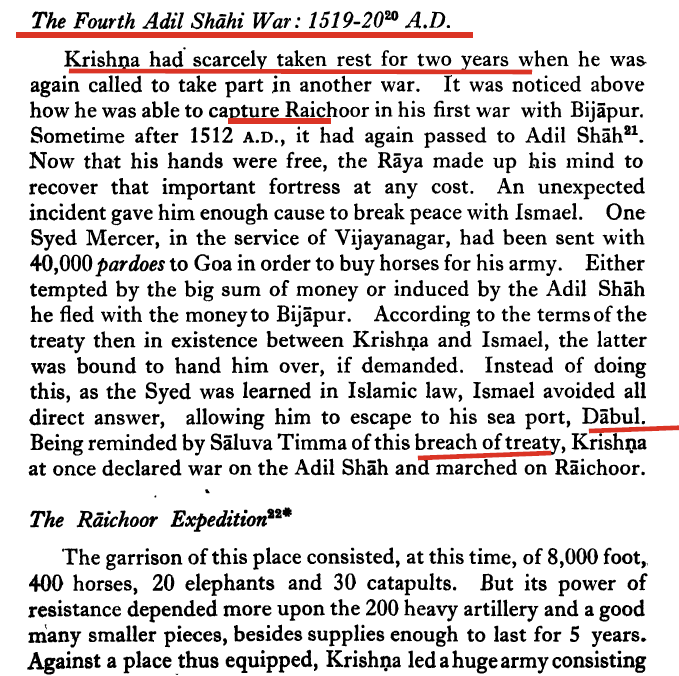
Battle of Raichur
The Siege & Battle of Raichur stand as the highwater mark of Vijayanagara’s set-piece clashes. It in fact merits standalone study, outside the scope of this already large article. As such, the broad outlines will be sketched here in it’s stead.
The vanguard was led by Virappodeya, the flanks by the Raya’s Dandanaayakas, with him at the centre. Seeing the van in disorder and the charging Adil Shahi cavalry, the Raaya planned for the worst. He handed over his signet-rings to his lieutenant, should the battle go ill. He then strengthened his picked cavalry with his bodyguard and then counter-charged the enemy. In this steely clash of cavaliers, the multitudinous heavy cavalary of Vijayanagara won out. The Adil Shahi fled the field. The bulk of his army are said to have drowned in the river, whilst he skulked back to Bijapur. It was a rout.
Siege of Raichur
It is unfortunate that accounts of the time must always be taken with a grain of salt. The Siege of Raichur was protracted, allegedly on account of its height and double walls. The portuguese accounts quickly claim credit, stating that their arquebusiers picked off the Bijapuri defenders.
Flush with reinforcements courtesy his vassal Tothe Raya, Krishna Deva then mounted yet another storming of a well defended fortress city (once the obligatory minework was completed).
The conquest of Kulbarga was rounded out with the usual tribute collecting naval fleet:
“In about 1522 , on the basis of an inscription, a Tamil general of the empire, Ponnambalanatha seems to have taken out a naval expedition to Srilanka and collected tribute from Bhuvanaika Bahu, the ruler of that island”. [8, 53]
Epilogue
Despite repeated victories, Krishnadeva Raya had to face repeated breaches from the bahmanids. Their opportunism knew no bounds, with old treaties being broken the moment the Maharaaya become distracted by the Gajapathis or his own Southern Chiefs or even his on-again-off-again Portuguese allies.
It is not entirely clear whether Kulbarga was destroyed in 1514 or 1520. If it is the latter, then it is apparent why Kulbarga was sacked and ruined. The permanent end of the bahmani sultanate meant that the 5 shahis could now be played against each other rather than have a figure of unity. Between 1520 and 1565, a half century of politicking would permit some respite to Vijayanagara, faced with internal dissension within and unreasonable Odisha ruler without.
On the homefront, fears of succession began to mount and were compounded by the loss of his heir. KDR suspected the Saluva Thimma family and imprisoned them. One of the sons escaped and raised the banner of revolt. It was defeated and he was captured. Here again there is discrepancy between the portuguese accounts and the contemporaneous chronicles of Vijayanagara. Saluva Thimma and his sons are said to have been released from prison, whilst the portuguese claim them to have been executed or blinded. It is clear that local legends occlude rather than clarify. It will be left to posterity to evaluate this period.
Whatever the legacy of Thimmarasu/Saluva Thimma as Mahapradhaana, the Raya had better fortunes with his Kulacharya Thirumala Thaathachaarya Sharma (a Srivaishnava) and the Raaja Purohitha Ranganatha Deeksitha (a Shaiva). Tradition maintains that the Madhva Braahmana Vyasatheertha was his spiritual advisor and Agamic teacher. [8, 55]
“The Raya, although a staunch vaishnava, continued the sign-manual of ‘Virupaksha’. He also maintained a fine balance between various sects of Hinduism like shaivas, vaishnavas and srivaishnavas.” [8, 55]
Despite such skilled Pandiths, Vaidhyas, and even Tantriks, the Tuluva lineage was allegedly plagued by stomach ailments (thought to be ulcer). According to Nuniz, this was hereditary and began to act up in the lead up to the birth of KDR’s second son Ramachandra, in 1527. Finally, in 1529 CE, at the advanced middle age of 58, the great man breathed his last.
The throne was to go to Achyutharaaya, released from his royal prison at Penukonda, after 19 years.
Achievements
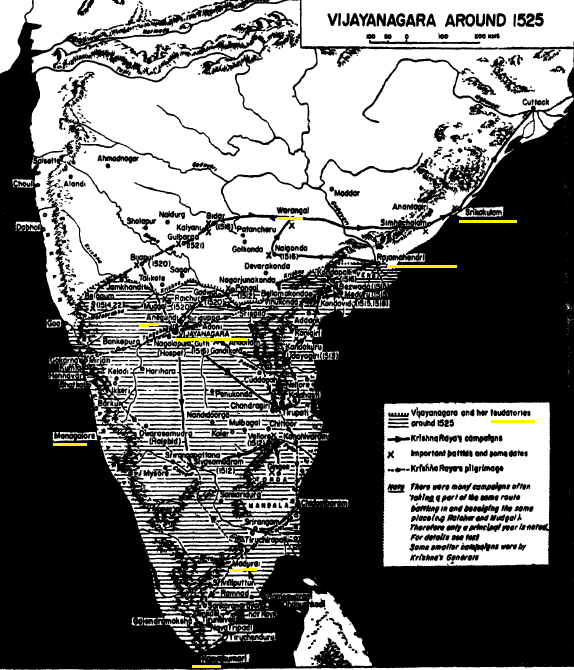
- Expanded Vijayanagara to its maximal limits
- Presided over the Noon-tide of the Empire in Politics, Culture, & Commerce
- Master Military & Political Strategist
- Cunning Diplomat who applied the Shaadgunya effectively
- Physically & Mentally strong ruler who was committed to a daily fitness regimen
- Patron of the Arts & Literature, sponsoring the Golden Age of Telugu Literature
- Composed as many as 6 Sanskrit Works, and 1 Telugu Work (Aamuktamalyada)
- Beloved by Kannadigas as “Raaja Ramana” and by Telugus as “Aandhra Bhoja”.
Inarguably, Krishnamaharaaya took the Vijayanagara Empire to its Zenith. This was the case not only culturally, which saw Vijayanagara’s halcyon days, but also militarily.
Though it would reach as far North as Choul and Dabhol under Harihara II, the Tuluva luminary would take it to its eastern-most limit. As per the marital treaty imposed on Gajapathi Prathaaparudhra, territory North of Krishnaveni river would be magnanimously returned to the Odia ruler, Krishna Deva Raya kept everything South of the Krishna. One wonders what might have happened had the Gajapathis been uprooted and Achytha been installed as Viceroy of Odisha.
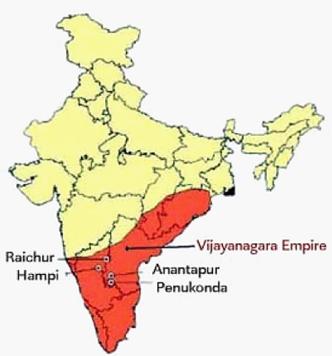
From Kulbarga to Kataka, Krishna Deva Raya was undefeated in all his wars. Throughout his life he contended with the most aggravating adversity: refractory chiefs, predatory periphery, traitorous father-in-law. Only the premature death (some say murder) of his 6 year old heir could demoralise so formidable a man.
He would carry-on with dignity, but life and had clearly taken its toll. Due to questions about his birth-year, the uncertain age of 58 years is often attributed to him. A life of campaigning and politico-strategic maneuvering and reach its limit. The grand old man left this world, but assigned his empire to his younger step-brother Achyutha.
If there are 2 errors that can be attributed to him aside from the questionable Thimmarasu episode—it was marital. By munificently marrying into the treasonous Gajapathi family and giving the hand of his daughter to “Aliya” Rama Raya, previously a lieutentant of Golkonda, the seeds for the demise of this Dakshinapatha Samraajya were sown. One cannot fault his judgments, as he was surrounded by traitors within and without, but perhaps indeed his stars.
Culture

Krishna Deva Raya distinguished himself in the world of Literature. Voluminous volumes could be composed on this topic alone. He is credited primarily with works in Sanskrit, notably the Jambavathi Kalyaana and Madaalasaa Charithra. However, he has become a literary legend of the Aamuktamaalyada: a work on Aandaal Bhudevi, and her incarnation in Sriviliputhur.
Commentary on poetry would not be complete without mention of his Ashtadiggajas (“8 directional elephants of Literature”).
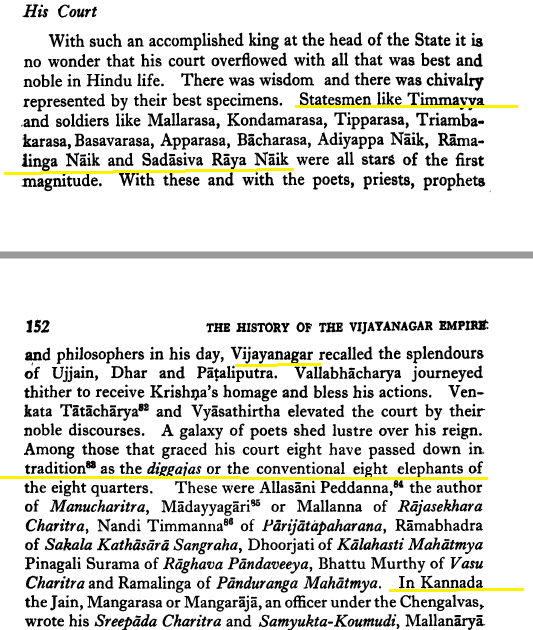
He is remembered for composing the timeless phrase: Desabhaasha laandhu Telugu lessa, meaning “Of all the regional languages, Telugu is the best”.
“In the Cultural history of Andhras, Srikrishnadevaraya’s period flourished with the fine arts. So it is marked as the Golden age. Srikrisha Devaraya is said to have written a treatise known as ‘Rasa Manjari’. In fact he mentioned so in his magnumopus kavya, ‘Aamukta Maalyada’ But it has not seen the light of day. In this temple of Kesava Swamy, there is an epigraphy which enumerates the names of dramatise personae of the day. According to this epigraphy some land was assigned to actor ‘Nagayya’ and actress ‘Paatri’, the daughter of ‘Timmayya’ for putting on boards the play ‘ Tayiknda Naatakam’. This play is supposed to be an opera. The dramatis personae indicate that both men and women were acting in these dance dramas.” [6, 30]
Krishna Deva Raya and the Ashtadiggajjas
Aandhra Bhoja was not only a master of statecraft and war, but also poetry. He composed the famous work Aamuktamalyada in Telugu (a language–likely his Mother Tongue–which he adored). It is regarded as an excellent specimen of Telugu prabandha.
Alasanni, Peddana
The poet laureate of KDR’s court, Peddhanna is considered the Andhra Kavita Pitamaha. His most outstanding poem was the Manucharitramu. Some claim Aamukthamaalyadha to be his own poem, but the only evidence exhibit remains the phrases Krishna Deva Raya quoted from the Manucharithramu that praise his dynasty and recount his Imperial lineage. A case of modesty rather than appropriation and ghost-writing.
Nandi Timmanna
Another of Andhra Bhoja’s Ashtadiggajalu, Thimmana is best known for his work Parijathapoharanamu
Ayyalaraju Ramabhadra-Author of the Ramaabhyudayam
Madayagiri, Mallana-Wrote the Rajasekhara Charitramu
Ramaraju, Bhushana-Author of the Vasucharitra
Dhurjati-Penned the Kalahasteeswara Mahatmyam
Pingali, Surana-Wrote the Kalapurnodayamu
Tenali Ramakrishna-The most famous of KDR’s 8 court gems, TRK was more than just the court wit, but also an author in his own right having composed the Panduranga Mahatmyam.
Among rulers, Emperor Krishnadeva Raya’s Royal Regimen remains the most famous. Per one account, he would drink a kumbha of ghee, and then lift weights until he sweat it all out. Then he would go horseback-riding. This was his daily exercise routine. A foreign observer elaborated:
“He is the most feared and perfect king that could possi-bly be, cheerful of disposition and very merry; he is one that seeks to honour foreigners, and receives them kindly, asking about their affairs whatever their condition may be. He is a great ruler and a man of much justice, but subject to sudden fits of rage.’ Krishnadeva kept up his bodily strength by hard physical exercise, he was a fine rider and his noble presence made a pleasant impression on all who came into contact with him“. [8, 251-252]
Legacy
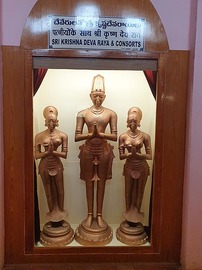
The Legacy of Maharaajadhiraaja, Mooru-raayara-ganda, Krishnamaharaaya cannot be minimised. From art to architecture to international diplomacy he touched it all.
2 of his 3 principal queens gave him 2 sons and a number of daughters (one of whom was a poetess in her own right). Though his direct line died out, his blood survives in the descendants of the Araveedu dynasty.
Artistic Legacy
True to the name Aandhra Bhoja, Krishna Deva Raya was a lover of learning and culture. In his youth he learned music. He was no doubt a great sponsor and enjoyer of Nrthya.
“SriKrishnadevaraya was a lover of dance. It is said that dancers belonging to the Ranjakam family were employed in his court. After participating in the literary debate, the great Royal used to witness a dance performance. The court dancer was ‘Kuppaayi or Kuppasaani’. Her two daughters Tirumalamma and Muddu Kuppaayi were also famous dancers. Muddikuppaayi was a court dancer of Achyutarayalu. She was also appointed by Achyutarayalu as temple dancer in Govinda Raja Swamy temple at Tirupati.” [6, 31]
“Srikrishnadevaraya in his Aamukta Maalyada makes con-siderable references to dance and music at a number of places. He says that various dances were being performed in the divine presence of ‘Srihari’ at Villiputtur. The descriptions of Sangiita and Naatya performances at Madura of Pandya desa are su-perb. He says that the buildings in Mahdura were lofty enough to lower the positions of clouds. The peacocks which were perching on the heights of the buildings failed to dance be-cause they were not under the influence of clouds. At that stage the discerning damsels in the buildings Bengal singing the Raaga-Me:gha Ranjani to draw the clouds to higher positions so that the peacocks on the heights would dance.” [6, 31]
“There used to be a special dance hall complex (Naatyasaala), where the Rayalu used to witness dance performances. Women of the Royal family were also learning dance in the Naatyasaala itself.” [6, 31]
Krishnamaharaaya was a tremendous patron of the arts in general. Though it is not clear what his contribution to the famous site of Lepakshi is, there are other artistic marvels attributed to him.
“These works of art which include this Naatyasaala, the Saptaswara Pillars of Vithalalaya and the Rangamatapam, all belonging to the period of Srikrishna devaraya have survived until now.” [6, 31]
“Kesava Bhattu, the grand father of the great poet scholar Jagannatha Pandita Rayalu was said to have pleased Sri Krishna devaraya with his prowess in literature and Kuucipuudi dance and received the Agraharam ‘Munganda’ as apresent.” [6, 31]
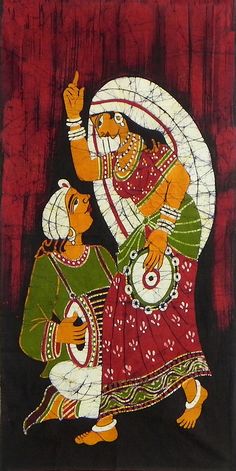
“According to Raghavendra Vijaya Kaavya, Srikrishnadeva Raya, when he was young he had learnt Viina from a scholar ‘Krishna’ and presented him with Jewels and sparklers. Bandaru Lakshmi Narayana wrote Sangiita Suryodayam a treatise on music. In the beginning he was employed in the court of Gajapathi but later he migrated to Vijaya Nagaram. Sangiitasuuryodayam was also known as ‘Lakshmana Bharatam’. He was also employed in the palace to teach music to the members of the royal family.” [6, 30]
KDR’s impact was not always direct. Placed under house arrest for 19 years, Achyutharaaya had much time on his hands. He is credited with works of musicology not seen since the heady days of Vidhyaranya Svami himself. Indeed, the revival of Saastriya Sangeeta can be traced to Vijayanagara’s founders and greatest rulers.
“Sri Krishna devarayalu’s younger borther Achyuta Rayalu (A.D.1530-1542) had written ‘Taala Kalaabdhi a treatise on musicology. Sri Krishna deva Raya’s son-in-law, Rama Rayalu (A.D. 1542-1565). Was a great patron of music. His court musi-cian Ramayamatya had written ‘Svarameelakalaanidhi’ a stand-ard work on musicology. He mentions ‘Acyuta Raje:ndra Viina’ one of the type of Viinas in use.” [6, 33]
Architectural Legacy
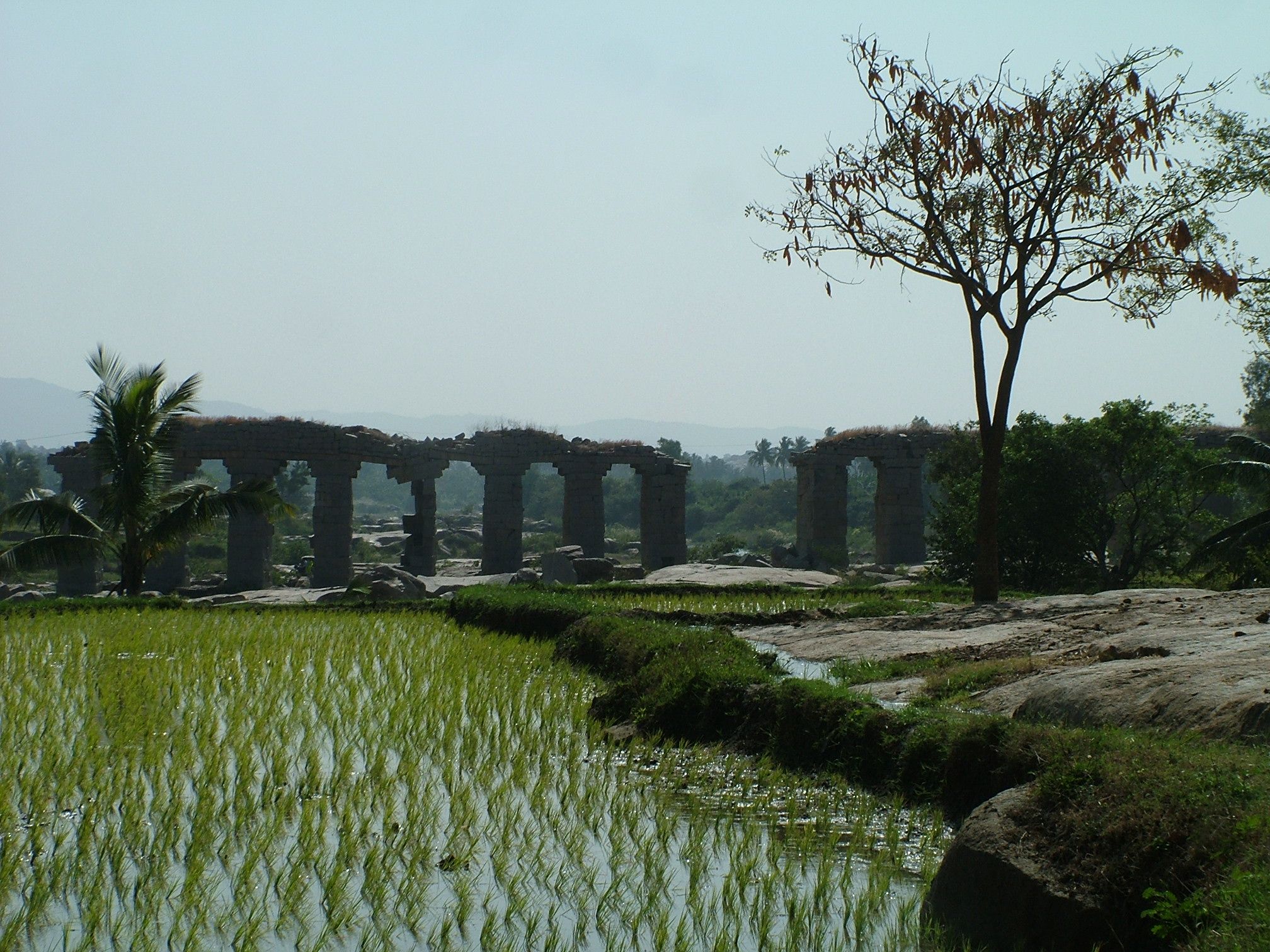
The Building programmes during the Age of Krishnaraaya were so signficant that modern scholars aver whether there was a distinct Imperial architectural style. In the past, many have erroneously attempted to downplay the classical Vesara and Dravida styles that were en vogue in the region.
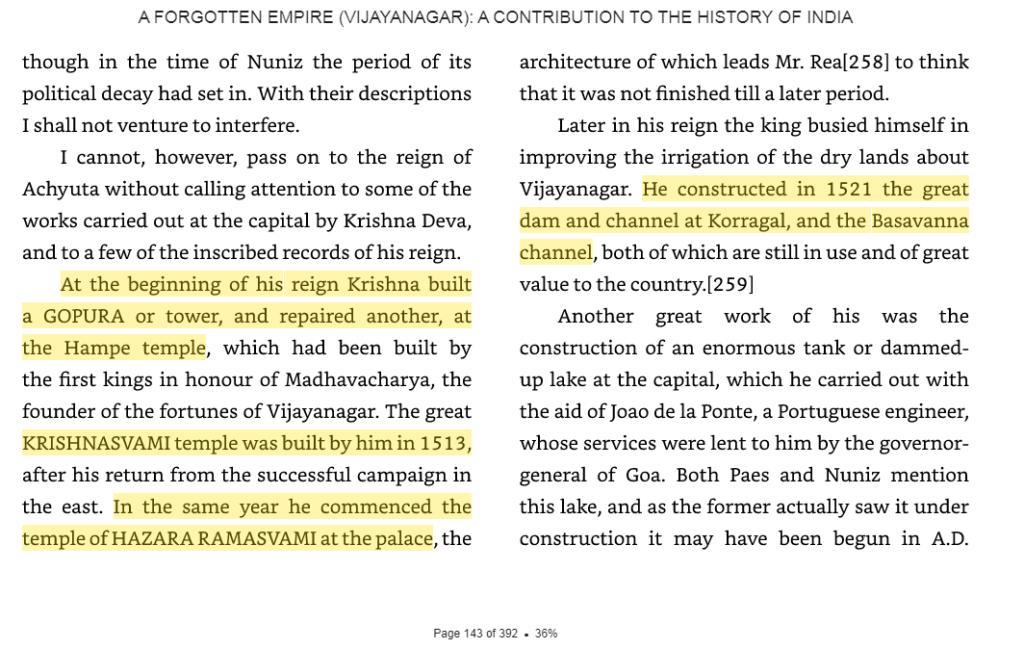
Krishnaraaya’s own direct impact beyond temple patronage,and is seen in his construction of the suburb of Nagalapuram. Named after his dear mother, it was a city of comfort that was later demolished by invaders. It nevertheless indicates many features of its former beauty.
He is also said to have constructed plentiful public works.
Adminstrative Legacy
It is perhaps in administration that Krishna Deva Raya’s mark is most clearly made. The rise of the Telugu Nayaks in Tamil Nadu is directly traced to this period, notably in Tanjore and Madurai.
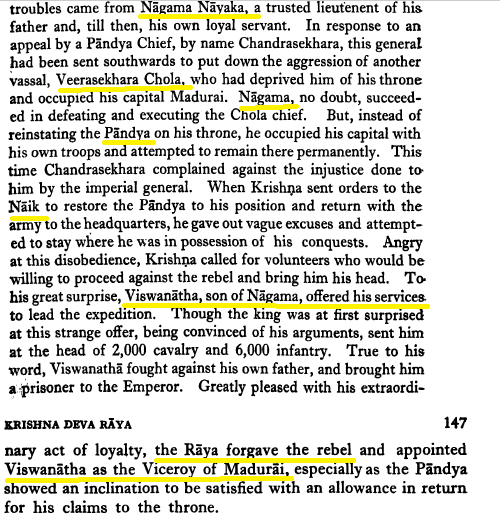
This was a product of the triple-nayankaara system. The Aandhra Martial class of Telugu Naayakas was one of 2 great engines powering the Military Machine of Vijayanagara: the other was the Kannada/Tulu Bunt caste, from which he drew many valorous warriors. Inspired by Kakatiya Pratapudra‘s system, Tuluva Krishnadevaraaya would use it to great effect against Gajapathi Prataparudra.
However, he made his own modifications: He assigned regions to the Amaranaayaka governors, forts to the Dhandanayaka generals, and taxation to the Karanayakas. His own additional innovation was the Palegadu system, which would feature famously in the Polygar Wars with the East India Company.
The Madurai, Thanjavur, and Jinji Nayaks all trace their power to bestowal of the munificent Krishnaraaya.
“There are asmany as eight hundred inscriptions in his name (approximately, 350 in Karnataka, 150 in Andhra and 300 in Tamil Nadu).” [8, 259]
“Krishnadevaraya’s vast empire was deivided in several provinces, which in turn, contained smaller units of adminsitration. The general terms used for these divisions and units were Rajya, Nadu/Sime, Sthala, and Grama.” [8, 259]
Though he was styled Mooru-Raayara-Ganda (King of 3 Kings), he in fact ruled many more vassal kingdoms:
Bhatkala Rajya, Goveya Rajya, Jagatapti Gutti Rajya, Haive Rajya, Konkana Rajya, Kundarpe Rajya, Kalasada Rajya, Mangaluru Rajya, Mulavayi, Rajya, Ghanagiri Rajya (Penugonde Rajya), Nagmangala Rajya, Nallur Rajya, Nidugal Rajya, Tiruvadi Rajya, Udayagiri Rajya, Ummatur Rajyua, Kondaveedu Rajya, and Chandragiri Rajya. There is some question about whether these were provinces or principalities; however, the Ummattur Raaja and his utter uprooting indicate these were in fact vassal or feudatory kingdoms. Provinces, after all, are adminstered by central governors.
The commercial splendour of the Maharaaya knew no bounds. He is said to have controlled 300 ports, brimming with ships carrying merchandise flooding from round the world. Horses were placed at a premium. There were countless local markets (shandis) and trade associations (nanadeshis). [8, 268]
Portuguese Diplomacy
“The Portuguese occupied Goa by defeating the Sultan of Bijapur in A.D. 1510” [8, 115]
The piratical Portuguese made their first depradations in the Peninsula during the time of the Tuluva Rayas. Vira Narasimha, KDR’s predecessors, is said to have waited and watched. The Portuguese had made their appearance first at Cochin in 1501. Due to their drunken misbehaviour, the had many soldiers slain and a ship destroyed. They sought audience with the Maharaya of Vijayanagara, who politely played the waiting game. Kerala had been been conquered by the Rayas, with its rulers serving as autonomous feudatories. There was one exception: The Zamorin of Calicut, who was able to slide by on tributary status. He nevertheless remained obedient to Vijayanagara’s commands. The Portuguese was eager to destroy the Zamorin.
It was only when Yusuf Adil Shah began entering into friendship with them, that Vijayanagara accept the Portuguese offer for alliance. One of their rebellious lieutenants (Thimmaji) assisted firangis in capturing Goa from Bijapur. This was facilitated by the Rayas, in return for trade in horses and artillery. Though gunpowder was known in India, its use was popularised by the seaborne trade of bahmanis, who effectively deployed cavalry and later artillery due to their monopoly on central asian bloodstock and turkic gunners via the Arab trade.
This strategic advantage was rebalanced by the Rayas of Vijayanagara, who only allied with the Portuguese when faced with no choice. Despite Feristha style exaggerations on peace conditions, it was clear that Vijayanagara was the senior-partner. It prudently ignored portuguese transgressions via aggressions versus Vijayanagaran subordinates. It was only when this piracy was turned on the Temples of the South, that a fierce and punitive response put the portuguese parvenus in their place. Periodic chastisements ensured this early European expansion was kept in minimalist limits—to be altogether expunged at earliest convenience. The empire’s Nayaka subordinates in Dravida desa and Sri Lanka certainly attest to as much.
Beyond equine bloodstock, Portuguese would prove pivotal at Raichur with their Arquebusiers, which picked off defenders of the fort. They would forced to retreat to the inner wall, making possible Vijayanagaran mining and storming. The fort soon fell, but the inhabitants were given honourable terms—true to the highest Hindu traditions. Only the most dangerous and worst criminals were punished, the rest were pardoned and permitted to evacuate.
“Raya had already granted permission to the Portuguese to build their own ‘factories’ at various port cities on the west coast. Somehwere between 1510 & 1522 he seems to have realised that friendship with the Portuguese was far more rewarding than friendship with the muslim Sultans. Besides, he had almost decimated muslim opposition by 1513 and had no use for their friendship.” [7, 33]
Conclusion

Sri Krishna Deva Raya is a man who should need no introduction. Whether he is called Andhra Bhoja or Kannada Raja Ramana, this Titan of Telugus and Kannadigas alike is claimed by many regions and many castes for many obvious reasons. Hailing from the Tuluva dynasty, it is only natural that the warlike Tulus make a claim to his mythos as well.
Unfortunately, there have been many other controversies as well.
“What ever be the wrangle that has surmounted the minds of the scholars our records along the coast are unambiguous and speak in unequivocal terms about the rule of these two ruler sside by side almost from the beginning of A.D.1509 to A.D.1510 April 9. Since all these epigraphs have registered munificent grants to temples and temple institutions, which are acts of peace time, we are compelled to beleive that tehre was a joint rule of Vira-Narasimha and his stepbrother Krishnaraya with mutual affection and love. It is said that Krishnaraya had started helping his step Elder brother as Yuvaraja, almost from A.D. 1507. Whatever it be the Horanadu inscription dated A.D. 1509.” [8, 108]
Thimmarasu, Apparasu, Kondamarusu, and all that…
There is yet another controversy beyond the origin of Sangama-Tuluva that has plagued Vijayanagara. This is the question of Thimmarasu. There is no question that the collusion of british dubashis with their firangi overlords produced a false history condemned by true braahamanas like Kota Venkatachalam. This is seen with a stable and consistent historical chronicle like Rajatarangini. One can only imagine what havoc videsis, with the narcissistically casteist desi slaves would have wreaked on the historical record of the Dakshinapatha. Alas, Pandit Chelam has been mostly silent here, and thus it is to us (and to posterity) that we must look to, in order to set the historical record right.
First and foremost, there were multiple Thimmas that dotted the Vijayanagara empire. Seemingly the equivalent of “John Smith” today, one can find contemporaneous with KDR, no less than 4 prominents: Thimma Naayaka, Thimma Bhoopala, Thimma Nandi, and Thimmarasu. Here is one historian on some of these Thimmas:
“Narasa Nayaka placed Timmabhupala on the throne but as he happened to be minor, the real authority was exercised by him. Timmabhupala was not destined to rule for long. He was murdered by Timmarasu, a rival of Narasa Nayaka. Timmarasu spread the rumour that Narasa Nayaka was responsible for the murder as he wanted to enthrone himself.” [3, 111]
Now Narasa Nayaka was true to his promise to Saluva Narasimha. He would go on to place all 3 of the ill-fated sons of Saluva Narasimha on the throne. He himself barely escaped Adil Shah’s treacherous attack after inviting him for a Peace Conference. So what was the fate of this Thimmarasu?
“Due to machinations of court politics Immadi Narasimha turned against his benefactor Narasa Nayaka and bestowed many favours on Timmarasu, the murdered of Timmabhupala. DIsgusted witht eh behaviour of the king Narasa Nayaka withdrew to Penukonda where he gathered forces and marched to the capital. Immadi Narasimha was forced to punish Timmarasu with death penalty.” [3, 111-112]
This is made all the more difficult when one of these was fully named Saluva Thimma. Given that the preceding dynasty itself was Saluva Narasimha’s Haihaya Kshathriya lineage—the assertion that Saluva Thimma must be one and the same as Thimmarasu (allegedly Aruvela Niyogi Brahmin) must be carefully re-examined. Kolanu is a common Aandhra Kshathriya Raaju surname as well, and yet Kolanu Rudradeva has been erroneously claimed as a Niyogi. Yet another is Baddena Bhadra Bhupala (author of Sumati Satakam), but we have incontrovertibly proven him to not be Niyogi, but in fact, to actually be a literateur Telugu Chola prince (there was another such as further evidence, Nannechoda).
In contrast, Thimanna Kavi is rightly claimed as braahmana, and his place as court poet/scholar of Kannada, all the more sensical and dharmically inclined.
Mahamanthri Timmarasu = Composite creation of Saluva Timma mantri, Rayasam Apparasu & Kavi Nandi Timma
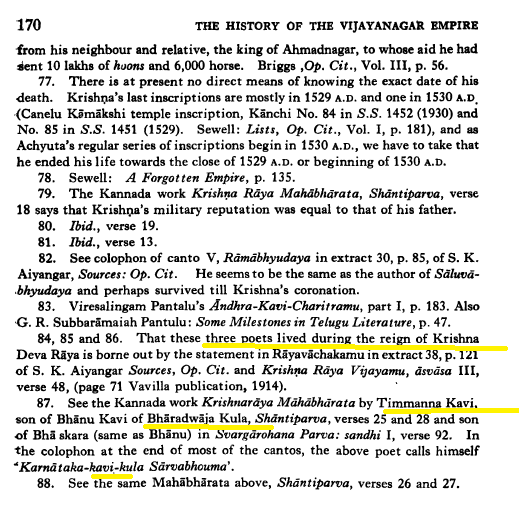
As such, there is no doubt that the hagiography of Thimmarasu is a similar creation to the now popped hagiography of Chaanakya. Kautilya’s achievements have falsely been conflated with that of the preceding Nanda minister, Sakatala. Undoubtledly both these figures existed, as Amaathyas. However, their achievements have been inflated to further inflate the egos of kapalika Brahmins.
Today, the Brahmin-bashing has gotten out of hand, with all sides losing their sense and decency. It is imperative to separate venerable Veda Braahmanas from the disgustingly despicable kaapaalika brahmin-bandhus (the latter are utterly unworthy of association with Vipras, and should be bahishkar’d at earliest convenience). No less than Adi Sankaracharya, that great Mahanubhava, struggled with and defeated these filthy brahma-rakshasas. Those who question the existence of brahma-rakshasas, claiming anyone of Brahman lineage must be “auto-sattvic”, see this selection from the Amuktamalyada itself:
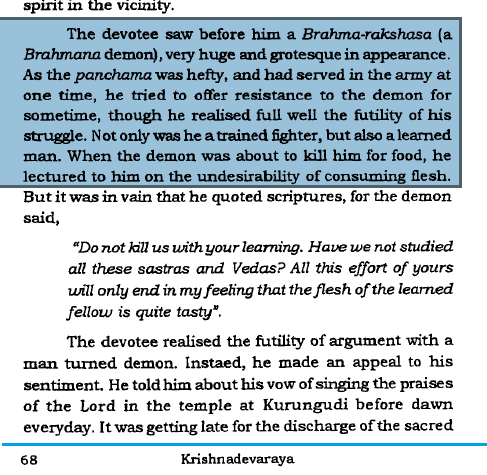
Vindicating our position on Vaidikas of today, the brahma-rakshasa confessed to ‘pride of learning’ causing his downfall, despite being born as the brahmin Soma Sarma.
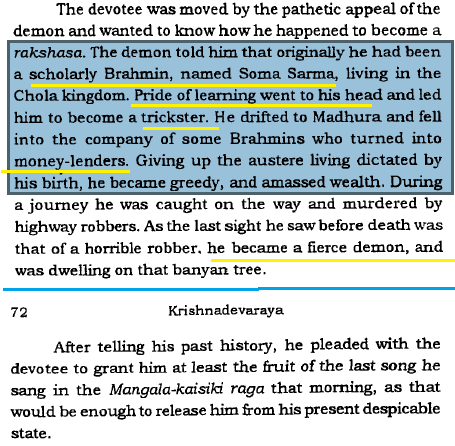
Thimmarasu does not appear to have been a kaapalika/kaalamukha, though rumours swirl as to whether child-prince Tuluva Thirumalaraaya was himself poisoned or…subjected to abhichara, like so many kings before (see the Tuluva predecessors as well as Chandrapida of Kashmir, Shivaji Bhonsle, Rajaram Bhonsle, & many Shrivardhan Bhatts). This is also not to take away from the Niyogi community, which produced many luminaries including P.V. Narasimha Rao himself. It is however meant to separate truth from untruth and wheat from chaff.
This is also relevant because the crimes of kapalikas (and their useful idiot non-brahmin student Kalamukhas) did not leave even our great Vaidika Hindu monarchs untouched. It is well known that Rajputs like Kumbhakarna Singh Sisodia (Rana Kumbha) followed the questionable advice of such kapalika brahmanas, whenever they faced an engineering problem. In order to conclude the magnificent fortress of Kumbhalgarh, Rana Kumbha was advised to do narabali, when a particular gate kept collapsing. He asked for volunteers and supported that family’s financial future—but adharma is adharma, even if compensated.
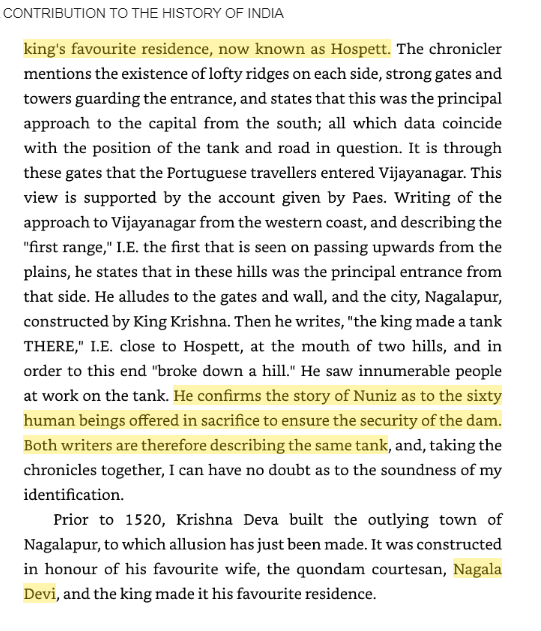
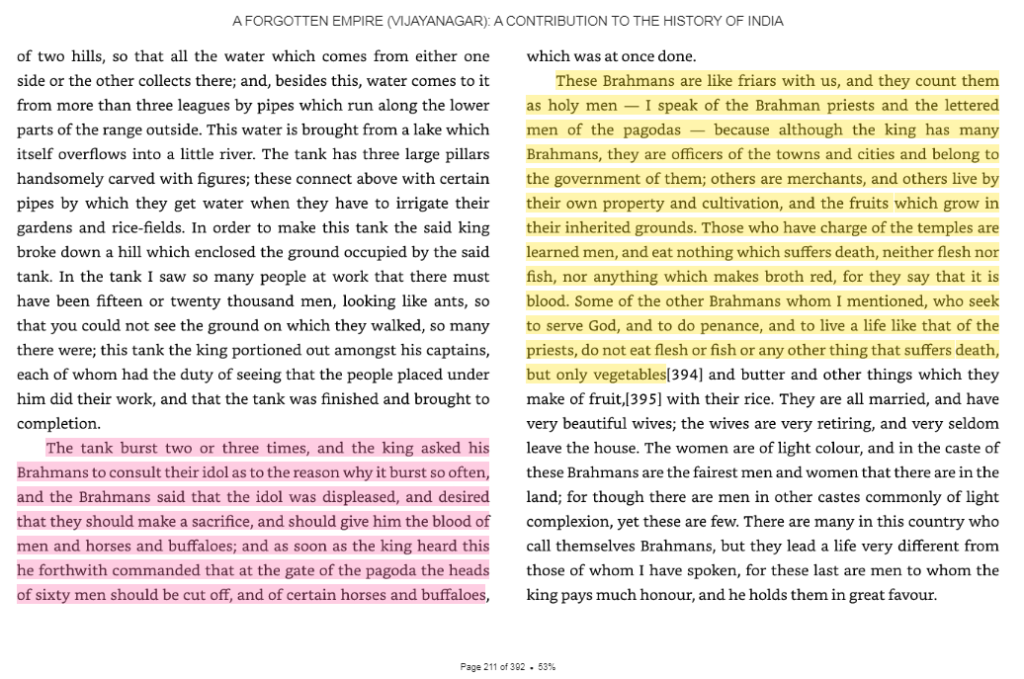
Krishna Deva Raya also similarly stands accused of narabali, this time to complete a collapsing dam. Naysayers may argue that both merely did so to fix engineering problems, and their reigns did not suffer—when in fact, they both suffered through their sons. Krishna Deva Raya lost this infant son Thirumala, and Rana Kumbha lost his life to his traitor son Udai I (black sheep of Sisodias). The injury to both polities resulted in their later defeat to the Turkic invaders at critical junctures, despite both decisively defeating and dominating the sultanates of their vicinity.
It is this self-same conflict between vaidikas and kapalikas that continues today among Bharathajas. Dhaarmikas can no longer play innocent, questioning why the Thrimurthi have punished Bhaarathavarsha so harshly in this millennium of the Kali Yuga, but the proof of the pudding is in the eating. All the Krishna Deva Rayas, Rana Prataps, and Shivaji Bhonsles in the world cannot make up for a fallen and corrupted people, and worse, a criminal clergy.
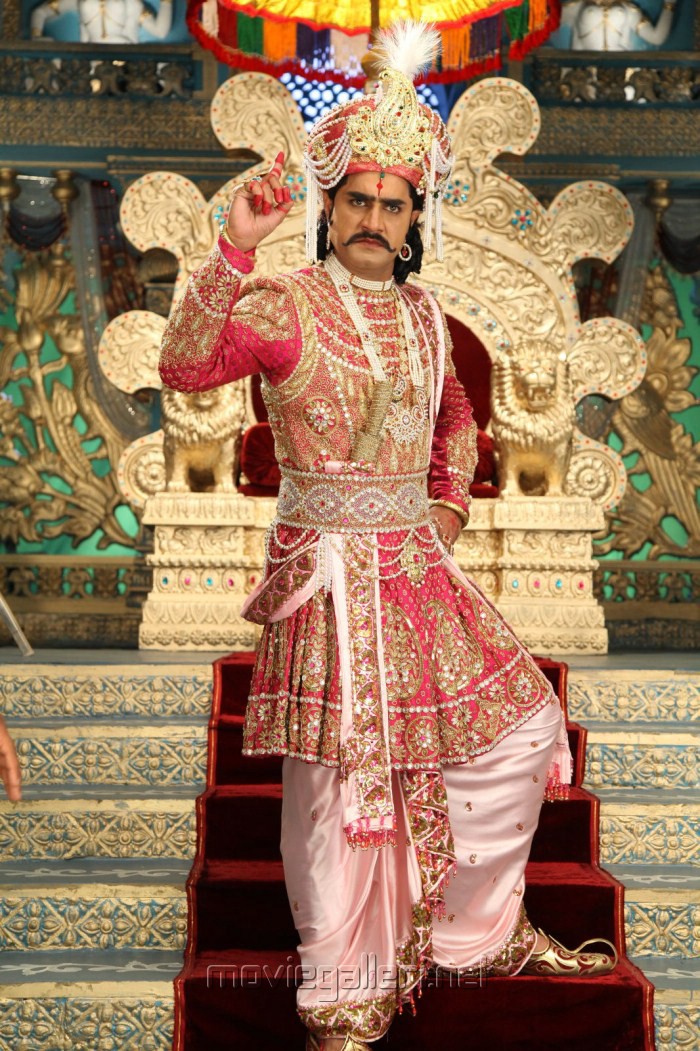
Despite his flaws, which are like the pock-marks to his otherwise fair face, let us celebrate the magnificent Maharaaya named Tuluva Krishnadeva, for his conquest, contribution, and protection of his people…and learn from his life at the same time. Let us remember him by his title.
“Sri-manmaha’raajaadhi-raja, Raaja-parameshvara, Sri-Veera-prathaapa” “Mooru Raayara Ganda”, Maharaaya. [8, 110]
References:
- Rao, Venkata Gutty (Prof.). “Vijayanagara Empire”. CH.16 of Vol. 5 of ‘ A Comprehensive History of India’. New Delhi: People’s Publ. House. 1970
- Sastri, K.A.Nilakantha. A History of South India. New Delhi: Oxford. 2015
- Rao, P. Ragunadha. History and Culture of Andhra Pradesh: From the Earliest Times to 1991. New Delhi: Sterling Publishers, 2012. 1-23
- Krishnamachariar, M. History of Classical Sanskrit Literature. Delhi: MLBD. 2016
- Mittal, J.P. History of Ancient India. Vol I. New Delhi: Atlantic. 2006
- Kusuma Bai, K. Dr. Music-Dance and Musical Instruments During the Period of the Nayakas (1673-1732).
- Rao,Adapa Ramakrishna.Makers of Indian Literature—Krishnadevaraya. New Delhi: Sahitya Akademi. 1995
- Gopal, Dr. R. (Ed.). Life and Achievemments of Sri Krishnadevaraya. Mysore: Directorate of Archaeology. 2010
- Sharma, M.H. Rama. History of Vijayanagara—Beginning & Expansion. Bombay: Popular Prakashan.1956
- Sewell, Robert. A Forgotten Empire (Vijayanagar): Contribution to the History of India.
Thank you for this very nice article, been waiting for the one on KDR.
Thank you for also showing how we can and must respect and protect good brahmins (like Tulsidas Ji and Samarth Ramdas ji), but at the same time relentlessly oppose bad ones. As past 1192, as discussed, Bharat has only had 4 (more or less) real Kshatriyas (in terms of strategic thinking along with valour), Rana Kumbha, Rana Pratap, Ch. Shivaji Maharaj and Rajah Krishna Deva Raya. And to see 2 of the 4, despite their love of their people, get manipulated by Ravans masquerading as (Rishi) Vasishtha’s is not only horrifying, but also heartbreaking.
And even Ch. Shivaji family empire building and dharmarakshak efforts got knocked down by Peshwas.
Lastly, as a Rajput, thank you for talking about appropriation of Kshatriya History. I will follow in same spirit and say and denounce the Duryodhana’s born in my community (but without the real spirit of my community-which matters infinite times more) who claim there are no Kshatriyas in the South (when examples like Rajah Pravir Chandra Bhanj ji show that Rajputs and Rajus viewed themselves as one Bharatheeya) family.
I will also denounce these Duryodhana’s who insult the Bhonsles, when Ch. Shivaji Maharaj was the best Kshatriya (100% by Karm, regardless of Varna) Bharat has recently given birth to. All these Duryodhana’s are doing are being useful puppets (again) to Ravan Bhakts who prevented alliance in history between Sambhaji Maharaj and Rajputs.
And the sad part and irony of it all, is that Ch. Shivaji himself not only took inspiration from Vijayanagar, but looked to continue the legacy of the Guhilot-Sisodias. Whether he was born into Sisodia lineage is trivial, whats important is as a fellow Arya Bharatheeya Dharmik, he looked up to the Sisodias, (and the Sisodias of Mewar always viewed Bhonsles as brothers), and yet the foolish infighting.
Articles like this and others that have been written either here, or on Andhra and Tamil portal, will help to continue to reignite the collective spirit that still overwhelmingly exists among Rajputs, Rajus, Marathas, and all other countless Bharatheeya Samudays who shed blood for our country. So thank you once again. Vande Mataram.
Great article! Thank You! Largest Dharmik empire Bharat had post 1192! Krishna Deva Raya ji- a true gem!