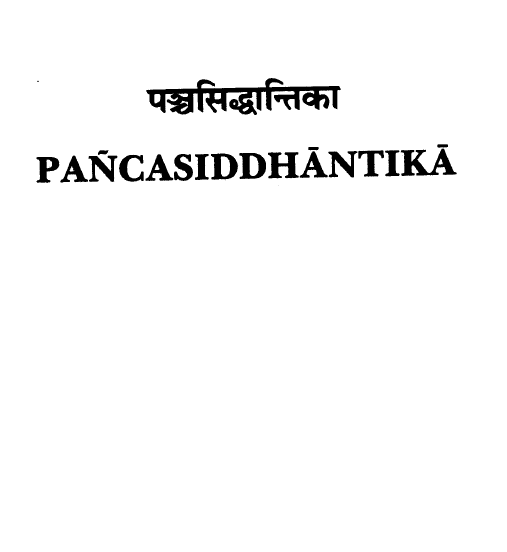
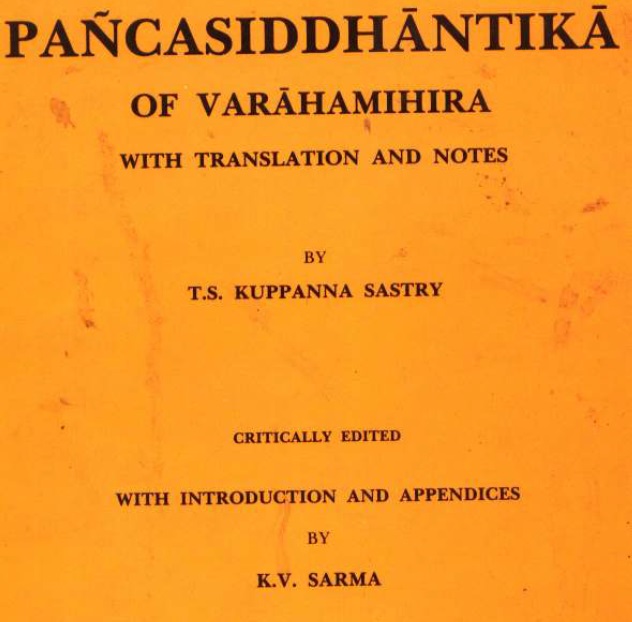
Continuing our theme of Varahamihira‘s work is one of his lesser known tomes, known as Pancasiddhantika.
As the name indicates, it refers to 5 doctrines or texts on which the famed jyotihsaasthri produced a commentary.
This work is important because many authorities actually believed it to be lost , and second because it contains excerpts of many actual lost works. But as always, it is best to learn by doing or in this case, to learn by reading.
Author
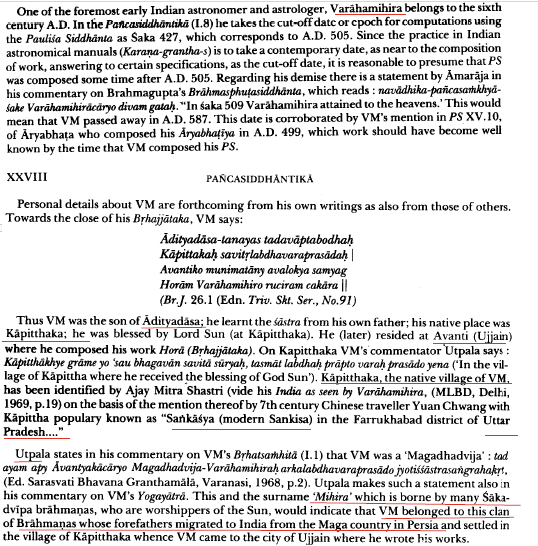
As mentioned in our previous installment, Varahamihira (Varaahamihira) was the son of Adityadasa. The latter was a native of Avanthi (Malwa, M.P.), of the village Kaapitthaka. Despite referring to himself as “of Ujjain”, Varahamihira was traced by Pandith Chelam to Kashmir. A number of scholars have echoed this, but have qualified it noting that he was specifically of the community of Saka-dhveepi or Maga brahmins. The very notion of this is questionable to orthodox Veda Braahmanas. After all, how can a mleccha Paarasaaka (Persian) become considered an Aarya, leave aside a Veda Braahmana? This becomes even more difficult to digest when one considers the implications of the Magi and their impact not only in Persia but ancient Babylonia.
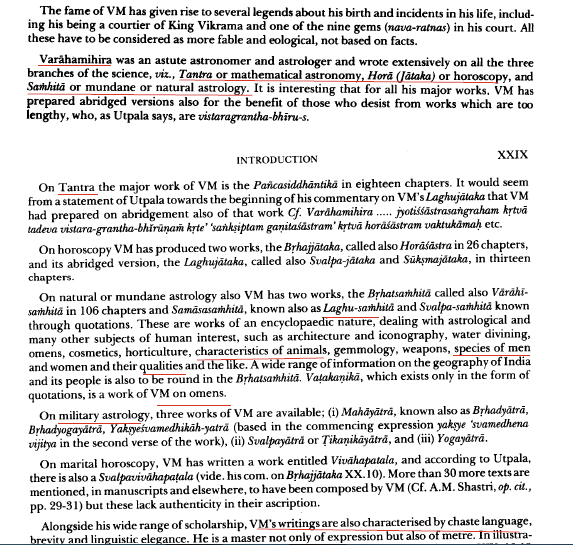
The records that have come down to us indicate that Varahamihira certainly considered himself a proper Indian. But the question of provenance is one that becomes more precarious when one considers the indological implications. This is further compounded by the alleged foreign origins of 2 of the 5 texts in the Panchasiddhaanthika (Pancasiddhantika).
Composition
[1, p.V]
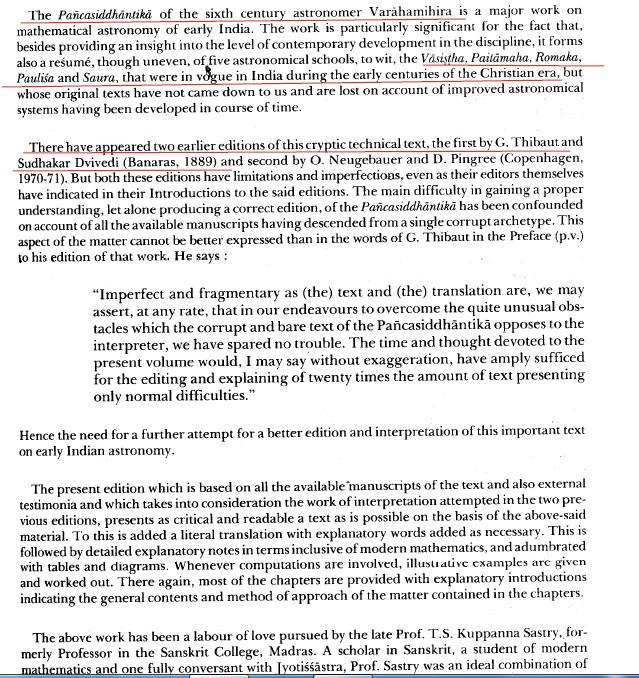
True to the lazy indological trope of relying on easy etymology to explain ultimate origin, the various texts of the Panchasiddhaanthika have come under the scanner. The Vasishta, Paitaamaha, and Saura Siddhaanthas clearly radiate orthodox Indic backgrounds. Paitamaha is thought to refer to the great Brahma himself, with Vasishta obviously being credited to the Brahmarshi. The usage of the Aarya metre in his exegesis further underscores the traditional background of the content. [1]
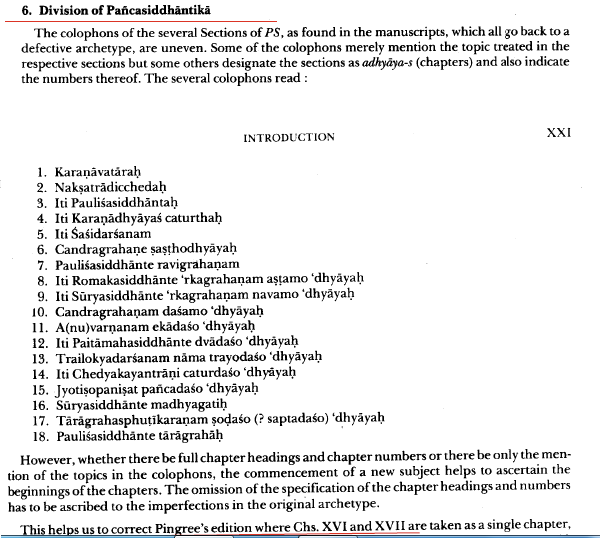 The divisions are particularly conspicuous yet logical in layout. The existence of a Pingree edition lends more curiosity and wonder at what the original manuscripts might have looked like.
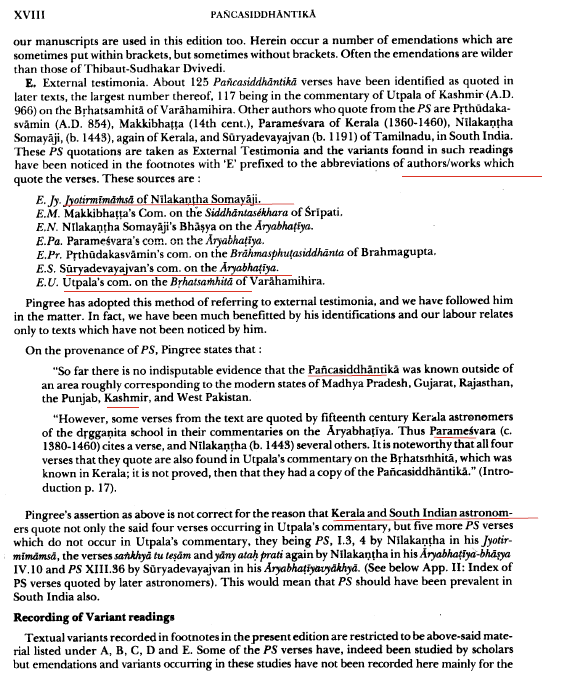
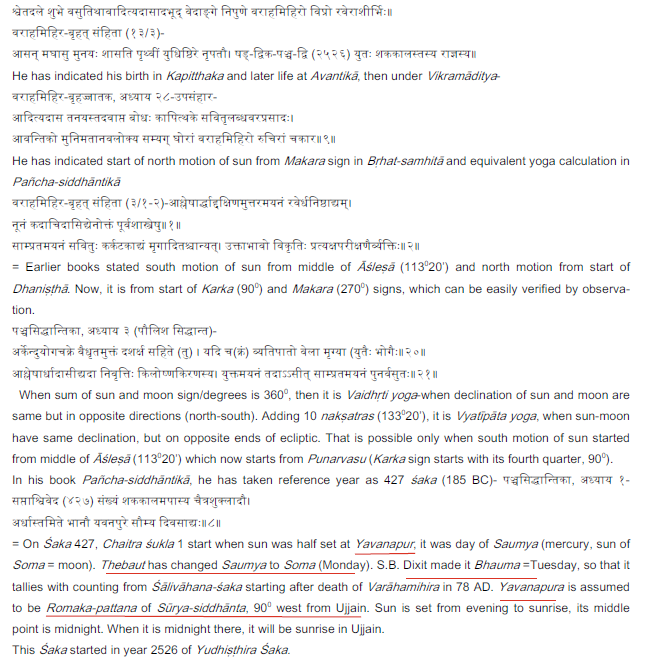
However, 2 texts, the Paulisa and Romaka Siddhaanthas have, as one might surmise, been attributed to foreign origins. Beyond etymology, there is the question of the coordinates of Yavanapura, induced to be Alexandria (again on the fallacy that “Yavana” means Greek). In actuality, whatever the provenance of Paulisa, the Romaka Siddhaantha can be plainly attributed to the Romakas of Yavanasthaana (in modern Afghanistan). This was underscored by Pandith Chelam in his “The Age of Buddha, Milinda, and Amtikiyoka” work. This once again emphasises the reality that Yavana referred to Bhaaratheeya Yavanas (ex-Vedic Indians, now Frontier “Indians”). They branched off as a separate nation from the original Aaryas (Vaidhikaaryas) of the Sindhu-Sarasvathi. It should be separately be noted that there was a literal Saptharshi named Roma-harsa, so such a prefix is not unknown among our people.
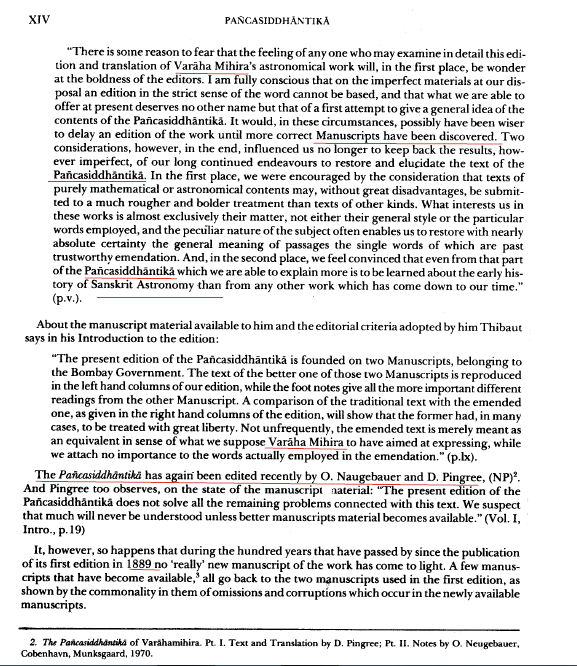
Indeed, study of the recensions makes the theorising and “speculative reconstruction” all the more suspicious. Shivoham’s favourite bugbear, Dr. Pingree, makes several (dubious) appearances as well. One wonders exactly how it came to be determined that the Panchasiddhaanthika was determined to be lost, when it might have simply been…disappeared.
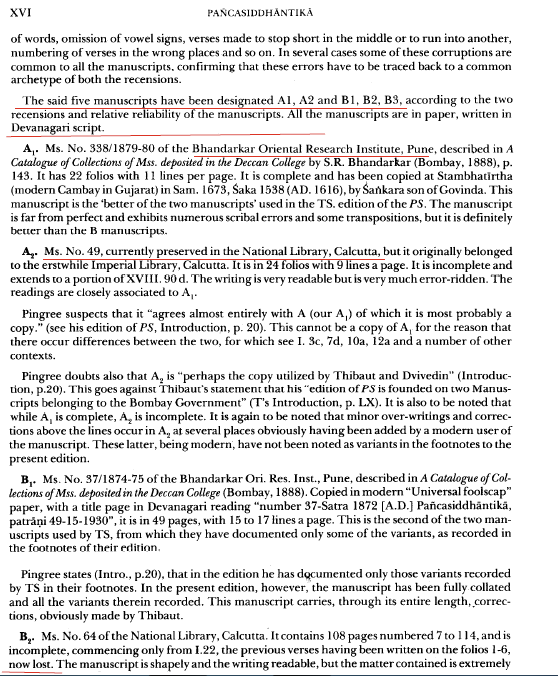
With original manuscript material being notably “edited” by Neuberger & Pingree, one can’t help but recall Pandith Chelam’s bold accusations against a one Aurel Stein and his “edited” versions of the Rajatarangini. After all, what better way to reify the hypothesis of foreign origin than tampering not with the translation, but with the original manuscripts as well.
The recent fire that engulfed the Nepal Govt. Library echoes a similar incident during the british empire’s zenith, when many a firangi coloniser got his grubby hands on Nepal‘s manuscripts, followed by a timely Library fire.
 Selections
The contents of Ancient Hindu texts are often seen with a jaundiced eye. The profound is merely marked as simple, the complex as needlessly complicated. As such, here is a quick table of contents for the reader to gauge for himself or herself, about the scope of the science at hand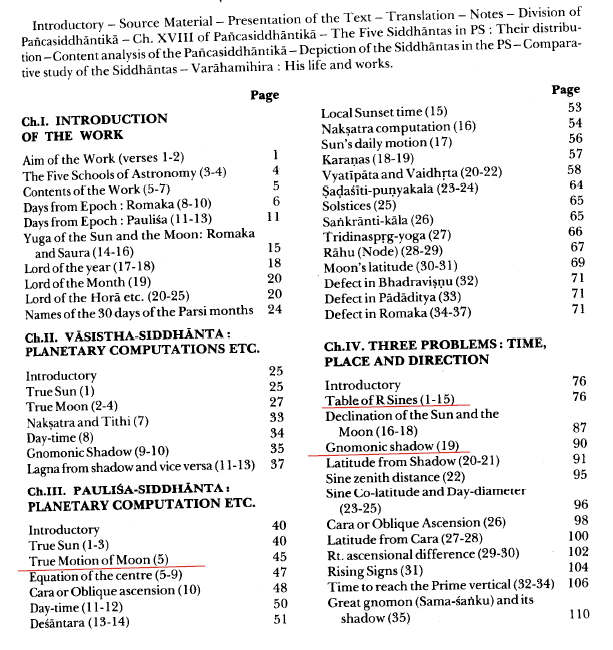
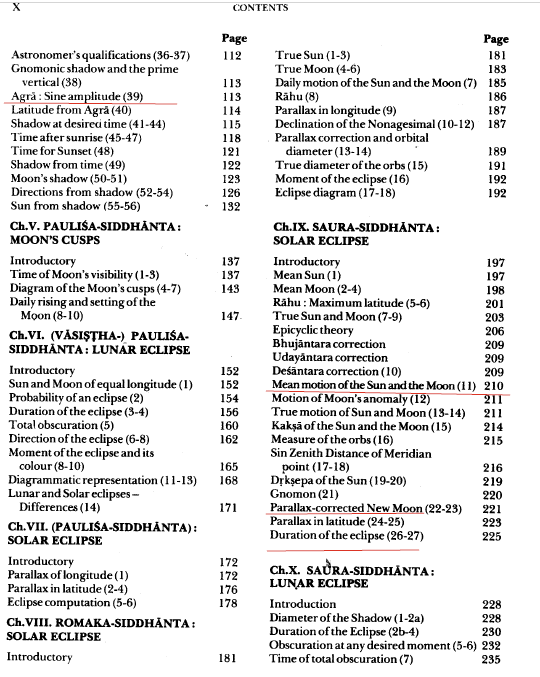
§
The Panchasiddhaanthika commences with the customary Salutation, unsurprisingly to Surya himself.
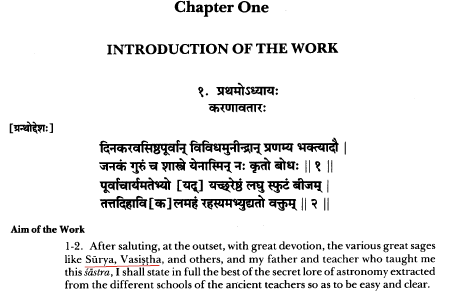
§
The 5 Schools of Astronomy are clearly laid out. Other commentators are also mentioned.
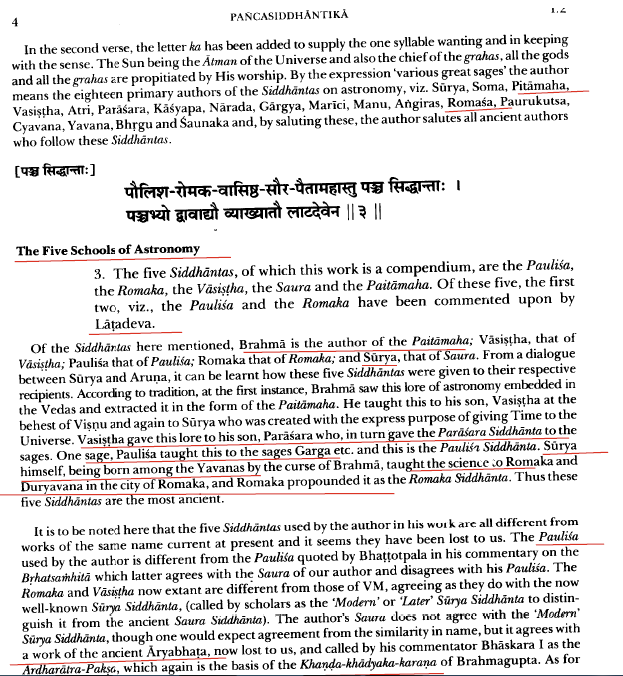
§
The Panchasiddhaanthika also features Spherical Trigonometry. This is particular interesting as there are those who speculate that rather than a planar elliptic, the planets orbit the sun in a partially conical arrangement projecting out. Tangential no doubt, but nevertheless interesting to consider. Regardless, Dhik-desa-kaala, the thriprasna, makes itself apparent yet again in kaala-vidhana vidhya.
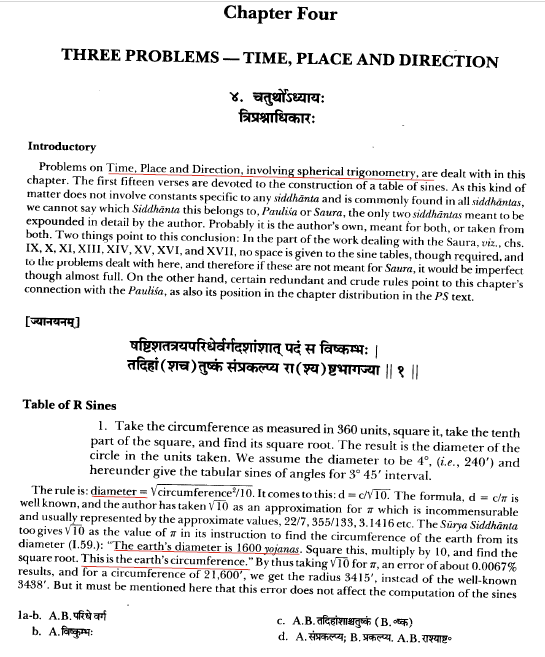
§
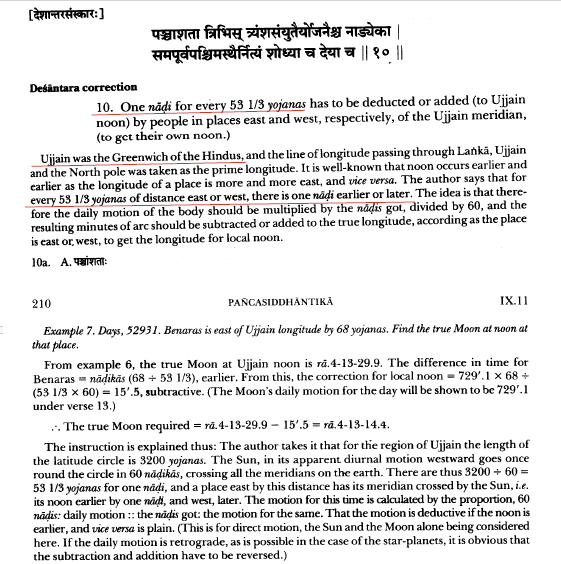
The Saura Siddhaantha provides a useful heuristic vis-a-vis Ujjain.
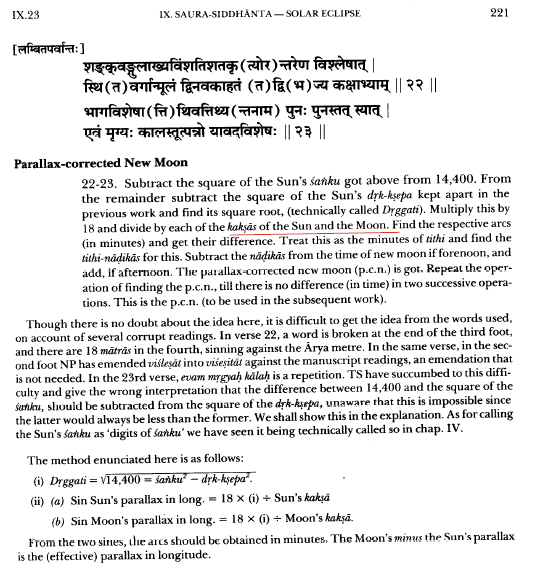
The Saura Siddhaantha further elucidates the concept of the parallax, as well as the calculation of the parallax corrected new moon.
§
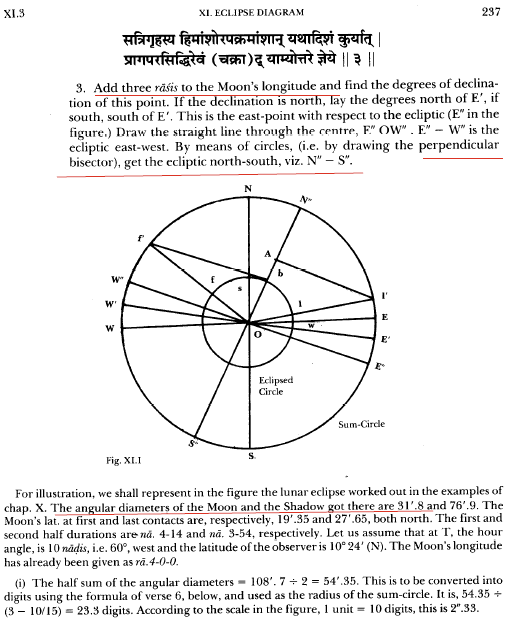
The work is not without diagram. There is an entire chapter dedicated to the topic.
§
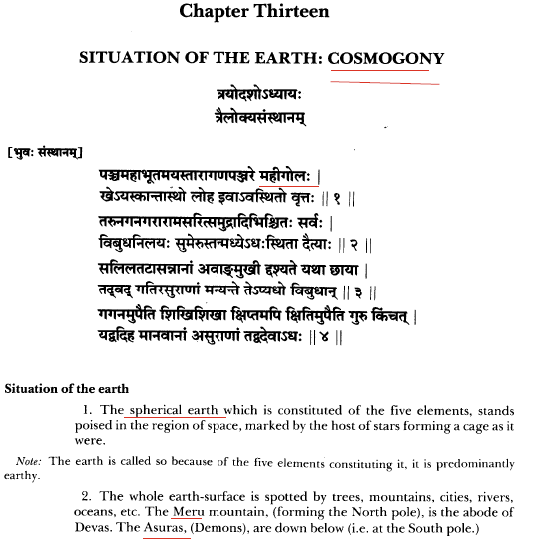
Finally, the Earth is referred to by Varahamihira as Spherical.
§
Conclusion
Many may very well argue that if Varahamihira were indeed a Saka-dhveepi/”MAGA Brahmin” (humorous phrase in today’s context), then how can the Hindus claim credit for their astronomical achievements (pun-intended)? Well, even assuming Varahamihira’s antecedents were anterior to India, then Shivoham’s outstanding point-by-point dismantling of Indology & Vedanga Jyotisha establishes precisely how and why.
Even if Varahamihira could be deemed a foreigner and the Romaka & Paulisa Siddhaantha’s foreign, then antedated Lagadha & Vedanga Jyotisha, are quintessentially Indian. There is a basic and essential Classical Indic Astronomy outside of any theorised foreign influence. The question of Varahamihira and his Saka-dhveepis, is one for another day.
Epilogue
In reconstructing native Indic Historiography, it becomes imperative to restrain oneself from bombastic and hyperbolic claims (the Hindu specialty). M.S. Paint Maps showing all of Jambudhveepa under Bharatha Dausyanthi or Paramara Vikramaditya, only render the dharmic cause more dubious to the eyes of the indoctrinated and skeptical. Indeed, who can blame them when ridiculous statements are backed by even more ridiculous maps, floated by caste-obsessed teens and twenty-somethings who need to learn something about deferring to their elders.
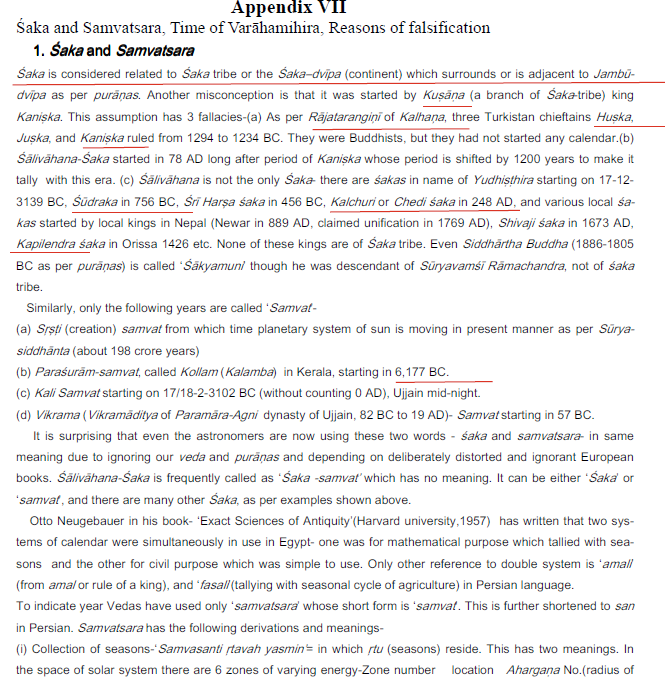
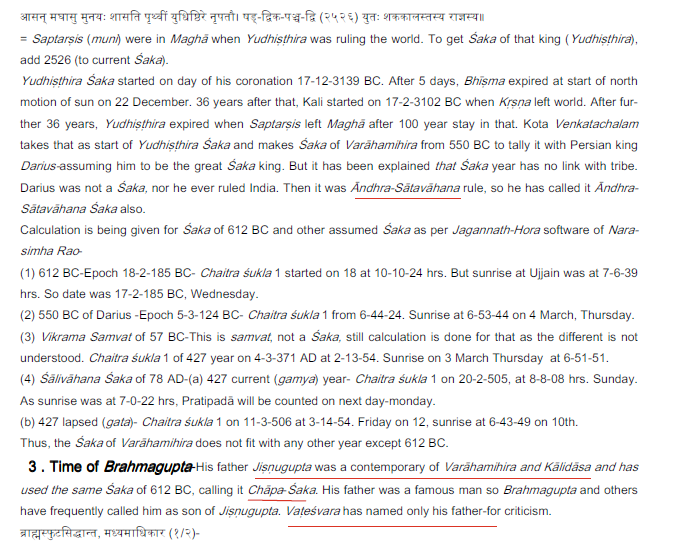
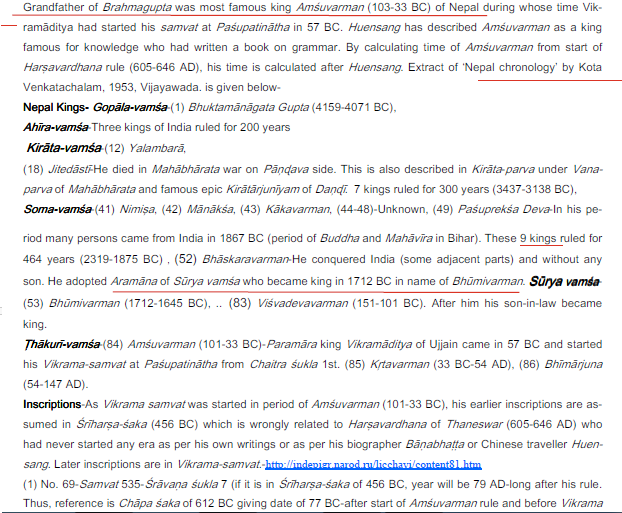
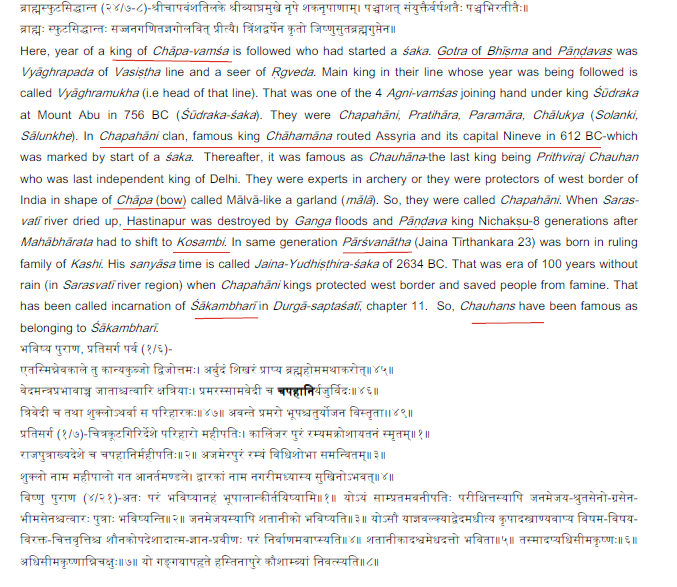
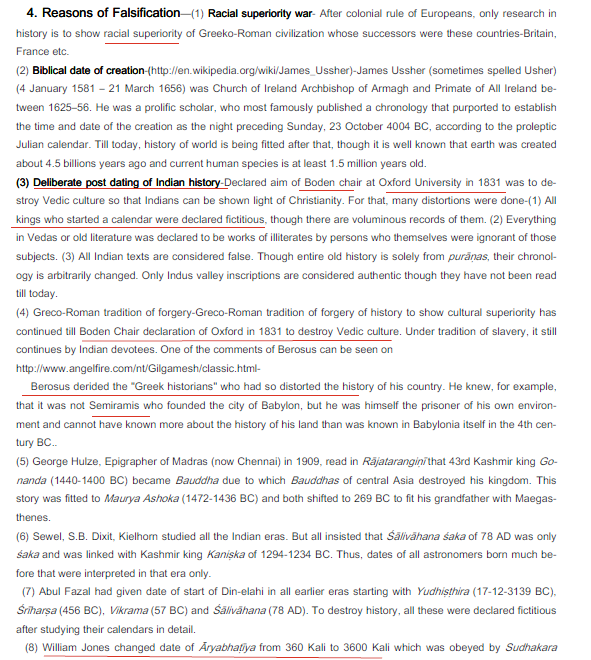
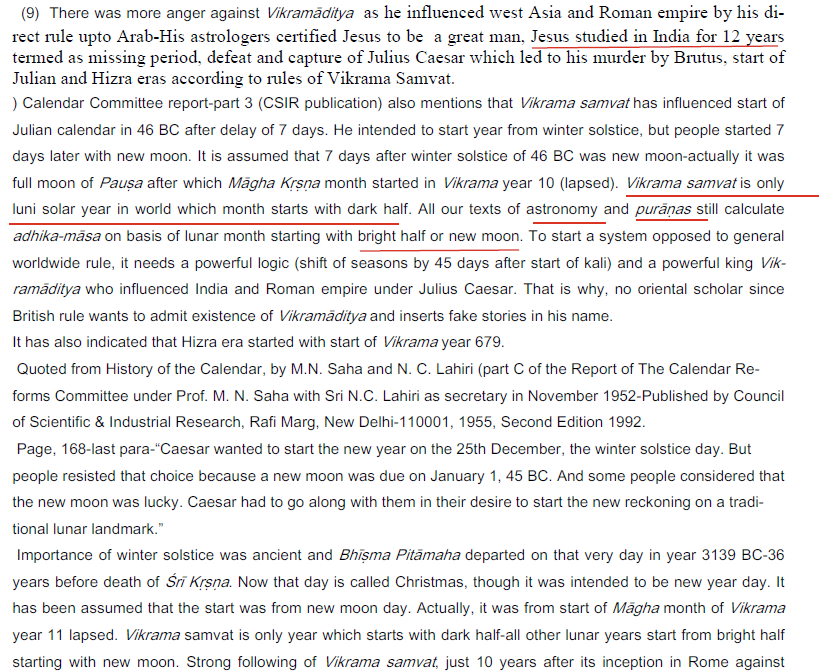
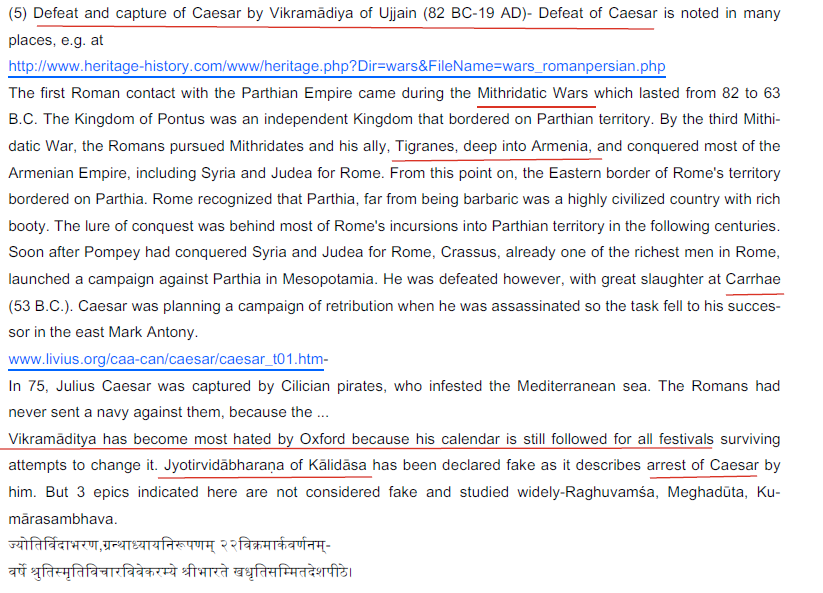
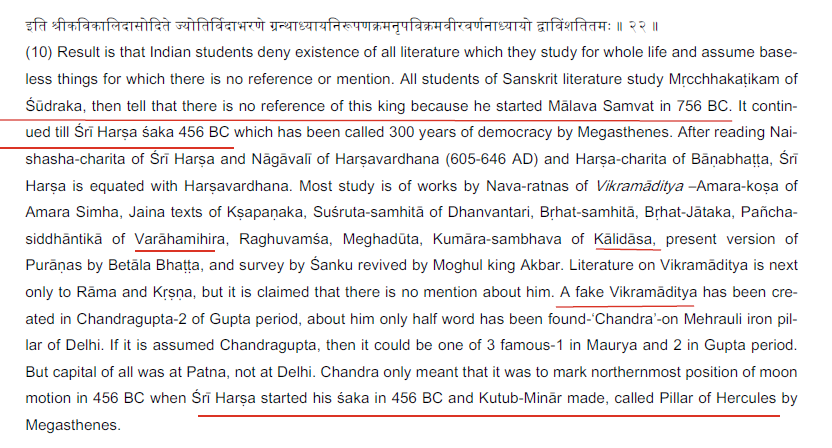
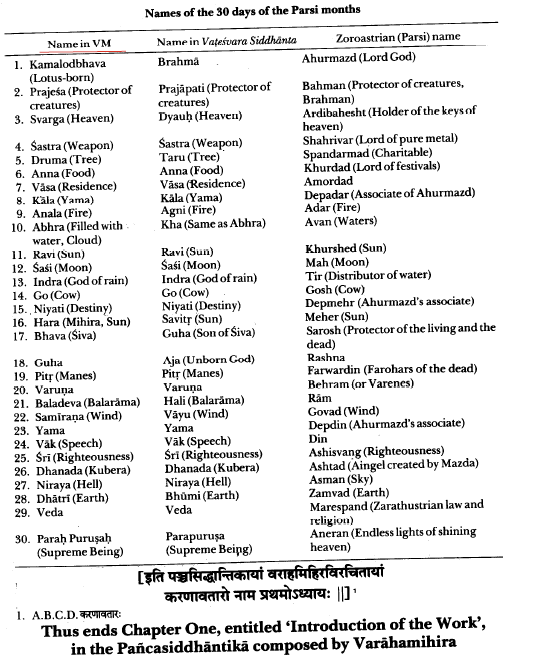
Ironically, it is not millennials, but zoomers who are echoing boomers in their pre-programmed narcissism. Legendary claims can’t be floated all at once. They must be carefully examined and discussed before they can be designated as credible. Kuppanna Swamy’s translation of Panchasiddhaanthika includes many an interesting footnote. Many of these assertions strain credulity. At the same time, they seem to align with some of the more off-beat claims of non-mainstream historians and scholars. We merely replicate them here for review.
These extracts are from Appendix 7, added by A.K.Upadyay:
Extracts (Appendix VII)
§
§
§
§
§
§
 §
§
References:
- Swamy, T.Kuppana. Pancasiddhantika of Varahamihira. Madras: P.P.S.TFoundtn. 1993