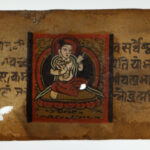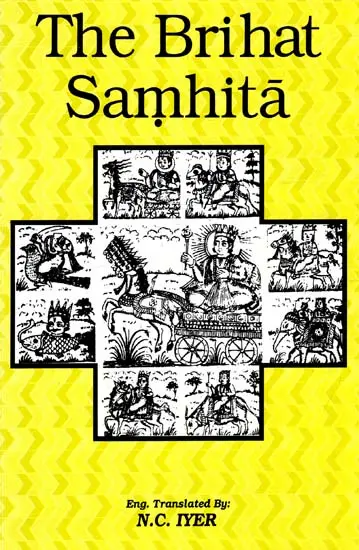
After a long time we return to the topic of literature. Almanacs and Encyclopedias were not unknown in Ancient India. One such encyclopedic work was the Brihat Samhita by Varahamihira.
Introduction
“India has long continued to be the centre of attraction not only in respect of its wealth and civilization but in that of its intellectual advancement. To it converged, as to a common focus, the eyes of foreigners from the earliest period of world’s history. It was the one fountain of knowledge from which issued streams to water distant lands of ignorance at every point of the compass, now yielding abundance of intellectual harvest. Time was when Indian wisdom shone resplendent, and, from its eminence, dazzled the eyes of distant nations—distant geographically and distant chronologically,—illumined every corner of the intellectual horizon and served as a beacon, lighting the paths of erring travelers.” [1, preface]
The Brhath Samhitha of Varahamihira (Varaahamihra) stands out as one such stream. It covered a wide variety of topics and remains famed throughout Bhaarathavarsha to this day. And yet, like its author who is not free from uncertainty, the text itself remains connected to controversy.
Colonialists have long asserted foreign influence where none was justified. Orthodoxy and Desh-bhakthi necessitated knee-jerk reactionism. And yet, it is only through a careful eye of both aasthikyam and post-modernity that one begins to understand the core of indigeneity did experience peripheral strands of the videshi (for better or for worse). After all, just as yours truly is currently writing to a bhaaratheeya audience in angla bhaasha, it is not impossible that foreign invasion in the North West resulted in (some) percolation to the South and East.
At first glance, Varahamihira does not appear to be one such product of admixture. And yet, closer study does merit the question, at what point did corruption of our Saasthras begin? After all, the phenomenon of kaapaalikas is well-attested in history as well as in scripture. Indeed, the rise of Raavan-worship today is emblematic of problems even in allegedly orthoprax communities. What can account for such stubborn stupidity even among the allegedly aasthika?
https://x.com/ANI/status/1845030627097133541
The Brhath Samhitha, as well as the life of Varahamihira, raises these questions and more.
“THE BRIHAT SAMHITA OF VAR[AHA] MIHIRA is an encyclopaedia of astrological and other subjects of human interest. Whatever subject the author takes for delineation, whether it is eclipse, planetary movements, rainfall, cloud, architecture, water-divination or some other topic he discusses the same with [thoroughness] and mastery based on the knowledge of…sastras. Wherever he differs he gives reasons for it.”—inset [1]
Author
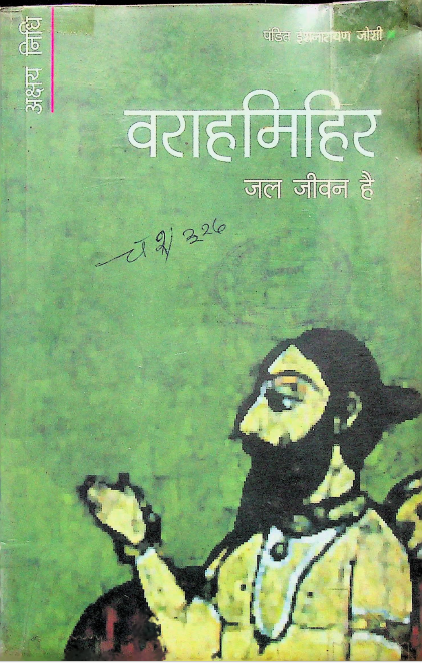
Varahamihira (Varaahamihira) is the famed jyotisha scholar from the court of the illustrious King Vikramaditya (Vikramaadhithya) of the Paramaara Dynasty. Alternately known as Vikramarka or Vikram Parmar, he was a veritable Emperor of India, with his armies marching the four corners of not only Bhaarathavarsha, but much of the continent of Jambudhveepa (Asia) itself. It is for this reason, he drew talent from the four corners. One such was Varahamihira.

1. Dhanvantari. 2. Kshapanaka 3. Amarasimha. 4. Sanku.
5. Vetalabhatta. 6. Ghatakarpara. 7. Kalidasa. 8.Varahamihira and 9. Vararuchi
Although the author asserts he was from Avanthi, Pandith Chelam adumbrated that his origins were in Kashmir.
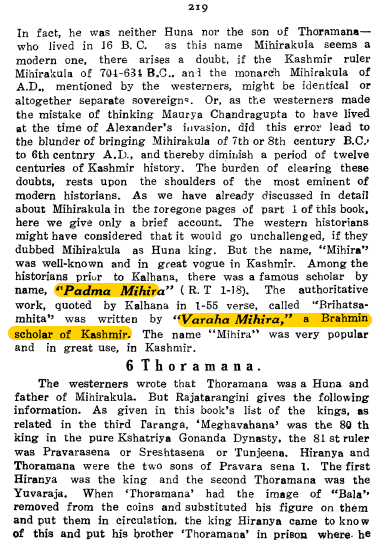 In establishing the true sheet-anchor to the Indian chronology, Pandith Chelam made close study of not only archaeological evidence, and the Rajatarangini, but the Brhath Samhita itself. He began to notice a pattern.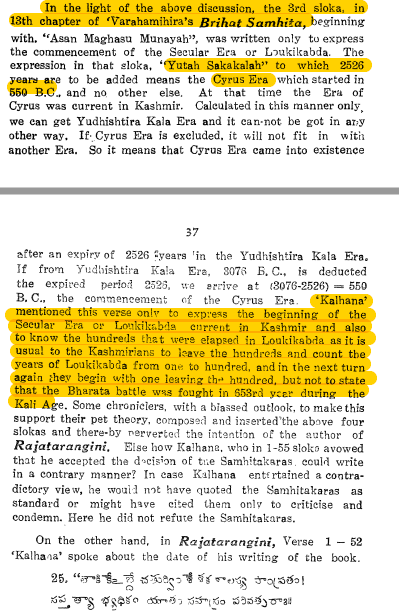
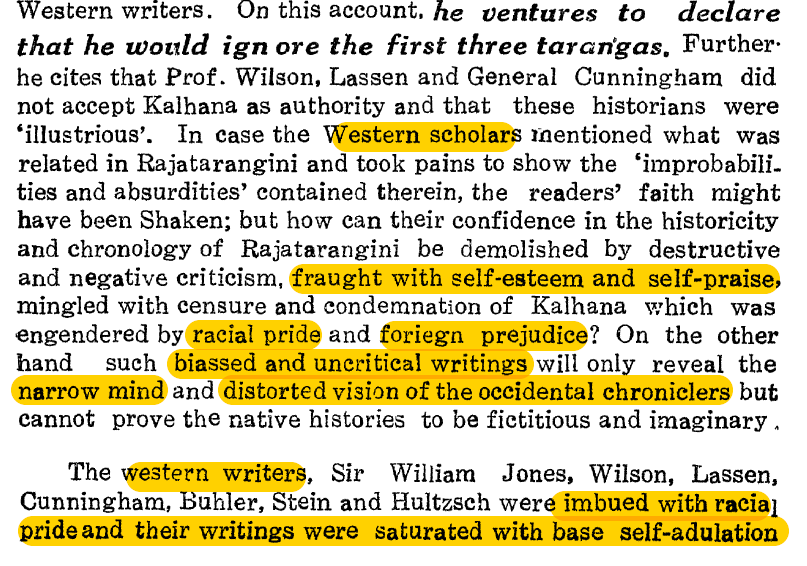 As a result, the Western contention that Yavana referred to Greeks and that Chandragupta Maurya was the contemporary of Alexander, rather than Chandra Gupta I, can be set aside. Here is the true source for the praise of Yavanas.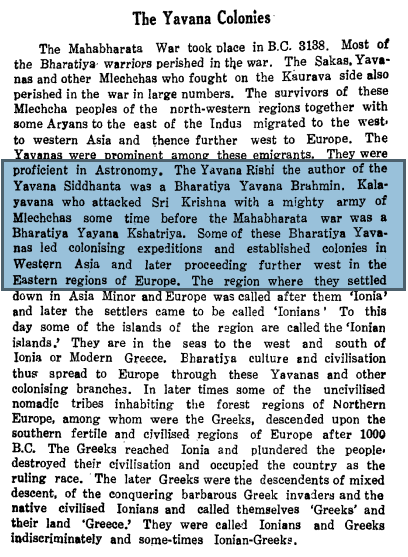
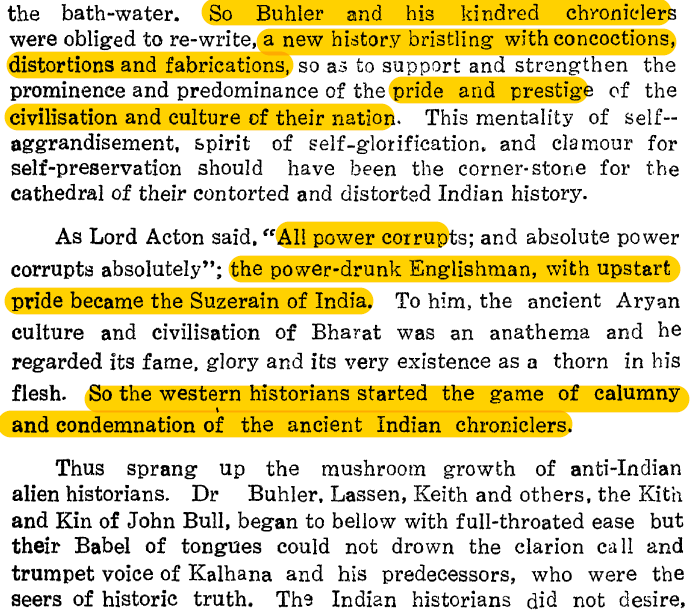
His lineage and geography have come down to us, despite occlusion. However, the british have managed to convince Indians not only that Vikramaditya was imaginary, but that Varahamihira was of a later date.
“Now A.D. 505 is considered by some to be the date of Varaha Mihira’s birth and by others to be that of his Panchasidhantika, and A.D.587 is thought to be the dat[e] of his death. It is also said that Varaha Mihira has quoted from Aryabhatta; that Aryabhatta was born in 476 A.D. .” [1, xiii]
While Western Indology asserts the above, Hindu History adduces the following:
“Varaha Mihira was a native of Avanti and the son of Adityadasa who was an astronomer and from whom he received his education as he himself tells us in his Brhat Jataka (Chappter XXVI Verse 5). The dat[e] of his birth is involved in obscurity. It is the practice of all the Hi[ndu]astronomers to give this information in their works on astronomy; but unfortunately Varaha Mihira’s work on astronomy, known as Panchasidhantika, is now lost beyond all hope of recovery. The popular notion is that he was one of the [9] gems of the Court of Vikramakra. Now Vikrama Era, as we find from the Hindu calendar, dates from 56 B.C.” [1, xiii]
Regardless of his antiquity, Varahamihira had an eye for the great. This is certainly evidenced by the titles of his numerous works. He is credited not only with the presently evaluated Brhath Samhitha, but also the Brhath Yaathra, and Brhath Jataka. Other works include the Pancha-siddhaanthika on mathematical astronomy.
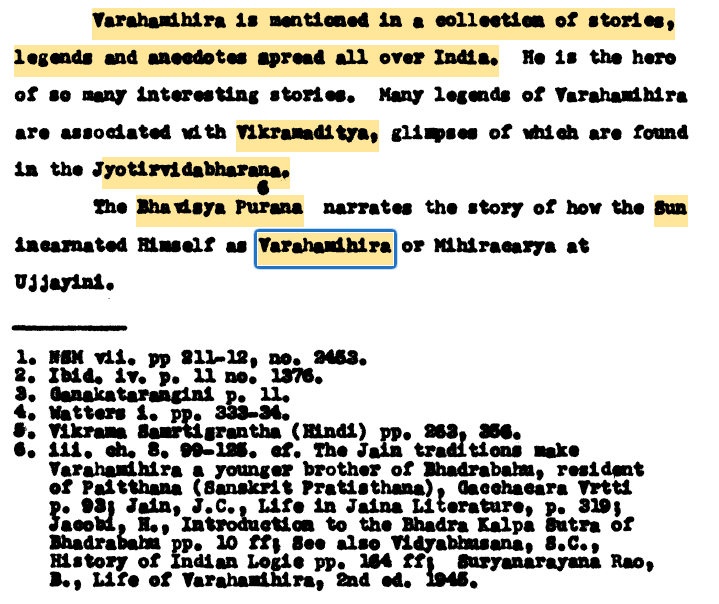
Here is a more comprehensive bibliography, but one scholar.
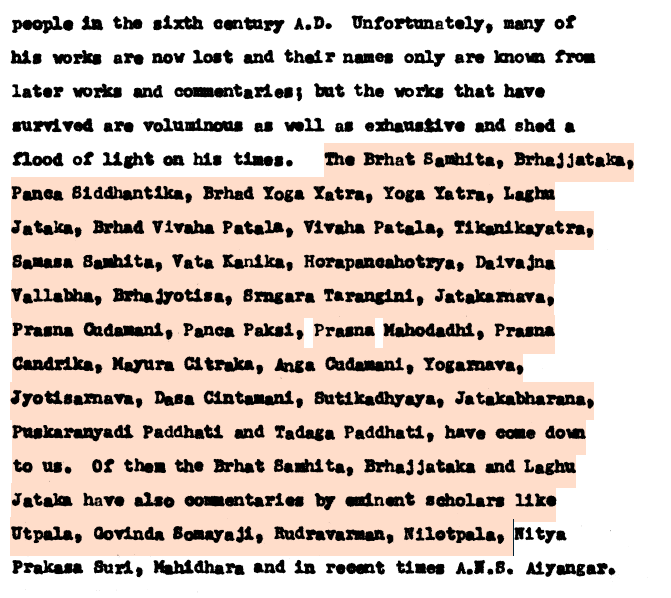 However, this Ph.D. of history raises other questions about the biography of Varahamihira. At one time, yours truly would have rejected such notions outright, in automatic autochthonal assertion. Closer scrutiny, nevertheless, merits consideration of uncomfortable questions.
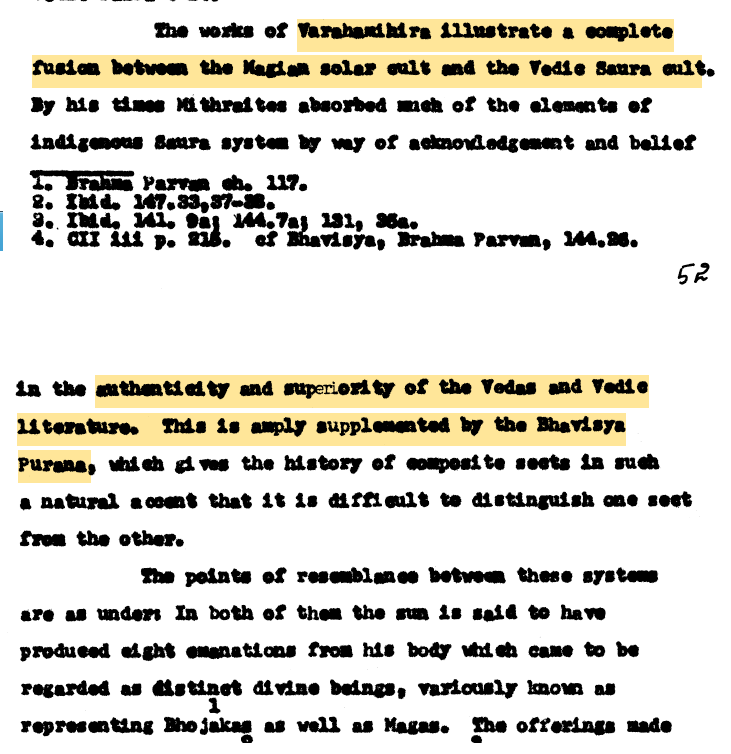
At first glance, this is difficult for any aasthika to accept. Nevertheless, there are certain trends that become apparent over time. The question of Raasi vs Nakshathra is a long-standing one in the videsi vs desi astrology debate. In contrast, the question of Mithras vs Surya is more trenchant. The two are often erroneously conflated, while there are distinct differences. Surya is a central part of the Vedic Pantheon; however, he is not seen as the primal deity that Mithras, of Avestan association, often is. This becomes all-the-more concerning when the question of “Maga brahmins” and “Saka-dhveepi brahmins” is raised. Could there be such a thing in a civilization so insular that it practices outcasting for mere association with, leave aside, patrilineal descent from mlecchas?
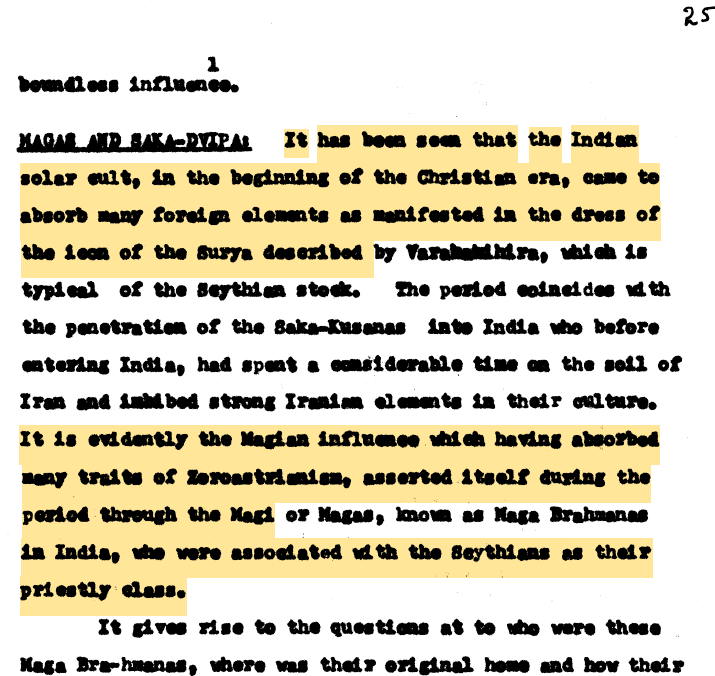
Indian astronomy undoubtedly has an ancient and Vedic origin. Our ancestors certainly produced indigenous astronomical hard science (separate from superstitious astrology). The british, through erroneous attribution of the word “Yavana”, postulated greek influence on Indian astronomy. Pandith Chelam clarifies this reality.

If Yavanas were ancient Afghans, that is residents of the Northwest corner of Bhaarathavarsha (Indian Subcontinent), and their astronomy was in fact prized, then foreign influence does become possible—not in totality (as alleged by Westerners), but partially. The Indic Yavanas may very well have become a vehicle for percolation of some, not all practices—specifically the anti-Vedic. It is quite well-known just how avaricious videshis are at attributing all Indic achievements in the sciences to foreign invasion. This should be rebutted post-haste; however, this does not preclude sifting and discarding of the avaidika.
Why is this postulation necessary? Because the merely orthoprax today are attempting to anoint “Yavan Reeshees” as our new leaders of Vedic orthodoxy. It becomes all the more apparent to study these corrupt threads as well as the foreign yarn that produced them.
Will detailed examination of the Brhath Samhitha stand to scrutiny? Inquiring minds may read on.
Composition
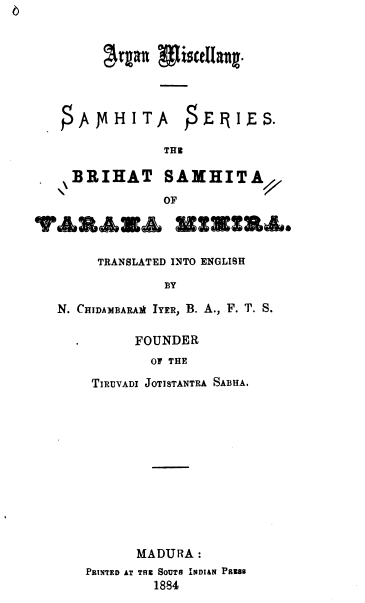
Nevertheless, it begins as follows:
“1.Glory be to the Sun who is the author and the Soul of the Universe, the ornament of the firmament and who is enveloped in a thousand rays of the color of molten gold.
2.Having correctly examined the substance of the voluminous works of the sages of the past, I attempt to write a clear treatise neither too long nor too short.
3.What means the notion that the works of the Rsis are sound and not so the works of men? In cases where the matter refers to no mantra, what is there to choose between, when the meaning is the same because the words are different?
4.If Brahma has declared “Kshititanaya divasa varo ansubhakrit’ and man ‘Kuja dinamanistam’ what is there to choose between the work of man and that of a Deva?
5.Having examined the vast works that have proceeded from writers from Brahma downwards, I purpose to write a brief work embodying the substance of the same. The task is a pleasing one to me.
6.There was darkness (chaos) in the beginning. Then came water (into existence). On it (floated) a gold colored egg, the (divine) seed consisting of the Earth and the Firmament from which there arose Brahma, the creative agent with the sun and moon for his eyes.” [1, 1]
Varahamihira, like many today, was exceedingly learned and scholarly, but did not follow orthodox teaching (ostensibly being a Yavana Pandith, albeit born in Avanti/Malava). This is the danger of allowing non-Vedic Pandiths to dictate foundational theory or to anoint them as “Reeshee”. It is one thing to employ or give respectful patronage to scholars who are non-Vedic or non-Indian, it is quite another thing to allow them to take over or overturn it by insinuating atheist or materialist (Lokayata) theory. Agnosticism is understandable, perhaps even the most scientific view, since it argues, “Eh, no proof (prathyaksha pramaana), so I don’t know if God exists). A fair argument from the rational-empirical perspective.
Atheism, however, actively argues against the existence of God, hubristically convinced of man’s own intellectual superiority. This breeds not only egotism but self-deification. It is for this reason that actual Veda Braahmanas were ordered to lead humble lives of non-materialism, subsisting on alms. Moorkhapandithas today have forgotten this true meaning of brahmanathva, which ensured the truthful transmission of knowledge from age to age. Today, instead, knowledge has become a battleground and field for the intellectual (and spiritual) domination of others.
Varamihira was no atheist, but like Lokayatins (and stealth Charvakas after him), he demonstrates the vakrabuddhi of one who shakes the faith of the naïve in the Vedas itself (unsurprising since he as a Yavana was supposed to have been barred from it—there are many more “brhat” jatiwadis who should be today).
For all these reasons, Varamihira (despite his brilliance) must be viewed with skepticism, while his scholarship and contributions should be truthfully transmitted and explicated. This tangent aside, there is nevertheless much astronomical and astrological knowledge for which Varahamihira and Yavana Pandiths (they can’t be Veda Braahmanas) are rightly praised.
“In verse 2 of Chapter III of his Brihat Samhita, Varaha Mihira says:
‘At present the Solsticial points coincide with the beginning Karkataka (Sign Cancer) and with the beginning of Makara (Sign Capricornus).’
This amounts to saying that the Vernal equinox, which is midway between the Solstices (90* from coincided was at the commencement of Mesa (Sign Aries) i.e. coincided with the Star Revati where the fixed Hindu Zodiac commences. The precession of the equinoxes was known to the Hindus long before it was known to the Europeans, although Hindu astronomers are not agreed as to the nature of its course—some asserting that it oscillates on both sides of the star Revati while others that it makes a complete revolution round the heavens, a point about which even European astronomers have not arrived at any conclusion. Now this point is at present about 20* to the west of the star Revati. Its annual rate of motion is known an increment in the rate is also know[n];so that by a process of simple calculation we can ar[rive] at the period when the point must have coincided with the start Revati. Now unfortunately, the exact distance between Vernal Equinox and the star Revati is not known, and cannot be determined from observation as the star (which the Hindu astronomers say was on the ecliptic) appears some how to have disappeared.” [1, xiv]
“The whole book is one huge attempt to interpret the language of Nature and ascertain its bearing on the fortunes of men and nations. [1, xvi]
“Hindu astronomers say that if Saturn should enter the constellation of Rohini (4th) the world would be at an end.” [1, xvii]
The Brhath Samhitha addresses various issues, primarily horoscopy and palmistry, interspersed with miscellaneous topics, such as architecture. Of particular note is one chapter called “On the Praise of Women”.
“4. In no world has Brahma created a gem superior to women, whose speech, sight, touch, thought, provoke pleasurable sensations. Such a gem in the shape of woman is the fruit of a person’s good deeds, and from such a gem a person obtains both sons and pleasure. A woman therefore resembles the goddess of wealth in a family, and must be treated with respect, and all her wants must be satisfied.
5.It appears to me that those are bad men who, out of a dislike for all things, speak ill of women, and these men are never found to speak the virtues of women.
6.Is there any vice with which women are not charged by men? Speak the truth. Those that reject women do so out of a stupid firmness of mind. According to Manu, a women possess more virtues than men.” [1, 336]
“12.In the eye of the Sastras, adultery in a man or woman is equally condemned. Man [n]eglects this condemnation, while women respect it. Hence the superiority of women over men.
17. A person who is fortunate enough to have an excellent wife, though he might be poor, appears to me as happy as a king. [1, 337]”
The Brhath Samhitha as a composition is neither to be comprehensively condemned nor blindly praised. It contains many laudable sections such as the feminine one above, bears the traditional superstitions that characterise the era, and yet betrays elements of skepticism that must themselves be viewed skeptically by the very orthodox.
As to be expected, it is only by reading directly that one can get a better sense of the import and consequence of such a famed treatise.
Selections
§
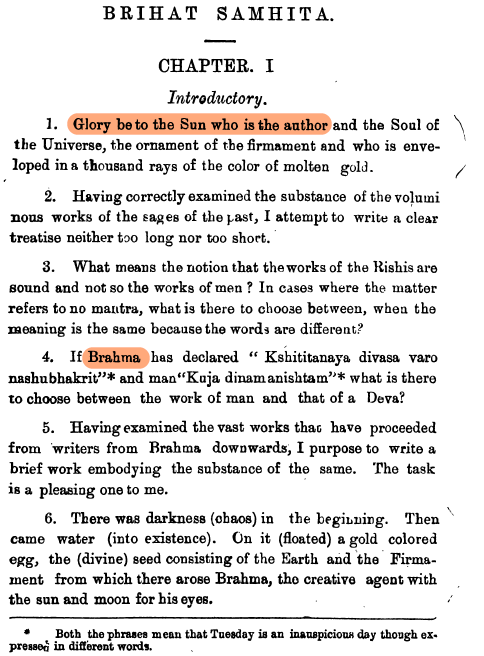
“7.Kapila says that the Universe had its origin in pradhana; Kanatha [Kanada] in drivya and the like; a few in kala (time); others in Svabhava (nature); and some in Karma.
8.Enough of this (subject of Cosmogony) on account of its vastness. If this question were discussed; it would swell very much in length. The subject I have now to treat of is the Angaviniscaya (Samhita) section of Jyotis Sastra.
9.Jyotis Sastra treats of many different subjects and consists of three sections. The sages call the whole by the general name of Samhita. This section which treats of the motions of the planets is called the Tantrasastra (Astronomy). Another section is the Horasastra (Horoscopy). The third section is known as the Angaviniscayasastra (Samhita or natural astrology).
10.In my work on Astronomy, I have treated of the heliacal rising and setting of the planets as well as their retrograde and re-retrograde motions and the like. In my work on Horoscopy I have fully treated of nativity, of yatra and of marriage.
11.In the pre[sent] treatise, I have rejected questions and re-questions, historical narrations, unimportant planetary phenomena and all that is useless; and I purpose to speak clearly only of the vital truths of the several subjects treated of.” [1, 2]
§
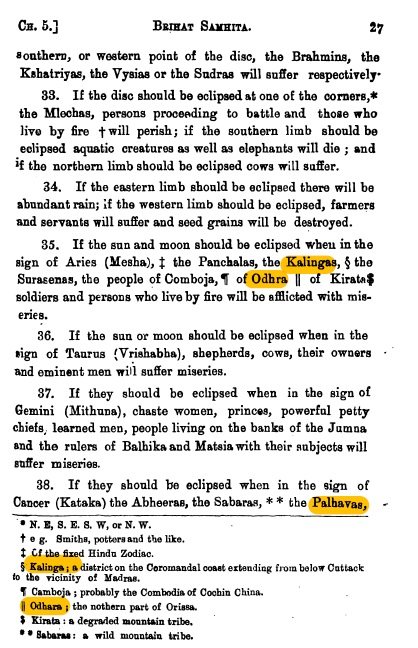
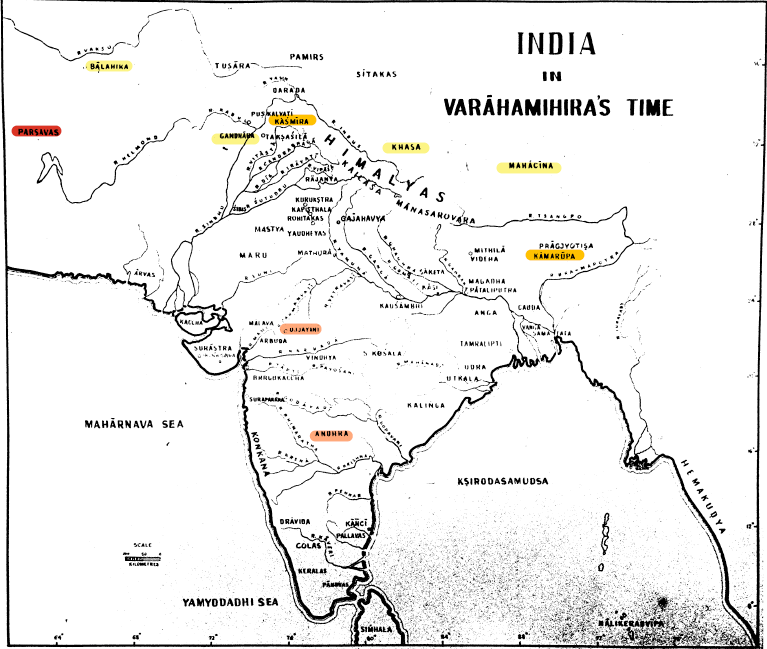
Various parts of historical India are mentioned—from Madra (in West Punjab) and Kashmir
to the Odhra (in Odisha) to the Andhra and Chola (in the south)
§
An interesting section on Amiability
“6.A person who is not selfish becomes popular and selfishness makes a man unpopular. A selfish person executes his work with much difficulty, and an unselfish man, through his sweet manners and speech finds it easy to do his work, being helped by others.” [1, 339]
“Again, the smritis refer to a number of days in which cohabitation is prohibited [i.e. during menses, holy days, when beneficent planets are prominent, etc], such as the new-moon and full-moon days, the eleventh-lunar day and the like. The sages of old appear to have strictly followed all these rules. If the whole world could be equally firm minded, there would probably be no occasion for so many curious, el[a]borate and sometimes even frightful solutions of the problem to check the growth of population. You allow the evil to grow and then seek a remedy; but the demand exceeds supply and a disturbance of the social equilibrium occurs, nature restores it by applying her own remedy—by carrying away every now and then, thousands, by wars, by the plague and the like epidemics.” [1, 361]
§
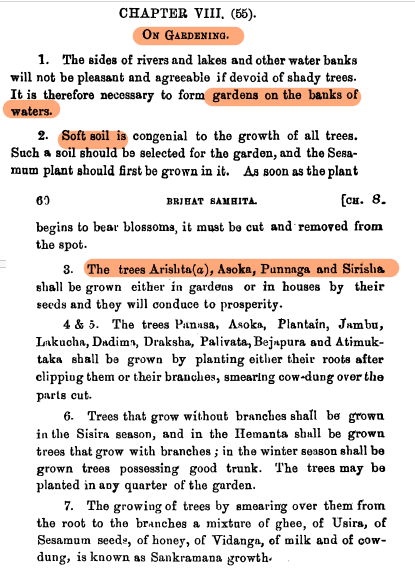
For those who think gardens were brought by mughals, here is Varahamihira on the topics:
§
Everything from Architecture to Chemistry to Botany and Zoology is covered. Despite its multifarious topics, at its heart, the Brhath Samhitha, is a work of Jyotisha. By that, we mean not only Astrology, but as Shivoham has written in his erudite work, Astronomy (or Jyotihasastra) as well.

§
The Brhath Samhitha concludes as traditionally as it began. Its penultimate and ultimate verses adumbrate the concerns of the composer that are natural to any scholar.
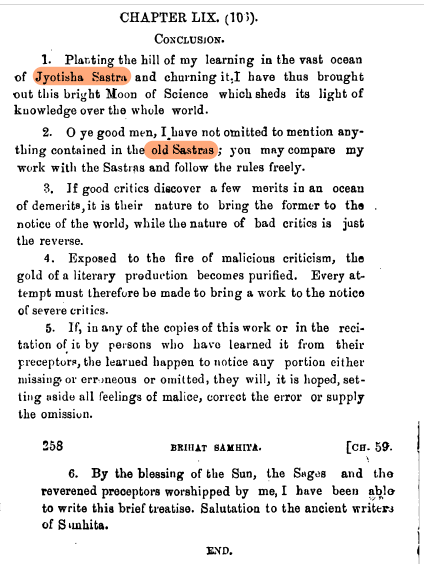
§
Conclusion
The Brihat Samhita was a widely recognised text appreciated in its own time and later. Chintamani was the Commentary of Bhattotpala on Brhath Samhitha by Varahamihira
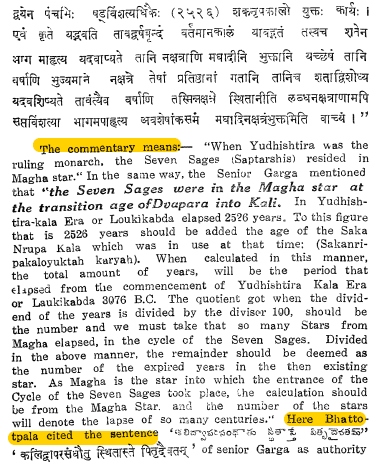
Such high regard no doubt indicates the widespread influence and eminence of the author. Be that as it may, was Adityadasa’s son an orthodox Indian Brahmin, or merely a Frontier Indic Pandith (a.k.a. Yavana)?
Unlike today’s moorkhapandithas, Varahamihira quoted copiously from the poorvacharyas. Although he acknowledges Vrddha Garga, there is nowhere mention of the alleged “Yuga Purana”, which is disavowed by aasthika Pandiths like Kota Venkatachalam garu.


Varahamihira was undoubtedly a brilliant man, with tremendous knowledge. But as we have previously established, knowledge is not wisdom. It is well-known that other than the Tamil & Malayalam Calendars, the main calendars in India are Amavasyat (used primarily in the Dakshinapatha & Mithilanchal) and Purnimasyat (used in most of Northern India). This change is traced back to King Vikramaditya of Ujjain, no doubt under the influence of his chief astronomer.
But if Varahamihira, like many (though not all) Pandiths from Kashmir was indeed a Yavana, then it calls into question not just the wisdom of this decision (branded as “more Vedic”) but his own authority. Whether this forms the basis for the return of an all-India Amantha calendar (excepting Tamil Nadu & Kerala for Solar/Historical reasons), it should be noted that this would restore coherence and cohesion to the Vedic Indic identity. After all, many invaders infiltrated into India. And as we are seeing now, there are phirangis openly attempting to cast themselves a “reeshees“, with the obligatory pseudo-orthodox imeciles drinking their paadhatheertha, and goodness knows what else… So rather than blindly accepting everything through blind faith in “brahmin-bhakthi“, whatever that means, one must meditate on Paramathma and apply critical thinking.
It is by studying the works of proven orthodox Pandiths like Kota Venkatachalam, that one understands precisely how many of these sepoy-supremacists are in our midst. They complain about “Itihasa-supremacy” whilst peddling “caste supremacy” from their corrupted recensions. Pandith Chelam himself warned of such characters.
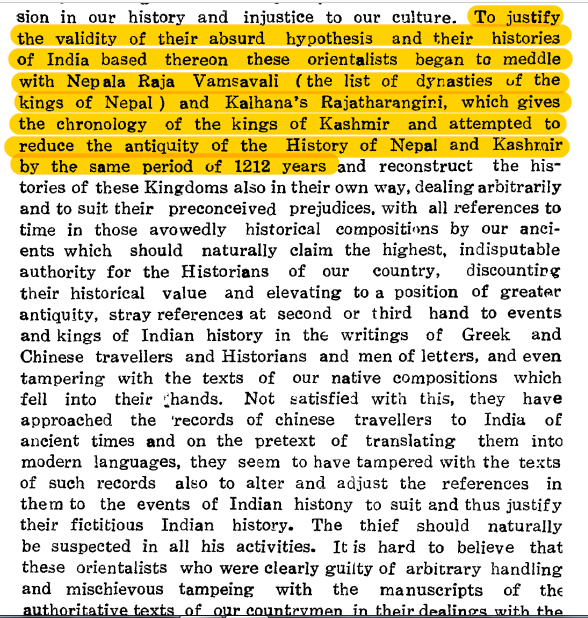
One such personage the present writer has long avoided naming is P.V.Kane. But don’t take my word for it, here is Pandith Chelam on the man-of-the-hour:
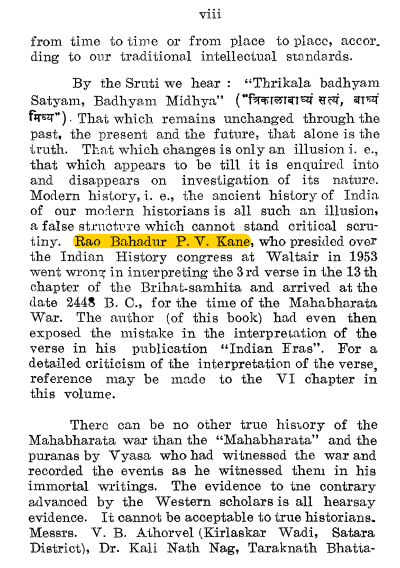
This explains why “Beef in Vedas” finds its mention in Kane’s questionable translation of Dharmasaastra. All true aasthikas know that madhuparka has nothing to do with go-maamsa. But a Yavana would have no such compunction. In fact, many of our “modern reeshees” today would not even qualify as Yavanas.
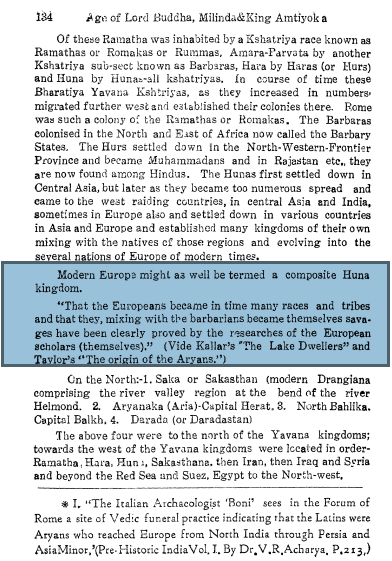
The Brhath Samhitha is a laudable work of knowledge on a variety of topics. But just as one must be wary of sepoy-supremacists from the lineage of Balaji Bajirao Peshwa, one must be wary of Yavana Brahmana Mlecchas (better termed Yavana Panditha Mlecchas). They do not have the lineage of true orthodox Braahmanas like Pandith Chelam, but they invent legends to compensate (and over-compensate) for their obvious phenotypical differences. If it looks like a phirang and smells like a phirang, it is probably a phirang—same goes for the Paarasika. Avesta stands in opposition to Veda. No such thing as Magi Braahmanas. They are as opposed to each other as Devas are to Asuras.
“Racist”, you say? No, it is but a simple response to all the racism Indians have been subjected to online and off. If we are not you—as outsiders insist—then how can you be us?
All are welcome to Sanatana Dharma, but Vaidika Dharma belongs only to Vaidhikaaryas (that is Vedic Indian Ethnicity), and no one else. Whatever one’s citizenship, that is what we are and how the world perceives. So be it—then how can they complain when we respond in kind?
It is not known for certain if Varahamihira and his clan were Yavanas (who migrated to Kashmir). Regardless, the Brhath Samhitha, is an excellent work that should be studied by scholars and students alike. But it should be taken with a grain of salt—just like all the other pontification passing itself off as punditry (sic) online. The starting point is to reject apocryphal texts from the Allopanishad to the Yuga Puraana (exposed by Pandith Chelam) and to disregard modern and medieval “orthoprax” who speak and write in contravention to Veda & Mahapuraana.
If it looks fairer, but feels fouler, it probably is.
References:
- Iyer, N.C. The Brihat Samhita. Sri Satguru Publications: Delhi.1987
- Iyer, N. Chidambaram. The Brihat Samhita of Varahamihira. Madura: Tiruvadi. 1884
- Kota, Venkatachalam Paakayaji (Pandith). Chronology of Ancient Hindu History Part I. Vijayawada:AVG
- Kota, Venkatachalam Paakayaji (Pandith). The Age of Buddha, Milinda, and Amtiyoko. Guntur: Sri Ajanta Printers.1956
- Kota, Venkatachalam Paakayaji (Pandith). Chronology of Kashmir History Reconstructed. Guntur: Sri Ajanta. 1955
- Chopra, Surendranath. India as known to Varahamihira. Chandigarh: Panjab University. 1968