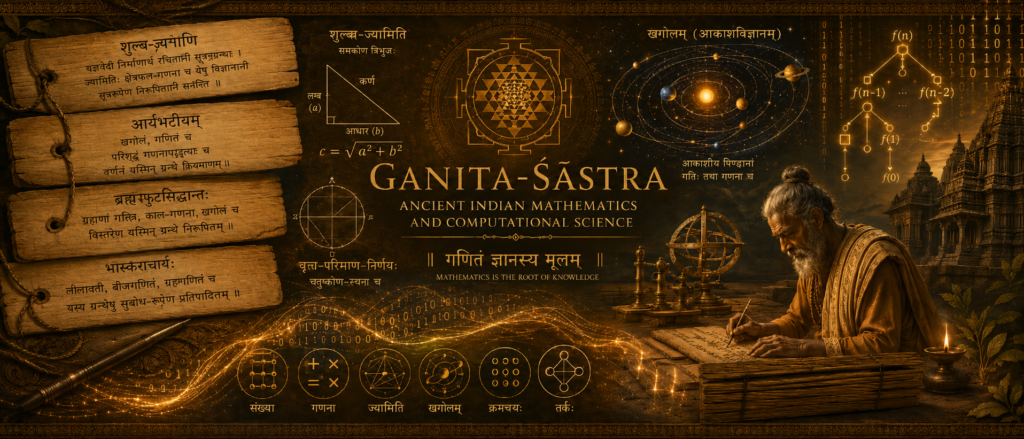
This post offers a description of Ganita terms, giving their English approximation or near-equivalent in mathematics, along with comments to provide context. This post does not offer a complete and formal description; rather, it offers an informal discussion to help orient a new reader toward the subject of Ganitasastra. Snippets of responses generated by frontier AI models (LLMs) are included for the benefit of first-time readers. The references at the end of the post provides links to an introductory book suitable for high school students [2], and an advanced treatise on Ganita for researchers [3].
Before we get into the subject, we must understand what Ganita is and is not.
What is Ganita?
Mathematics is not Ganita
Ganita is the science of computation or calculation. It is not the same as Mathematics although the term ‘mathematical sciences’ comes closer. Here is ChatGPT 5.2’s brief summation of the difference:
Ganita asks: Does it work, endure, and harmonize with reality?
Mathematics asks: Can it be proven from axioms?
Modern mathematics begins with explicit axioms that are assumed.
Ganita begins with operations that are justified by construction.
In this sense, Ganita is not less foundational than mathematics—it is often less assumption-laden and, paradoxically, closer to first principles.
Ganitasastra
Ganitasastra is Vedic in its origin. It is an integral part of Vedanga Jyotisha, as well as the Sulbasutras within the Kalpa Vedanga. Dr. Saraswati Amma explains the goal of Ganita derived from her research of the Sulbasutras [7]: “self-realization and resulting deliverance from birth and death were the most legitimate purpose of life, and those sciences which were supposed to further this purpose directly or indirectly were most assiduously pursued“.
A contemporary understanding of Ganita
The NPTEL lecture series on Indian mathematics offers a wealth of technical and historical information on the Bharatiya Ganita heritage and is presented by some of the topmost Ganita, Math, and Science scholars, some of whom are also Sanskrit experts.
Validation and Methods
Pramana – correct cognition, a means of acquiring valid knowledge. Pratyaksha and Anumana are two important Pramanas in Ganita.
Anumana – inference, the key reasoning component in Indian logic. This is not the same as deduction, but is a derived conclusion from the observation of patterns.
Pariksha – careful, comprehensive observation. e.g. yantra pariksha: observation using instruments. An extension of Pratyaksha (direct observation and perception), the oldest and most universal Pramana among darshanas.
Drg-Ganita – ‘seeing and computing’. This important method, introduced by Parameshwara of Kerala’s Ganita school, looks for agreement between computation and observation.
Siddhanta – doctrine rooted in a validated conclusion, or a validated algorithmic package. What happens when there is a clash between Siddhantas? In [4], “ Siddhantas are thus human creations, and the best at any time may not remain so for long—it is valid only for some finite periods of time.”
Yukti – skillful and ingenious practice. Ganita gives pride of place to Yukti, sometimes overruling the primacy of the Agamas. Verse (2.5) from the Bhagavad Gita says “yogah: karmasu kausalam“, yoga is skill/excellence in action [4].
Anveshana – ‘wild goose chase’. Usage: This word has a positive connotation, but in Ganita it represents a futile exploration.
Upapatti – evidence based on a rigorous validation of results to the satisfaction of peer experts. Upapatti differs from the axiomatic theorem-proof approach of mathematics. Yukti is employed to demonstrate constructively how anyone else can correctly reproduce a result. This is not the same as the synthetic notion of abstract proof [5]. An important book is the Ganita Yukti Bhasa of Jyeshtadeva hailing from the Kerala school. The idea that Indian mathematicians offered no proofs for their findings is a misconception. To fully grasp a mathematical result—including its underlying proof—one must study the explanatory commentaries written alongside the concise Sutra texts [1]. The tradition of providing Upapattis is an old and well-established one[6].
Arthapatti – postulation/implication, from Tarka Sastra (Indic logic and epistemology). A vital method of acquiring valid knowledge by “assuming an unperceived fact to resolve a clear contradiction between two otherwise well-established, observed facts” (courtesy Google Gemini). Whether it is an independent Pramana (like Anumana) is an open question.
With this overview of Ganita, its motivation, and methods, let’s get into the various topics.
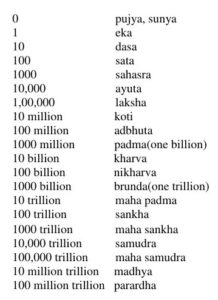
Here is where most of us see the similarity with mathematics. This is not surprising, as the foundational areas of mathematics arose from the translations of Ganita texts in two waves, relating to large numbers and tiny numbers, respectively, which is described in other ICP posts related to Ganita [1] and metrology.
1. Classification of Ganita Disciplines
- Pati-ganita, Anka-ganita ~ Arithmetic
- Bija-ganita, Avyakta-ganita ~ Algebra (“calculation with unmanifest quantities“). This original Sanskrit name contains the meaning of the subject, whereas Algebra is simply a corruption of the Arabic scholar Al-Jabr who translated the Indian treatise.
- Kshetra-gaṇita ~ Geometry.
- Kalana, Kalana-vidhi, Ganita Vidhi ~ Calculus. Strange as this may seem, it turns out that the Ganita method and calculus are synonymous. Here’s the etymology given by Perplexity AI starting from Latin origins:
“calculus is the diminutive of calx (“limestone, stone”) and referred to a small pebble used as a counter on a counting board or abacus. Because such pebbles were used for reckoning votes, distances, and sums, calculus also came to mean “reckoning” or “method of calculation,” a sense that carried into early English usage… the word “calculus” is attested at least as early as 1672 in the sense of a method or system of calculation.”
2. Arithmetic Operations and Quantity Types
- Yoga, Ganana, Saṅkalanam: Addition, sum.
- Viyoga, Vyavakalananam: Subtraction.
- Gunanam: Multiplication.
- Haranam: Division.
- Samvarga: The product of two or more numbers or functions.
- Bhaaga, Khanda, Ansha: A fraction, section, or part.
- Krti, Varga: Square (x²).
- Ghana: Cube (x³).
- Vargamulam, Dvikaraṇi: Square root. (Specifically, Dvikaraṇī is the geometric side of a square of area 2, i.e., √2).
- Rna-sankhya / Kshaya: Negative number (often represented conceptually as debt). This original Indic understanding of a ‘negative number’ as a debt and direction is truly critical to human advancement and modern science.
Note: The idea of denoting points east and north with positive numbers, and south/west with negative numbers originated from ancient Bharatiya astronomy and its Ganita for tracking planetary movements. Arab translations of Ganita eventually traveled to Europe, and became the default choice in all graphs, from school classrooms to machine-learning scatter plots. Using positive/negative signs to denote direction is fundamental to the vector representation (e.g. velocity) that drives modern physics and today’s machine learning models.
- Google Gemini adds:
“By decoupling the negative sign from being purely a state of "loss" or "absence" and defining it as an algebraic operator of reversal, ancient Gaṇita laid the absolute groundwork for vector space.”- Dhana-sankhya / Sva: Positive number (represented as wealth).
3. Computational Metrology, Precision and Approximation
- Sukshmam: Mathematically accurate or precise result.
- Aasannam, Asphuṭah, Sthulam: Approximate, coarse, or unrefined value.
- Dashamaana-paddhati: The base-10 decimal numeral system.
- Bhuta-sankhya & Kaṭapayaadi: Sophisticated mnemonic numeral systems used to record large numbers and astronomical constants within verse meters.
- Terminology on weights and measures can be found in the ICP post on Pauthavam.
4. Algorithmic Frameworks, Reasonings and Tools
- Sutra: A dense, cryptic rule, formula, or aphorism.
- Abhiyukti: Algorithm. Per Google Gemini: “an Indian computational method that is procedural but not blindly mechanical.” Abhiyukti is a gem of Indic terminology.
- Kalana-vidhi: A neologism and modern technical word for the western rigid mechanical ‘algorithm’ that aims for mathematical equivalence. Abhiyukti is the preferred, original and profound Ganita term that reflects the original algorithm.
- Trairaashika: The Rule-of-Three (the foundational linear model of proportions mapping).
- Unit Rate (k) = B / A, output Y = k × C = (B / A) × C.
- Shanku: Gnomon (a vertical pole or stick used to calculate time, solar altitude, and terrestrial latitude via shadow geometry).
- Nyaya: Vedic logic (refer ICP post on Tarkasastra), not identical to the Western category of logic.
5. Geometry & Engineering (Kshetraganita)
- Rajju, Sulba: Measuring rope, cord, or string (the foundational tools of geometry).
- Kshetra-phalam: Area of a shape.
- Ghana-phalam: Volume of a solid.
- Aayama: Length or dimension.
- Aayata: Rectangle.
- Vrttam: Circle.
- Trijya: Radius of a circle (“tri-sign chord“).
- Jya, Kotijya: The horizontal and vertical half-chord lengths in a circle of radius R (corresponding to R sin θ and R cos θ). The original chord lengths that map to sine and cosine, which are dimensionless ratios. For a circle with unit-radius, their Jya-Kotijya values equal sine-cosine. An error in the Sanskrit to Arab to Latin translation of Jya yielded the silly ‘sine’ in use today.
- Bhuja-Koti-Karna-Nyaya: Base-altitude-hypotenuse Vedic logic. This predates the Pythagorean theorem. This Nyaya differs from the theorem because the theorem only states the sum of squares of lengths. The ancient BKK result is a huge leap ahead of the theorem, for it also knew how to calculate the square root to high accuracy that is required to establish the length of the diagonal given the sides of a square or rectangle. Refer to this X/twitter note by Prof. C. K. Raju for reference.
- Karna: Hypotenuse or diagonal. Karaṇi means a surd, or a square-making side.
- Additional terminology can be found in the ICP post on Sulba Sutra applications to Engineering.
6. Calculations in Algebra and Commercial Mathematics
- Samikaraṇam: Equation.
- Mulam: Root of an equation (or the root of a plant/origin in Ayurveda).
- Prakrti: Coefficient or weight, i.e., the multiplier preceding a variable.
- Anka-Paasha: Combinatorics and permutations-combinations (“net of numbers“).
- Muladhanam: Principal amount (capital).
- Mulaphalam: Simple interest generated from the principal.
7. Indeterminate Analysis in Bijaganita
- Kuttaka: Literally “the pounder”. Aryabhata’s powerful approach for solving linear indeterminate equations (ax – by = c). It precedes the extended Euclidean algorithm. Importantly, it is an exact algorithm for solving ‘Diophantine’ equations, i.e. to find feasible integer solutions, which is a precursor to modern integer-programming optimization problems.
- Chakravaala: The cyclic method, which is Brahmagupta and Bhaskara-2’s sophisticated algorithm for solving second-order indeterminate equations (N x² + c = y²), wrongly attributed in the West as Pell’s Equation).
- Bhaavana: Brahmagupta’s principle of composition and an algebraic identity that enables us to compose two distinct solutions of a quadratic equation to generate an infinite number of new solutions.
8. Fundamental Bijaganita Variables
- Yaavat-Taavat: Literally “as much as / whatever amount.” This is the oldest specific term for an unknown algebraic variable (‘x’). Google Gemini adds: “When handling multiple unknowns (y, z), Ganita used color terms like Kālaka (black), Nīlaka (blue), and Pītaka (yellow)”.
9. Calculus
- Anantam: Infinity.
- Parama-Samiksha: Differential calculus or optimization (maximizing or minimizing a function where the change drops to zero, first articulated by Bhaskara-2 via the instantaneous motion of planets). This is pretty much the basis of (stochastic) gradient descent used to train AI/ML models by minimizing the training loss.
- Jya-Bhaavana: Trigonometric interpolation and the derivation of the sine differential equations (δ(sin θ) = cos θ δθ), which laid the direct groundwork for the infinite series calculus of the Kerala School.
Key Ganita Personalities
Note: This is an incomplete list that does not contain many illustrious names, both ancient and modern. The focus of this list is on Ganita rather than mathematical contributions.
Vedic Rishis: transmitters of the revealed knowledge of the Vedas and Vedangas which include the Ganita-rich Sulbasutras, Jyotisha, and Chandaḥsastra, among others. The known names of the Rishis who compiled the extant version of Sulbasutras (800 BCE or prior) include Baudhayana, Apastamba, Katyayana, and Manava.
Sage Lagadha: credited author of the extant compilation of the Vedanga Jyotisha, circa 1350 BCE.
Pingala: author of the important and influential Chandaḥsastra (3rd BCE) and is also known as the Pingala Sutras. Archarya Pingala’s work is now recognized as codifying the world’s earliest known principles of combinatorics, binary systems, and computer science. Acharya Pingala documented the Meruprasthara, now known as Pascal’s Triangle, over 1500 years before Blaise Pascal. His work also contains the origins of the Hemachandra-Gopala series (aka Fibonacci series).

Meruprasthara, Raghunath Temple, Jammu & Kashmir, India. Source: Wikimedia
Paanini: author of the peerless Sanskrit Vyakarana (~grammar) work Ashtadhyayi (3rd BCE or prior) and the fourteen Shiva Sutras that precede this work. These are not Ganita-centric works but contain pioneering ideas of algorithmic and computational science that fall under Ganita. The ~4000 sutras of the Ashtadhyayi serve not simply as grammar rules but are also a generative algorithm. Paanini introduced the idea of the zero or null operator (Lopa).
Google Gemini: “Long before modern formal mathematics emerged, Pāṇini invented the foundational structures of formal language theory, generative logic, and abstract algebra.”
Kautilya: author of Kautilya Arthasastra, dated to 1500 BCE per Bharatiya tradition and 4th-3rd BCE per western Indology. This work on statecraft is not a Ganita-centric treatise like the others here but is a monumental work that applies Ganita methods in multiple areas including financial calculations, statistical accounting and auditing, portfolio management, metrology, military geometry and logistics, inventory planning, etc.
Aryabhata– author of Aryabhatiya (499 CE) at age 23. This work comprises 108 core scientific/technical/Ganita verses. The Gaṇitapada section comprises 33 verses that contain some of the most powerful original results in Ganita covering arithmetic, geometry, algebra, square/cube roots, sine/cosine and the approximation of Pi, besides laying out the foundations of Calculus.
Brahmagupta – author of the Brāhmasphuṭasiddhānta, dated to 628 CE and Khaṇḍakhādyaka. The former treatise comprehensively covers spherical astronomy and its Ganita chapters established pioneering algebraic and geometric results, including its famous R-sine tables.
Bhaskara-2 headed the astronomical observatory at Ujjain and his magnum opus was the Siddhanta Shiromaṇi, 1150 CE. This compendium comprises four distinct works, including the Lilavati, Bijaganita, Grahaganita and Goladhaya, which became the standard global textbooks of that era.
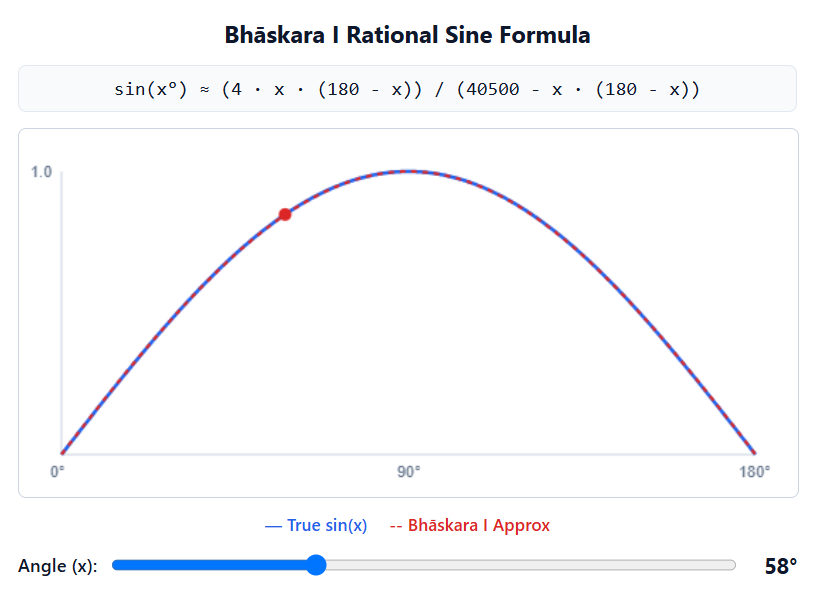
Bhaskara-1 (629 CE) carried forward the Aryabhaṭa school of Ganita and wrote several commentaries and texts such as Mahābhāskarīya that contains an remarkable rational approximation for the Sine function that is so accurate that it is practically indistinguishable from the sine function in a graphical plot.
Varahamihira (~500 CE) was a Jyotisha scholar in the court of the great king Vikramaditya and is the author of the Panchasiddhantika and Brhat Samhita. Combinatorial formulas (nCr) for mixing perfumes and codified sine tables are also among his known contributions.
Mahavira: author of the Gaṇitasaarasangraha circa 850CE. He was a Digambara Jaina Ganita expert and a gem of the court of the Rashtrakuta emperor Amoghavarsha. This work is encyclopedic and covers nine chapters and contains over 1000 Ganita rules, including topics covering negative roots, permutations and combinations, the geometry of ellipses, and unit fractions, among others.
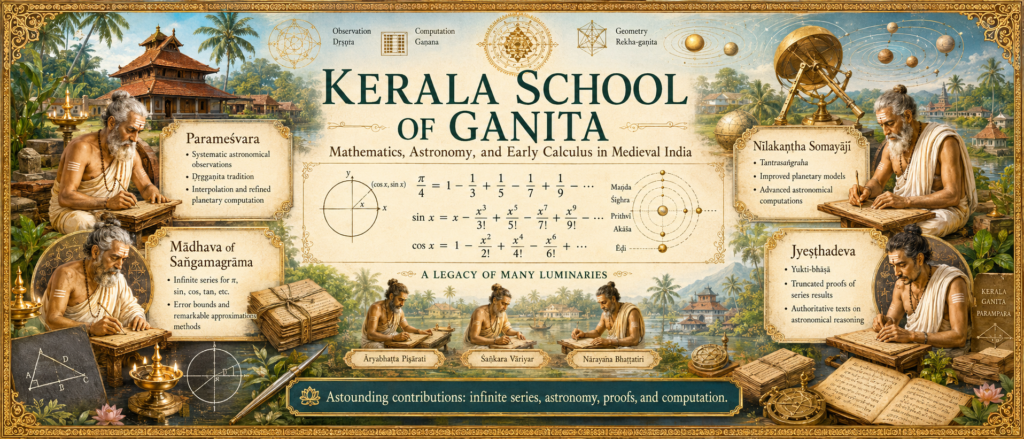
The Ganita school of Kerala: Jyesthadeva (Yuktibhasha), Nilakantha (Tantrasangraha), Parameswara (Drg-ganita), Madhava (founder of calculus, infinite series for Pi) and other great scholars, between 1340-1610 CE. Their contributions are too many to be listed here.
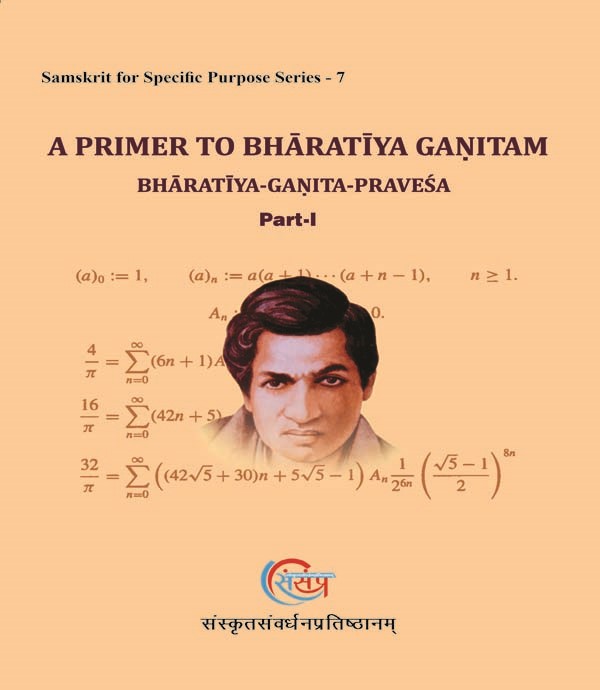
Srinivasa Ramanujan: The Ganita genius who is also the greatest mathematician. In a short life span, he published a huge number of results in the Ramanujan Notebooks (1903–1914) and came up with many novel discoveries that are being analyzed to this day.
Shakuntala Devi: The Human Computer. Between 1977-1988, she multiplied two random 13-digit numbers in 28 seconds, and beat the UNIVAC computer in computing the 203rd root of a 201-digit number in 50 seconds, among several astonishing features of calculation.
Narendra Karmarkar: He invented the Karmarkar algorithm at AT&T Bell Labs in the 1980s, which was the first practically useful polynomial-time algorithm for linear programming. His work has since spawned thousands of research papers that took the field of both linear and nonlinear optimization (central to training machine learning models) forward.
Manjul Bhargava was awarded the Fields medal in 2014 (the Nobel equivalent in Mathematics) for his work in modern algebraic number theory and arithmetic geometry. His methods and motivation are deeply rooted in Ganitasastra and its algorithmic methods. In particular, his work on higher composition laws were inspired by Brahmagupta’s work. He has also spoken about the algorithmic combinatorics in the Chandahsastra. Google Gemini notes: “Bhargava’s style leans heavily into constructive computation, explicit parameterizations, and counting principles—a core hallmark of the Gaṇita epistemological tradition.“
Modern scholars of classical Ganita
Bibhutibhushan Datta: A giant of modern Ganita scholarship, he co-authored, along with Awadhesh Narayan Singh, the multi-volume magnum opus, History of Hindu Mathematics: A Source Book (1930s). This work was critical in keeping alive and reaffirming the Ganita contributions of Bharata over the centuries and influenced several other others, including those below in the list. He completely overturned the western historical analysis of the famous Bakhshali manuscript through his scholarship in the 1920s and explained many of its powerful Ganita results and its ancientness. He conclusively proved ancient India’s pioneering understanding of Ganita topics such as systems of linear equations and radical fractions.

Bakshali Manuscript (Wikimedia)
Saraswati Amma: brilliant author of the 1979 work: Geometry in Ancient and Medieval India, which emphatically corrected the western-lens view of Ganita, and the Indian contributions to Geometry, in particular. Her fundamental exposition of the goal of Ganita is a critical and understated civilizational contribution.
KV Sarma: Historians consider him the authority on the Kerala School of Ganita. Between 1972-2002, he authored or edited over 100 books and 500 research papers and rescued innumerable ancient palm-leaf manuscripts and translated them into English, bringing to light so many Ganita discoveries.
Roddam Narasimha: coined the term ‘computational positivism’ to describe Ganita as an algorithmic science based on Yukti rather than a rigid deductive system that relies on theorems and proofs like axiomatic western mathematics. Google Gemini adds: “Roddam Narasimha elegantly demonstrated that the algorithmic structure of ancient Ganita was not a primitive stepping stone, but rather a sophisticated precursor to modern computational mathematics and data-driven simulation.”
CK Raju: Professor Raju has authored several important papers and books on Ganita and Science, including the highly influential treatise, Cultural Foundations of Mathematics in 2007 that traces the transmission of Calculus from India to Europe. He passionately advocates for the decolonization of mathematics and has rigorously established Ganita’s distinctiveness. His ‘calculus without limits‘ is an important contribution toward reviving the Ganita view of calculus.
M. D. Srinivas: Pioneered the study of Upapatthis, ancient Indian combinatorics, and explicated the original algorithmic approach of Ganita. He co-edited the critical exposition of Jyeṣṭhadeva’s Ganita Yuktibhaṣa with M.S. Sriram and other renowned authors (some of whom are in this list). His Youtube lecture series on Ganita is a must-watch.
K. Ramasubramanian: Member of faculty at IIT-Bombay, he is an expert in Sanskrit and Ganita and co-authored authoritative English translations of important texts produced by the Kerala School of Ganita including Ganita-Yuktibhasha, Tantrasangraha, and Karanapaddhati.
References
- Introduction to Ganita. Indic Civilizational Portal. 2016.
- M.D. Srinivas, Dr. Ramakalyani, M.V.Mohan, N.Karthik, R.S.Venkatkrishna. A Primer to Bharatiya Ganitam: Bharatiya Ganita-Pravesha. Sanskrit Promotion Foundation. 2021.
- C. K. Raju. Cultural foundations of mathematics: The nature of mathematical proof and the transmission of the calculus from India to Europe in the 16th c. CE. Pearson Education India. 2007.
- Roddam Narasimha. Epistemology and Language in Indian Astronomy and Mathematics. Journal of Indian Philosophy (35). 2007.
- M. D. Srinivas. Indian Mathematics: An Overview. Video Lecture. 2013.
- Ganita Yukti Bhasa: Rationales in Mathematical Astronomy of Jyeshtadeva. Vol 1. Malalayalam text critically edited with English translation by K. V. Sarma. 2008.
- Saraswati Amma. Geometry in Ancient and Medieval India. Motilal Banarsidass Publishers. 1979.
- Sulbasutras and the Indic Approach to Engineering-2, Indic Civilizational Portal. 2018.
Acknowledgment: Proofing and accuracy checks were done using the following frontier models: ChatGPT 5.2, Google Gemini 3.6 Flash, and Perplexity AI. Thanks to the ICP editor Nripathi garu for patiently reviewing multiple versions of this Anukramani and shaping this post and suggesting critical changes. Any error in this post belongs entirely to the author.
The author is a Ganita professional.