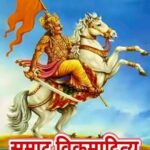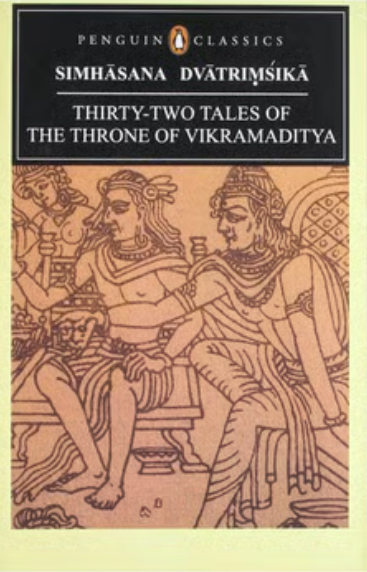
It is not possible to properly do justice to the memory and legacy of Emperor Vikramaditya without recounting what is possibly his most famous, and most indirect, literary contribution. Known to most as Singhasan Battisi or 32 Tales of Vikramaditya’s throne, the original (and correct) title is in Sanskrit: Simhasana Dvatrimsika.
Introduction
Perhaps no royal literature, outside of the Ramayana and the Mahabharata, has animated the minds of Bhaaratheeyas than the 32 Tales of Vikramaditya. Now shown beyond a shadow of a doubt to have been an historical figure, Paramaara Vikramaadhithya stands as the greatest Indian Emperor of the Kali Yuga. There were more chivalrous Rajputs like kshathriya shiromani Maharana Pratap, or greater Generals such as Shivaji Raje, or greater Geo-politicians, like Krishna Deva Raya, or even greater warrior-kings such as Rana Sanga, but no Emperor cast as wide a reach both imperially and imaginatively in the caste-riddled Hindu mind than Emperor Vikramaditya Parmar. No ruler showed that he could truly do it all as he did. Most pretenders today point to their 1 strong point, and say they should rule, but the question is, did you truly master it all like the King of Ujjain—that is the standard for who should run the show. That is why Vikramaditya was able convince even the proud Amshuvarman of Nepal, that he should join the Paramara Empire as associate-partner and tributary, marking the 57 BCE Vikrama Samvath (Saakas were defeated in 56 BCE).
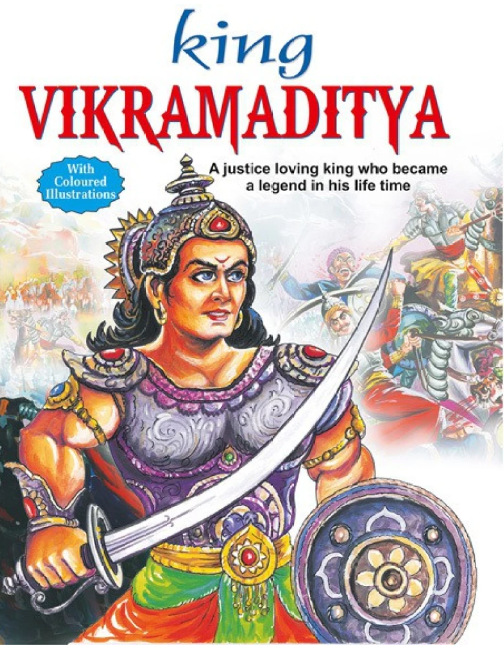
The Simhasana Dvatrimsika is his eternal place in the Kali Yuga canon as the King who not only cared for his subjects (by looking after them incognito) but who threw out foreign invaders. His Imperial Court stood above caste-and-creed, honouring both orthodox Braahmanas as well as heterodox Jains (despite the sins of 1 Jain against his father). This ability to simultaneously separate national and collective threats from individual conduct is what makes him not only Vikram-aditya (‘Sun of Valour’) but Vivek-aditya (‘Sun of Distinguishment’). In each of the stories of the Dvatrimsika, he shows not only his rote-recitation command of Saasthra & Sasthra, but also the ability to apply with tremendous nuance and subtlety, the deeper aspects of Dharma to non-cookie cutter situations. Setting aside Sri Krishna (of course), perhaps none since Yudhisthira and Bheeshma Pithamaha himself set such a standard of excellence.
He demonstrated in situ exactly why Raja, who was the Supreme Jurist and Final Arbiter in the land, as a kshathriya must not be a hot-blooded blockhead to be puppet-mastered by pseudo-sattvic svengalis, but rather a wise and insightful ruler with an ability to master not only theory, but also practice. That is why a pound of practice is worth a tonne of theory.
It should be mentioned that Bhartrhari of the famed Thrisathika (Collection of 300) is erroneously mentioned as half-brother of Vikramaditya. In actuality, he was the brother of Sriharsa Vikramaditya of 457 BCE fame. The brother of Paramaara Vikramaadhithya was named Sankaraaja, who ruled for 30 years while Gandharvasena did thapasya. When the former died, the father returned and ruled before 57 BCE Vikramaditya took the throne. From valorous Vikramaditya to stern Salivahana, the warrior-kings of the Paramara dynasty remain as fixtures not only in Rajput folklore but in Hindu history & heritage. The Simhaasana Dhvathrimsika is the embodiment of that.
Author
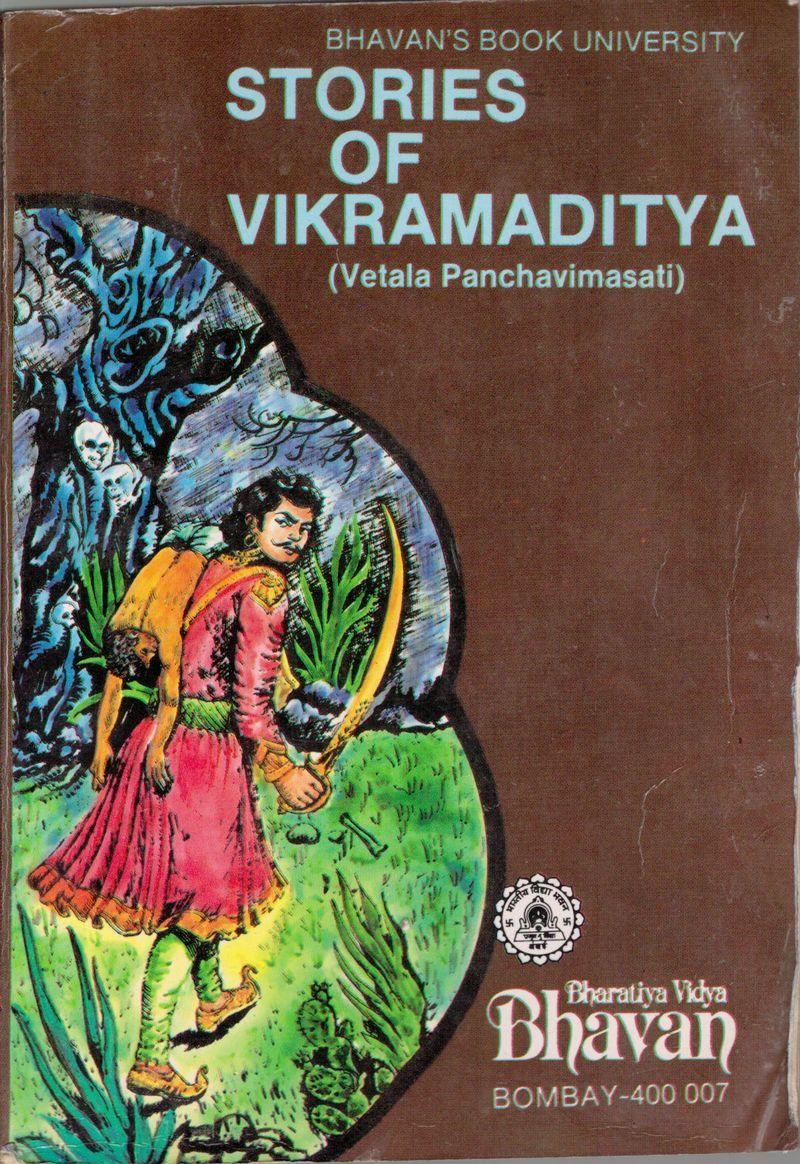
“Nothing is known about the author of the original Simhaasana Dvaatrimsika, and very little about the compilers or redactors of individual recensions. Some manuscripts of JR [Jain Recension] indicate in identical stanzas that it was rendered from an earlier Maharaashtri Praakrit version into Sanskrit by Kshemaankara Muni, separately identified as a Svetaambara Jaina teacher who also authored another work called Shatpurusha Charita. Some other JR manuscripts attribute authorship to Siddhasena Divaakara or Ramachandra Suri.” [1, xiv]
No author is incontestably attached to the Simhasansa Dvatrimsika. Part of the confusion is the result of countless works on this captivating figure.
“The numerous stories about Vikramaditya from a considerable literature in Sanskrit, from which some of them passed into other Indian languages. In turn at least one was rendered into Sanskrit from Maharashtri Prakrit. The Sanskrit works still extant date mostly from the medieval period. They include: the Maadhavaanala Katha of Aananda, about the adventures of two lovers eventually united with each other through the king’s chivalrous efforts, the Vikramodaya, in which he appears in the guise of a wise parrot; the Panchadanda Chhatra Prabandha, containing tales of magic and witchcraft; and the Vira Charitra of Ananta, which begins with Vikramaditya’s final war, and continues with his successors.” [1, x]
In conjunction with the JR are the BR (Bengali Recension) and SR (Southern Recension). This is of course on top of the numerous Jain works on the subject. Even more relevant, however, is that there is there is another famous collection of tales, which is the Vetala Panchavimsathi, or 25 Tales of the Ghoul. In some ways, it is the more compelling of the two. While the Dhvathrimsika centres around Apsaras (celestial nymphs), the latter is associated with a Vetala (ghoul). It is not for nothing that the ‘Sun of Valour’ (Vikramaadhithya) is also known as Sahasaanka (‘Marked by Courage’). [1]
Nevertheless, a number of authors are attributed to Simhasana Dvatrimsika. These include Kalidasa, Vararuchi, and Nandisvara. Some have turned to comparatively more recent works dating to the time of Bhoja of Dhaaranagara. Works mentioning this include the Chathurvarga Chinthaamani of Hemaadhri, the Rathi Rahasya of Kokkaka, the Sarva Dharsana Sangraha of Maadhava, and the Prabandha Chinthaamani of Merutunga. Collectively, these indicate a date of the 13th or 14th Centuries CE. [1, xv]
Composition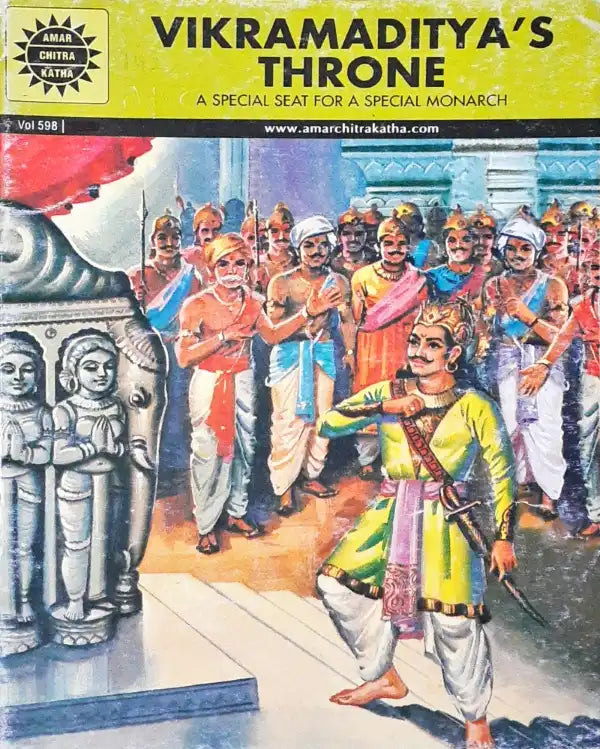
The Simhasana Dvatrimsika is an unique composition as it connects Paramaara Vikramaditya with his scion Paramaara Bhoja. Better known as Raj Bhoj, the latter is almost as celebrated as his antecedent in the mind of the average Hindu, to the point that he has spawned numerous maxims and aspirers like “Andhra Bhoja”. Not “just a king” as some conceited commentators have remarked, but a scholarly polymath, Bhoja Paramara was nevertheless inspired by the achievements of his ancestor.
Seen as an example of exemplum (nidharsana katha), it is a didactic work in the manner of the famed Panchatantra and Hitopadesa. Like the Vetala Panchavimsathi, it demonstrates the wisdom of Vikramaditya, tested in different situations.
Descriptive verses to illuminate lessons to the reader are sourced from Raamaayana, Mahabhaaratha, Garuda & Skandha Puraana, Abhijnanasakuntalam, Kumaara Sambhava, Maalavikaagnimithra, Sisupaalavadha, Amarusathakam, and Sringara-Niti-Vairagya Trisatakam. Elsewhere, particularly in the Southern Recension (SR), one will find the Arthasaasthra, Maadhavaanala Katha and Katha Rathnaakara as sources.
Manuscriptology
As mentioned above, there were 3 main recensions, the JR, the BR, and the SR. The codicology of the Dhvaathrimsika was most categorically compiled by American Sanskritist Franklin Edgerton. “In the course of his investigations Edgerton found the work titled variously in different manuscripts. The titles referred to the king, the throne, the divine statues, the number thirty-two, or a combination of these features. Some of the titles were: Simhaasana Dvaatrimsika, or Dvaatrimsatikaa; Dvaatrimsat Puttalikaa Aakhyaana (Thirty-two Statue Stories); Vikramaaditya Simhaasana Dvaatrimsikaa (Thirty-two Tales of the Throne of Vikramaditya); and Vikramaditya or Vikrama Charita (Deeds or Adventures of Vikrama). Edgerton chose the last of these arbitrarily as the title of his own work, as it was the shortest and simplest [standard American naming convention].” [1, xiii]
There is a fortuitous (or rather a not-so-fortuitous) coincidence between Dvatrimsika codicology and one of the most famous Colonial Era disasters.
“Edgerton’s own work utilized thirty-three manuscripts originating in different parts of India over a period of nearly four hundred years, if not longer. Another fourteen manuscripts sent from Bombay were lost in the shipwreck of the Titanic.” [1, xvi]
Nevertheless, it is not for nothing that the jnu brigade sought to pattern their beloved akbar after none other than Vikramaditya.
“The Simhaasana Dvaatrimsika is known to have been translated into Persian by order of the emperor Akbar in about 1574 AD. The Persian version as rendered into French in 1817, bringing the work to the West for the first time. It also exists in Siamese, Newari and Tibetan or Mongolian versions, as well as in adaptions in various Indian languages such as Bengali, Gujarati, Hindi, Tamil, and Telugu. The only translation so far from the original Sanskrit into English has been Edgerton’s literal rendering over eighty years ago” [1, xvii]
Selections
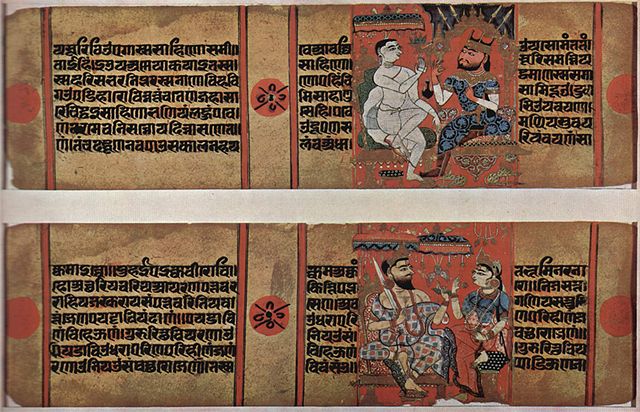
Given the variety of recensions from which to choose, selective selections promise to become a difficult proposition. Nevertheless, particular tales from the Simhaasana Dhvathrimsika stand out. We will attempt to do justice to this most illustrious of kings and this most illuminative of works on his life. It should be noted that it follows traditional metronymy and is classified as kavya in form.
We begin with the Prasthaavana (Prologue):
§
“Salutations to the great Ganesa, remover of dark obstacles, whose gaze is tender with limitless compassion.
Having done reverence to Vishnu the Primal Being, Brahma the Lotus-Born, Siva the Lord of Uma, and the blessed Sarasvati, I write of the deeds of Vikramaditya” [1, 3]
§
“Once Paramesvara, the Supreme Lord, was seated on the peak of Mount Kailaasa. Jagadambikaa, the Mother of the World, bowed to him and said: ‘Behold,
The wise pass their time in the pleasures of literature and the sciences. Others, who are fools, spend it in sleeping or quarrelling.
To pass the time in keeping with this maxim, tell a tale which will fill every mind with wonder.’
‘Listen, my beloved,’ Paramesvara replied, ‘I will tell a tale which will entrance every heart.’ [1,3]
§
‘Once upon a time thirty-two most marvelous tales were recounted before the estimable King Bhoja.’ [1,3] He was the repository of the most excellent royal glory. Related by the thirty-two statuettes supporting a throne of moonstone [chandhrakaantha] gems built by some god, these tales, extolled the virtues of the noble Vikramaditya.’ [1, 4]
§
“There is a city called Ujjayini. It lacked nothing: it was better even than Indra’s heaven. In it there reigned a king called Bhartrhari, who was versed in all the arts and skilled in every science. All the nobles and the lords paid him homage: the vermilion from the hair-partings of their wives reddened his feet. His own wife, Anangasenaa, was more beautiful and charming that the nymphs of heaven. He also had a younger brother named Vikramaditya whose valour was greater than that of all his enemies.” [1, 5]
§
“An old father or mother,
A faithful wife, and an infant son
Must be looked after, says Manu
Even if they do a hundred things wrong.” [1, 85]
§
“I was a Brahmin in this very town,” the demon replied. ‘But I lived always by accepting tainted gifts and conducting forbidden sacrifices. I was also arrogant about my learning, and used to slander all the old and senior hermits. Because of these sins I became a Brahmin demon” [1, 99]
§
“Gambling, meat eating, wine drinking, fornicating, hunting, theft, and adultery
Are seven very evil vices
Which intelligent people should eschew.
§
Moreover,
Yudhisthira was brought down by gambling,
The ogre Baka by eating meat,
Balaraama by drinking wine,
Indra by fornication,
King Brahmadatta by hunting,
Yayaati by theft
And the great ten-headed Raavana by adultery.
People can be ruined by even one of these vices.
Who will not be destroyed by all.” [1,156]
§
5 Sacred rites of Kings:
“Punishing the wicked;
Honouring the good;
Augmenting the treasury justly;
Impartiality among the petitioners;
And protection of the realm:
These five are called
as the king’s acts of worship”
§
“The rulers who hand over the burderns
Of government to their officials and go
Wandering where they please are as foolish
As the people who go to sleep after putting
Pots of milk before a horde of cats.” [1, 101]
§
“Who is there to control
A king turned libertine
An elephant gone berserk
And educated people
Engaged in villainy” [1, 25]
§
“The good wish for the happiness of all
They grieve deeply in the grief
Of others, abandoning their own
Desires for pleasure and enjoyment”…
“Animals too live just to fill their bellies.
That life alone is praiseworthy,
Which is lived for others.” [1,88]
§
Click here to Buy this Book!!!
References:
- Haksar, A.N.D. Simhasana Dvatrimsika. London: Penguin. 1998