After a Quarter-long hiatus from the topic, we return to Rajadharma. However, while the previous article centered around the spirit of republicanism (small ‘r’), this one will focus on the actual structures of republican governance, indeed, Government Typology itself.
One of the more interesting debates in the present time revolves around governmental typologies. Specifically, in an era where Constitutional Democracy has seemingly dominated global governmental forms, economic turbulence has caused many to question it. Is there a dharmic form of governance? Or is the dharma the spirit that determines the efficacy and justness of any form of governance?
To do this, necessitates a closer study of ancient, medieval, and modern typologies, with some minor reference to foreign forms as well.
Introduction
The modern Republic of India, that is, Bhaarath Ganaraajya, is a constitutional democratic republic. Dissatisfied with quota systems and reservations in education and the public sector, a vocal minority wants to turn the page back to past, arguably, without quite understanding it. Caught up in the rhetoric of Chanakya-Chandragupta, they haven’t read the correct history as taught by traditional pandiths, such as Kota Venkatachalam gaaru, to understand that Prime Ministers and Raajagurus cannot engage in proxy rule via puppet kings, via “guidance”. In fact, Bheeshma expressly condemns this and states that such false Acharyas may be destroyed by the king for such insubordination.
Authorities on Government
There is a long list of treatises not only on Rajadharma (Governance), but also on Systems of Government (Prabhuthva Vyavastha). Common names are of course Kautilya and Kamandaki, but also Kaunapadantha (Bheeshma) and Vaisampayana. Nyaayavaadins are lawyers of the past. Names such as Chandesvara, Mitramisra and Neelakantha are some of the few who have written on the topic.
The famed story from the republic of the Vrjjis in fact demonstrates in contrast to the erroneous touting of Uttaramerur, that Varnashrama Dharma had a very different notion of which should actually be the ruling class.
Terminology
- Prabhuthvam/Adhikarana—Government
- Raashtra—Polity/Nation
- Raajya Vyavastha—Monarchy
- Ganaraajya Vyavastha—Republicanism
- Jaanaraajya Vyavastha—Democracy
- Sacheeva varga/Adhikaari vyavastha—Bureaucracy
- Raaja Vamsa—Royal Dynasty
- Manthri Parishad—King’s Cabinet of Ministers
- Raaja Sabha—King’s Royal Court
- Raashtra Vidhatha—National Conclave. Governors.Nayakas
- Jaana Samithi—Popular Assembly. Official 1 at National Capital Region.
- Uthsanga/Apavarga—Gift
- Upahaara—Tribute
- Paaritoshika—Prize/Reward/Gratuity
- Puraskaara—Award
- Anujeevin—Dependent
- Padavee—Degree/Certification
- Unnathi—Rank
- Pravesha—Admission
- Kakshya—Class (i.e. class 1, class 2, inter, etc)
- Phalitaamsha—Result
- Prathishatam—Percentage
- Ankaah—Marks
- Utteerna—Pass
- Niyuktha—Office
- Unnathi—Rank
- Manthri—Minister
- Adhyaksha/Adheekshaka—Superintendent
- Sanchaalaka/Nirdhesaka—Director
- Mukhyaayuktha/Aayogin—Commissioner
- Mukhya/Adhikaarin—Warden
- Adhikaari—Official
- Aadheesa—Chief/Master
- 354 days=1 year of work
- Nirvaachaka—Elections
- Janagananaa—Census
- Janasankhya—Population
- Upeksha—Impartiality
- Saasana sanchaarin—Bailiff
- Salaaka-prathigraahin—Ballot Counter
- Salaaka—Ballot/Vote Tally
Government Types

As mentioned in our previous article, bigmouth bloviating dindutvavadis blather on about different topics (from “kshthreeya!” to “raashtreeya!” as they rule from “kendhreeya!“) without understanding meaning, pronunciation, or even spelling. What is known for sure, is that no matter what, Ancient India apparently had it all—and certainly, their caste did…
But serious commentators on Political Philosophy and Political Science known better. And the beginning of wisdom, after all, is calling things by their correct names. Some basic political science concepts must first be understood, not just to understand the past, but also the present:
India’s republican traditions have historically been deprecated by the English and their associates. The word ‘tribal’ and ‘oligarchy’ was frequently attached as though genuine republicanism could have only existed in “the west”. The typology historically provided by Aristotle, on the basis of Plato, was as follows:
- Monarchy vs Tyranny
- Aristocracy vs Oligarchy
- Democracy vs Ochlocracy
The former in each form of government devolved into the latter as corruption and decline in civic virtue set in. Democracy (termed ‘Polity’) could devolve into Ochlocracy (mob rule). For this reason, Plato is said to have remarked that the ideal government was under the Philosopher king. Interestingly, the idea of the Raajarshi is an ancient one and demonstrates how noble governance ideals were in ancient India.
If the republic did exist in ancient India, how is it differentiated from that of the West? The West (itself a synthetic concept that straddles Nordic and Mediterranean civilizations on the basis of Western Christianity) can rightfully claim credit for spawning Constitutionalism, Parliamentary Democracy, and Liberal Democracy—resulting in the following division:
- Military Republic
- Aristocratic Republic
- Democratic Republic
A military republic is a simple military junta that abolishes monarchy. Indeed, that is the simplest definition of a republic—a non-monarchical state governing on behalf of the people. Military juntas, constitutional or otherwise.
Aristocracies often had constitutions themselves, and ancient Indian republics had such Basic Law—the simplest definition of a constitution. While aristocrats would vote, the demos (people at large) did not. In fact, only the ruling caste (Kshathriyas), voted in the Assembly and decided policy. That was the nature of the Ancient Dharmic Republic.
Liberalism is an ideological theory and premise said to have originated with Spinoza, who sought to develop a theory of Ethics that transcended religious lines. It paved the road for universal suffrage in the present era, thereby making both the liberal democracy and the democratic-republic distinct Western legacies. Previous democracies did not have universal suffrage (ancient Athens) and frequently presided over large slave populations. In contrast, such chattel slavery did not exist among ancient Hindus, though the brahmin, vaisya, and sudra classes were deprived of suffrage in these republics.
- Sammucchaya—Collection
- Sammaithree—Alliance
- Sangharaajya—Confederation
- Sandhaana—Federation
- Samyuktha—Union/Unitary State
- Adhiraajya—Dictatorship
- Krooraraajya—Totalitarian State/Oppression
- Jaanavaadha—Populism
- Janathavaadha—Nationalism
- Raashtravaadha—Statism
Political realities, in contrast to Legitimate Government Typologies
Trading Bloc(vanika sangha), Customs Union (raashtra gana), Common Market (saamaanya aparga), Monetary Union (dhana samyuktha), Fiscal Union (kosaajna samyuktha)
Corporatism
1.usury governance 2.singularity 3.atomism 4.nonculture 5.mammon 6. Human resources
Neo-Colonialism
1.capital drain 2.human exploitation 3.anti-racist veneer 4. museum piece 5. religious replacement 6. trafficking
Colonialism:
1.pirate plunder 2.genocide 3.racist indoctrination 4. history erasure 5. teligious atrocities 6. human & drug trafficking
Imperialism:
1.tribute/taxation 2.civilian protection 3.shared humanity 4. truthful history 5. common virtue 6. non-displacement
Political Concepts
Feudalism: Political order based on enforced class differences/hierarchy of political rights
Tribalism: Loyalty or insularity stemming from supporting one’s own immediate clan/tribe.
Patriotism: Loyalty to one’s own country (patria) or political nation (polity)
Populism: Catering to mass needs & whims, and basic essentials a population might lack.
Nationalism: Favouritism or bias towards one’s own political nation disregarding right or wrong
Ethno-nationalism: Political favouritism or belief in ethnic politics as natural just order
Ethno-tribalism: Group solidarity with common & promotion of own ethnicity or ethnos.
Ethnicism: Bigotry towards other ethnicities (i.e. French, Mexican, Maori, Vietnamese)
Ethnism: Bigotry towards other ethnes (ethno-civilizations: i.e. semitic, teutonic, indic, sinic, bantu,).
Racism: Bigotry based on misguided belief in different human sub-species/races rather than 1 Human Race.
Xenophobia: Fear of strangers and extreme homophily bordering on bigotry.
Homophily: Preference for those with similar outward traits (i.e. ethnicity, religion, etc)
Marxism: Political theory of Karl Marxism exhorting Dictatorship of the Proletariat (Masses)
Cliocracy: Rule by Priests
Theocracy: Rule by the Divine (de factor Priest or God-King rule)
Aristocracy: Rule by the “Best” (i.e. Nobility/Martial class)
Kakistocracy: Rule by the “Worst” (i.e. Criminal or Uneducated)
Fascism: Hyper-nationalism, characterised by Fusion of Business & Government Interests)
Corporatocracy: Rule by Corporation (i.e.subtle achievement of Fascism by consultation)
Tyranny/Dictatorship: Capricious One Man rule by Diktat
Oligarchy: Rule by the Few (i.e. Elite or Mafia)
Ochlocracy: Mob Rule (Devolving of a Democracy)
Constitutionalism: Basic Law in an unorganised/organised Document determining legal government.
Rule of Law: Law by statute is legitimated by consent of the governed vs Chinese legalism
Rule of Justice/Virtue: Law finds legitimacy ultimately in principles of Justice or Dharma
Ancient Types of Government
- Democracy: Universal suffrage, all recognised citizens vote (direct democracy, i.e. Athens)
- Representative democracy: citizen vote for elected representatives (i.e.constitutional Monarchy)
- Republic: non-monarchical state (i.e. aristocratic, democratic, military junta)
- Aristocratic Republic: (Early Rome via Patricians)
- Democratic Republic: Late Roman Republic, USA
- Merchant Republic: Polity, typically City-State, governed by Merchants (Thalassocracy, i.e. Carthage)
Various forms of government, which had elements of ‘democracy’, ‘republic’, ‘self-governance’ existed in our land from ancient times – when western society was yet to be initiated into the civilization process.#Periyava #Hinduism
— Sage of Kanchi (@haraharasankara) June 5, 2019
History of Government Types
The key point in the quote above is elements. Bhaaratheeya Prabhuthvam had a preference for monarchy, but would periodically develop confederations (light government with constituent small kingdoms), republics (non-monarchies governed by an aristocratic assembly), and town/village democracies (i.e. panchayaths). These town and city level assemblies were usually for the benefit of corporations (nigamas/pugas). The city-state democracy (polis), which governed as Imperial state like Athens, appears to have been absent in India, as did the concept of democratic-republic (which the later Roman Republic & British Cromwellian Parliament) established. Notably, the former maintained a Tribune of the Plebs, with an assembly distinct from the Patrician Senate. Indeed, Indic Republics were decidedly Patrician, or more specifically, Aristocratic.
“The Kasika (an authoritative commentary on the Asthadhyayi) makes clear that the rajanyas or leaders of the ksatriya families were consecrated to rulership. It appears that all the members of a samgha were not entitled to exercise political power which was the privilege of only the governing class. The head of each ksatriya family bearing the title raja represented his kula in the samgha assembly. The republics consisted of other castes besides the ruling ksatriya caste, but the political sovereignty was in the hands of the dominant ksatriya clan” [10,3-4]
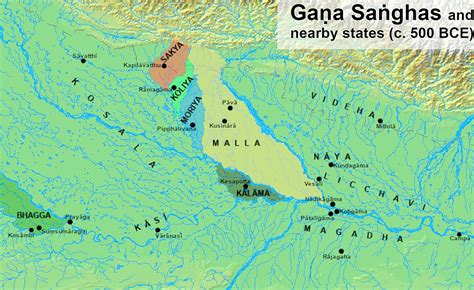
The most famous confederation almost tritely referenced is that of the Vrjjis (Vajjis, in Paali). The constituents included the Sakyas, the Koliyas, and the Vidhehas, among 7707 knights-raaja. Interestingly, the precursor is in fact traced to Vidheha. In a tale similar to that of Tarquinius Superbus, the last king of Videha (of Janaka fame) was driven out for his tyranny and oppression. As a result, the kshathriyas of the kingdom constituted themselves as a republic.
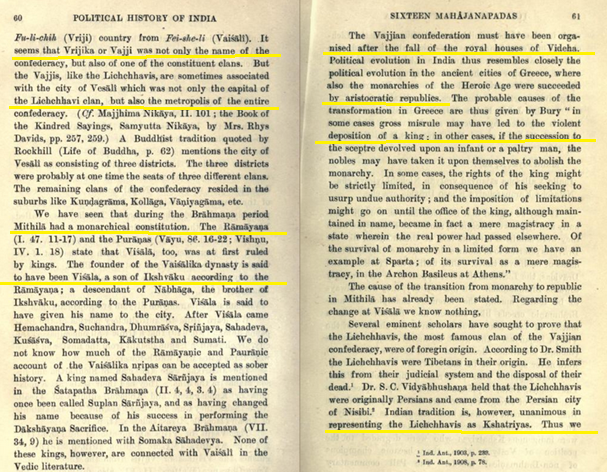
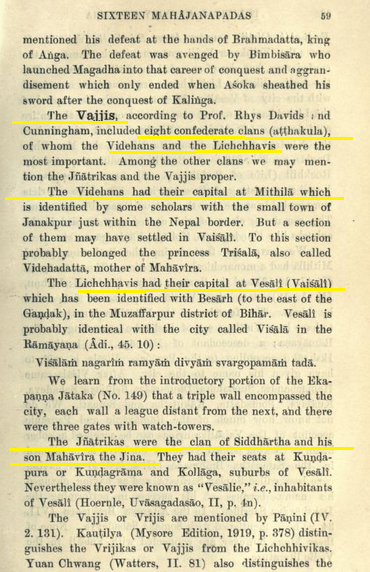
Beyond the Sakyas, Vrijjis, Videhas, and Licchhavis, other republican societies included the Koliyas, Mallas, Moriyas (of Pippaleevana), the Bhulis, the Bhargas, the Kshudrakas, the Arjunaayas, and the Yaudheyas. The Sakya council was composed of 500 members, and they were said to have had a law where each citizen could have only 1 wife. [9, 43]
“The Political history of the Lichchhavis is too well known to be repeated here. They were very powerful. They sur-vived the Saisunaaga and the Maurya empires and helped in building up the Gupta empire. They founded a curious const-itution in Nepal” [9, 50]
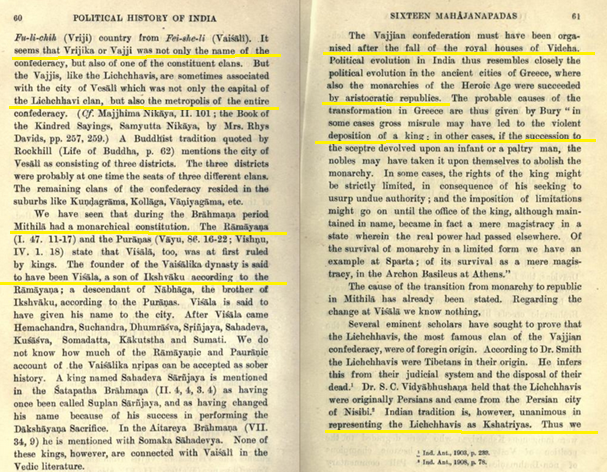
Other republican peoples include the Surashtras and Kambhojas (a Sanskrit speaking people with some Persian influence). [9, 52] There is also an unnamed republic that is thought to be the Yaudheyas, that distinguished itself in the final centuries BCE. “It was from the doors of the unnamed republic that the campaign of Alexander assumed the form of retreat.” [9, 58]
Within a civilization (Bhaarathavarsha), one may find nations (Bhaaratha, Sinhala, Yavana, Kiraata), states (Bhaarata Raashtra, Nepaala Raashtra, etc), republics (Bhaaratha Ganaraajya), provinces (Kerala, Odisha, Andhra), and tribes (Saka, Gond, Chenchu). Jana refers to individual, ergo Janaah refers to different people, and Janatha refers to a specific people group known as nation. These different Visaah (tribes) still constituted part of the Bharathaja/Vaidikaarya ethnic-nation.
There have been many visaah (tribes) that were distinct from the Bhaaratheeya/Aarya Janaah (Indian Nation). Sakas were among the most famous. Others, such as the Ahoms eponymously renamed ancient provinces such as Kaamaroopa (Assam). Some tribes (chenchu) are liminal to the Indian nation (sometimes in/sometimes out), while others are clearly peripheral (Baloch). Jats, who assimilated, are more inside than out, while Dards are more outside than in.
Kautilya describes 2 main types of oligarchic forms: raajasabdopajeevin samghas and sastropajeevin samghas. The first was a confederation and included Licchavikas, Vrjika, Malla, Madra, Kukura, Kuru and Paanchaalas, all of whom elected a raaja. The second class referred to mercenary companies of ayudheeya ksathriyas who sold their services for gold. Included in these Ayudhajeevi samghas by Panini were the Vrka, Daamani, Trigartha Sasttha, Yaudheyas, and Paarsavas. [10,6]
It should be noted that many of the Yavana-Bhaaratheeyas (i.e. Kambhojas & Gandhaaras) often organised themselves into Aayudhajeevi-samghas, i.e confederations of mercenary warriors. For this reason they are often mentioned in the ranks of Persian armies, having lived the life of sell-swords. However, rather than legitimising Aryan Invasion Theory, it actually does the opposite. The Vedas and Puraanas condemn Bhaaratheeyas who drifted from “Arya Dharma” and excommunicated/out-casted them. This is the actual origination of the term Dasa.
“The Dasas of the Rgveda are often identified with the Dahae of Iran. Dahya, which meant country or countryside in ancient Iranian, was probably a tribal name in origin and is the Iranian equivalent of Sanskrit Dasyu.” [8, 63]
This is underscored elsewhere:
“Dr. A.D. Pusalker, however, thinks that the Dasyus did not constitute a distinct people and their difference with the Vedic Aryans was mainly in matters of religion. The Dasyus were called rite-less (akarman), indifferent to gods (adevayu), not recognising Brahman (a-Brahman), not sacrificing (ayajvaanah), lawless ((a-vrata), following strange ordinances (anyavrate) and reviling the gods (devapeeyu]). They are also called anyadevaah] (having different gods) and sisnadevaah].” [8, 64]
No doubt, political decline leads to corruption of law and political institutions, ultimately fomenting tyranny. Nevertheless, the actual political condition of dasas should be clarified:
“The daasas in India were not slaves as in Greece or Rome with no rights of any kind whatsoever. They could hold and transfer property, and regain their freedom by right under certain condi-tions.” [8,265]
Arrian on slavery
“’All the Indias are free, and not one of them is a slave.” [4, 111]
“The Indians do not even use aliens as slaves, and much less a countryman of their own.”[4, 112]
As stated previously, republics offer a sense of self-government that is not as apparent in the monarchies or even confederations of the past, leave aside the current cliocratic-corporatocracies of the present. That is the point of Sahakarana Dharma.
The concept of equality (samatha) and equal citizens coming together in the interest of self-government requires a sense of civic duty and civic spirit, not to mention civic sense, lacking in the present. The concept of material rigid equality was not a principle of our past, but it was a spiritual principle that even the Buddha pushed (as did great saints like Annamacharya), who preached that the end is the same for all Souls, who are in that sense equal. It is from this spiritual principle that the greed and lust that drive exploitation of fellow citizens or just fellow human beings can be expelled. When this is achieved at a local level, then steadily, the constituent-units of a republic (be it presidential or parliamentary) can be achieved via confederalism or federalism.
Subsidiarity

One of our articles specifically delved into the concept of subsidiarity. Whatever the specific system of government, there was a notion that rather than Unitary Government (UK), or even Federal Government (US), there could be a devolution of power that allowed local, county, and provincial systems to autonomously function within whatever state.
As R.C.Majumdar wrote, “It should be remembered that Kautilya wrote a practical hand-book for the guidance of statesmen and not a general text-book on political science“. Without political philosophy, without Rajadharma, Arthasastra becomes a mere guidebook for goondas. It is the spirit of Rajadharma that ennobles it, and interweaves Good Governance with Practical Administration.
“A further constitutional development is indicated by a passage in the Mahabharata, according to which 4 Brahmanas, 3 Kshatriyas, 21 Vaisyas, 3 Soodras,and 1 Soota formed the State council.” [4, 143]
“The king was the supreme head of the executive, judicial, and military branches of administration. Sometimes the kings were elected by the people, though hereditary kingship became gradually the established practice.” [4, 145]
Even with a monarchical or imperial set-up, one might find such subsidiarity functioning.
Vishayapathis during the Gupta Empire “were assisted by a Board of Advisers constituting of four members representing the various important interests”. [4, 415] They formed the Adhishtthaana-adhikarana. These were as follows: Nagara-Sreshtin (Guild-President), Saarthavaaha (chief merchant/caravan leader), Prathama-kulika (chief artisan), and the Prathama-Kaayastha (chief scribe). [4, 415]
At the village level, there was the Ashtakula adhikarana, which included Kutumbins (householders).
At the top-most level, above Saasana sanchaarin—Bailiff or Sheriff, we find a number of positions more appropriate for central governance.
- Ganastha—Gana Commander
- Pramaathri—Surveyor
- Antharanga—Royal Physician
- Saasayitha—Royal Charter Executor
- Thairthika—Chief Ford crosser
- Rahasyadhikrtha—Chief of Secret Police
- Thantrapaala—Royal Representative to Feudatory
- Dhvaarapaala—Protector of Passes
In line with the devolution of power—better termed decentralisation—village council functioned almost autonomously of central governments, which periodically changed. Other than the 1/6th share of revenue due to state collectors as well as charges involving capital punishment, the village was typically left alone. “It had exten-sive judicial powers and tried all cases, except serious crimes, arising within the boundary of the village. It was a trustee for public charities of all kinds, and received deposits of money, land, and paddy, on condition to provide, out of their interest, the things stipulated by the donors.” [4, 420]
Tolls could be levied for specified public works. “The provision of drinking water and proper mainten-ance of garden, irrigation, and means of communication deman-ded special care of the village corporations. During famine and scarcity the village corporations helped the poor people to tide over their difficulties.” [4, 421]
Today, village government is unfortunately translated as corporation, which has lent credence to various theories of mercantile capture of government. Here, one finds these panchayaths functioning more in the civic sense.
“The village corporations fully realised their responsibility for maintaining temples and other local institutions.” [4, 422] “They were, however, responsible for the payment of taxed due from the village, and we have an instance on record where the members of a Village Assembly were arrested and imprisoned for the unpaid balance of revenue. The royal officers supervised their accounts from time to time and they were liable to fine for dereliction of duty.” [4,422]
Contrary to the “Free the Temples” brigade today demanding “dhaarmeek rule!”, Temple governance necessitated oversight by royal governance.
“In one case the corporation was actually fined by the king on the complaint brought by the temple authorities that it was mis-appropriating part of the revenues assigned to them. On the other hand, the corporation could bring to the notice of the king any misdoings of the servants of any temple within the area of the village. Some of the regulations passed by the corporation required sanction of the king. On the other hand any royal charter affecting the status of a village had to be sent for approval to the Village Assembly before it was registered and sent to the Record Office.” [4,423]
One in fact finds the charge of many laypeople that temple fund misappropriation has an ancient history, wherein hundika funds were used (no doubt by Yavana Pandiths who captured Vedic temple governance) as investment banks and hedge funds of the era. This behaviour would have been in clear violation of varnashrama dharma.
This basic unit of the polity, be it the village or town, can be seen as the precursor not just for a monarchy but also for a peculiar type of republic, called the guardianate republic. For now, however, we will focus on the institutions of monarchy, which also had some populist features.
“But there were corporate organizations of areas larger than a district. An inscription of Rajaraja Chola refers to the ‘Great Assembly of twelve districts’” [4,426]
Raajya Vyvavastha
Monarchy
“The word Raajan and its origin Raat literally mean a ruler…King is called Raajaa because his duty is ‘to please’ (ranj) the people by maintaining a good government.” [9,183]
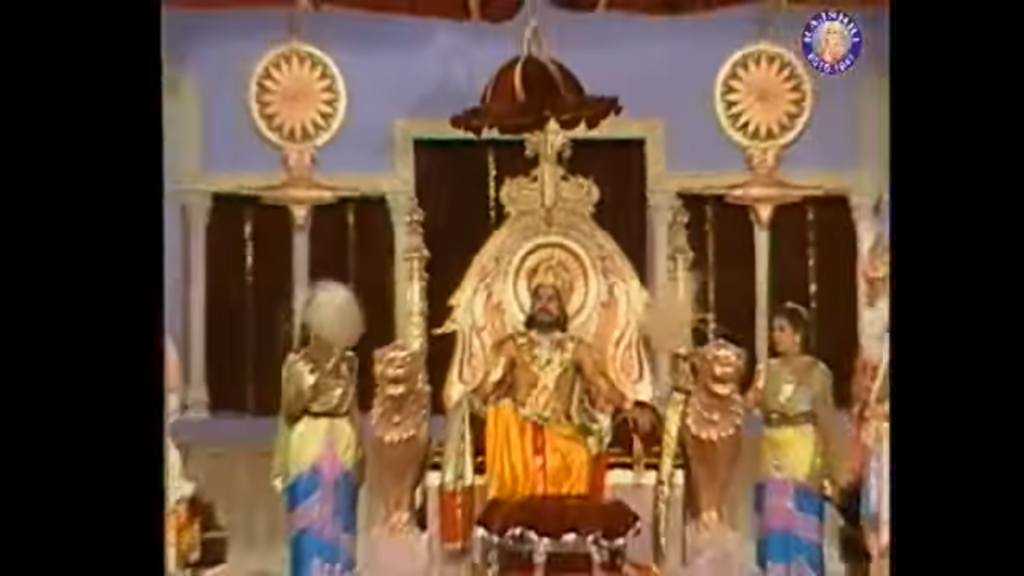
The most basic form of government has been Monarchy. Nevertheless, Dharmic Monarchy was not simplistic Divine Right of Kings nor was it a cliocracy. In the Indic state, Dharma was Supreme, and the King tasked to uphold it. He was the commander of all the varnas, and the undisputed head-of-state and head-of-government. As a kshathriya, he was expected to be educated in administration and trained in war. Though elevated above brahmanas, the Raaja was expected to individually respect and protect them, and to seek their counsel (particularly on dharma) as a body. All dharmas, even that of the raashtra, are subordinate to and under the auspices of Rajadharma.
The notion of an elected Kingship is not alien to India. Indeed, the most recent Imperial Example was the Pala Empire of Bengal, which elected a Soodhra as King/Emperor.
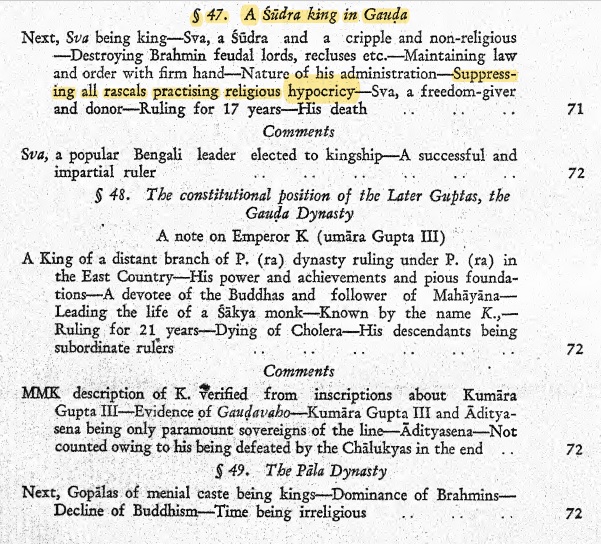
“Megasthenes notes that after Svayambhoo, Buddha and Kratu, the succession was generally hereditary but that ‘when a failure of heirs occurred in the royal house, the Indians elected their sovereign on the principle of merit.” [9, 185]
Indeed, there was a populist angle to the elevation of kings. This was often institutionally ingrained so as to manage the issue of vacant thrones.
“The king was elected by the people assembled in the Samitee. The people assembled are said to elect him according to rulership unanimously. The Samitee appoints him. He is asked to hold the state. It is hoped that he would not fall from his office. He is expected to crush the enemies.” [9, 186]
“According to the last verse of a hymn in the Rig-Veda corres-ponding to the song of election quoted above, he becomes the sole taker of taxes from the people; he becomes the king of the people. The ‘sole taker’ signifies that the regular tax, as a royal due, had already developed. No one else but the king alone was entitled to it. The king is asked to ascend a raised seat which is signi-ficantly described as the highest point of the body of state. It shows the idea of state as organism is realised as early as the Vedic kingship.” [9, 188]
“The king thus accepted his royal authority for the whole folk including equally the king-makers and the artisans. The king as elected for his whole life.” [9, 189]
However, a wise king abdicated before he entered the twilight of his life. He should descend from the throne (unless the kingdom is in peril and needs him) in the last fourth of his life and enter vanaprastha.
“In the Srutis there are three ceremonies for consecrating heads of society. There is the first and foremost, the Raajasooya, or the inaugura-tion of a king, there is secondly, the Vaajapeya used for, consecrating a king or a high functionary as the royal priest, and thirdly, there is the Sarva-medha, ‘a sacrifice for universal rule‘.” [9, 192]
“The King-elect himself as representing the Kshatra or ‘rule’; in the Taittireeya we have ‘Raajanya’ in the place of the king-elect.” [9, 193]
The concept of the Raaja Rathnin (King’s Gems) is also of importance. When the throne was vacant or when there was a crisis of kingdom, they would be assembled. Among the Ratnin is the Sudra Courier: “Paalaagala (the Courier). His uniform was a red turban and leather quivers. He was of the Soodra caste. In his place the Maitraayanee Samhita of the Yajur-Veda gives the Taksha and Rathakaara, carpenter and chariot-builder.” [9, 196]
“The same principle of completing the spiritual self of the king-elect is extended by other schools of the Yajur-Veda who make the king-elect do worship also to his other wives of lower castes, Vaavaataa and Parivrikti. In the Ashvamedha ceremony even the wife of the lower Soodra caste (Paalaagata) takes part.” [9, 194]
“Coronation Oath, as given in the Aitareya Braahmana is in these terms:
“It was administered to the Ruler (Kshatriya) whatever the form of polity, whether he was desirous of being consecrated to Saamraajya, Bhaujya, Svaaraajya, Vairaajya, Paaramesthya, Raajya, Maahaaraajya Aadhipatya, or Saarva-Bhauma” [9, 203]
The various titles in the monarchical hierarchy are also apparent above.
“A point of the greatest constitutional import is that the king is to be protected by the four estates of the realm. Protected by the people (in his office) he is to carry on the administra-tion. This principle was one of the accepted axioms of Hindu politics; raashtrena raaja vyasane parirakshyastathaa bhavet.” [9, 203]
“In the Aitareya Braahmana, however, the Brahmin is fully subordinate to the king” [kp. 205]
Teleology is also of importance here. Rather than the people existing for the state (statism, i.e. neologism “rashtr dharm!”), the state exists for the people.
“The purpose for which ‘the State is given’ is defined, ‘for culture, well-being, prosperity, development’ and is generally summed up in the express; ‘for the weal’; as the Commenta-tor explains (saadhave tvaa). It is not a gift; it is a trust, and a trust made sacred by the most sacred rites.” [9, 208]
Also contradicted are today’s “der faderland” advocates who seem intent on responding to feminism and gynocracy with “brahminical patriarchy!“. But the feminine view of the Motherland is clear.
Satapatha Brahmana: “The original manthra begins with salutations to the ‘Mother Land” [namo maathre prthivyai namo maathre prthivyaa…] and she is pointed out to the king-elect as the State or Sovereignty. The modern editions of the Sathapatha give the words saadhave tvaa after poshaaya tvaa with an intervening iti.” [9, 208]
Prthivi maatharmaa maa hi seermaa aham tvaam |
‘Mother Prithivee, injure me not, nor I thee.” [9, 209]
Interestingly, the term moordabhishikta was applied by Svayambhuva Manu to the sons of Brahmins by Kshathriya mothers.
“a king to be a legal sovereign must receive his royal conse-cration. The Puranas called foreign barbarians of the sixth century ‘naiva-moordhaabhishiktaas-te,’ ‘unconsecrated heads.’ i.e., ‘usurpers'” [9, 223]
Here again, the true nature of varnashrama dharma is again apparent.
“The reason why the sceptre of Hindu sovereign never became the wand of magician, was that the matter of constitutional powers of the king, in fact, lay beyond the province of the ritualist and the priest. It lay in the hands of those ‘through whose strength’ the king had become ‘might’ or vested with the power.” [9, 228]
“The Jaatakas are full of the ideal of an all-India Empire (Sakala-Jambudveepe eka-rajjam).” [9, 230]
“Jaanapada yet has another synonym in Raashtra, which is found in later works. In the Dasakumaara-charita (Ch.3) the president of the Jaanapada is called Janapada-mahattara (Lord High President). Further on, the same person is called the Raashtra-mukhya or the Leader of the Realm (Assembly).” [9, 235]
It should be noted that Janapaadha and Raashtra are 2 distinct concepts. Janapaadha refers to the organic constitution of people and country (i.e. Mahajanapaadha), whereas Raashtra refers to inorganic or artificially and even arbitrarily constituted political state or polity.
“It was perfectly un-derstood that all ministers including the mantrinah served at the king’s pleasure, and the latter was not bound to accept their advice. The monarch indeed headed the sys-tem and was in full charge of the civilian administration, armed forces, and the legal system. All appeals for justice, from the lowest level of the village up through the hierarchy of officials, lay with the king.” [11, 75] “A very distinct appointment was that of kanta-kasodhaka (literally, ‘remover of thorns’), who could not only help eliminate bu-reaucratic bottlenecks in specific cases but also bring matters of importance or of severe neglect directly to the attention of the mantrinah or the king.” [11, 75]
As for governmental bodies, the most ancient was the Vis (tribe). It referred to a collective body of the heads of families, and the first Raajas were elected from here as Vispathi (tribal chieftain). This was a proto form of a body later known as the Samithi.
The Raashtra Vidhatha was the National Conclave. It was an Executive Assembly, consisting of the Military and Provincial heads of the Nation. Presided over by the King or his representative, membership was primarily Key military leadership, as well as Provincial governors, and often Military district Commanders. Due to the breadth of territory, these were only periodically called (i.e. Once a year) or in the wake of a national emergency, populated by representatives and named-proxies. These could be convened by the King. The Vamsa Vrddha or another official would be ideal to organise and oversee it.
The Jaana samithi was an assembly of state nationals of all four classes of society. The King would call together individual praja samithis, or they might form on their own. While the Raaja nominally presides over the Jaana samithi, the Raajadhaanipaala (Capital Mayor) should organise and oversee it.
Provincial Councils (Pradesa/Naadu Varga) and City Councils (Pauras) also existed. The functioned in microcosmal form serving as appendages to the executive leadership (i.e. Governor, Mayor, etc).
“The few councillors, who may themselves be ministers, are advisers at the highest levels of policy making. The ministers, who are not council-lors, are, primarily, the body of officials who execute these policies. It is worth mentioning here Dr. Kangle’s comment that this body was, by no means, ‘a Cabinet armed with powers to enforce its decision on the King.’” [2, 200]
“Every man shall be judged according to his ability to perform [a given task]. The king shall appoint as ministers, but not as councillors, all those judged to be fit [to hold ministerial office] and divide the work of the government among them, taking into account each one’s ability and the nature of the work assigned to him. {1.8.28-29}” [2, 200]
The various facets and institutions inherent in Dharmic Monarchy has been discussed in detail elsewhere. The inherent aspects of bureaucrats as public servants (rather than colonial lordships) is what had to be deprecated here (ICS and its successor IAS bring one to mind here).
Sangharaajya Vyavastha
Sanghas
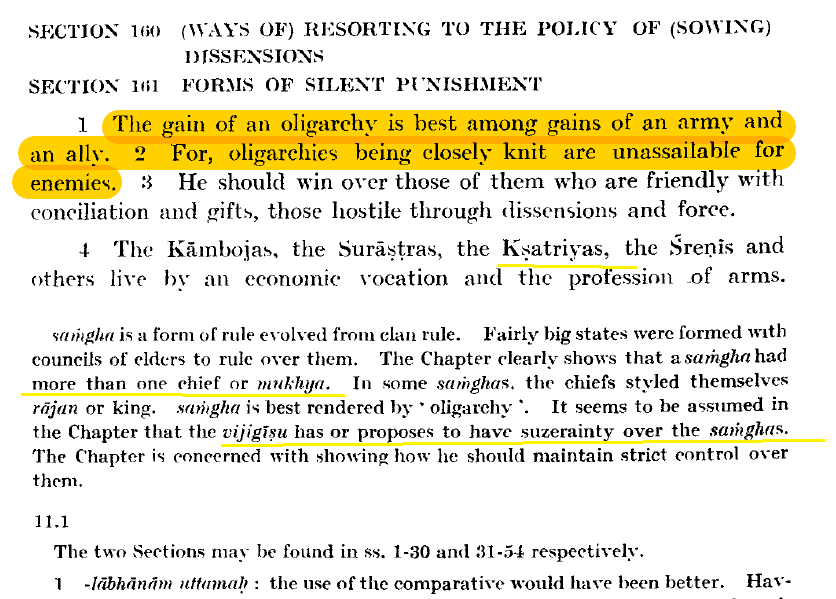
“The political thought represented in its Saantipar-van (Chap. 107) is, as distrinct from the one advocated in Kautalya’s Arthasaastra which favoured a strong monarchy, is evident in favour of the republican states which successfully functioned in the epic period in some of the parts of Punjab as also outside it. The states at this period, both monarchical and non-monarchical ones, the latter included the ganas (republics) and the samghas (confederate states), varied in size and in political importances.” [8, 183]
Dynasties existed in the ancient Confederations of India, known as Sanghas. In later periods, this was adapted into Bauddha Dharma as a religion governing body, known as the Buddhist Sangha. Interestingly, the proper term for republic is Ganaraajya, and the later Jains called their organisations Ganas.
Since ancient times, eminent Noble families had responsibilities beyond their own well-being and luxury. Indeed, with their wealth and influence came responsibility to govern the state, or at least contribute to its governance and administration. The whole wealth of the state did not belong to individual vamsas to plunder.
The Sakyamuni, better known as The Buddha, was born to a confederate people, Sakyas. An historical anecdote is illustrative of the efficacy of this form of government. When the King of Magadha sent his Chancellor to ask The Buddha whether it would be advisable to invade the Confederacy of the Vrijis (Vajjians), Licchhavis, and Videhas, the Enlightened One answered as follows:
- (1) “So long, Aananda, as the Vajjians hold full and frequent assemblies:
- (2) “So long as they meet together in concord and rise in concord and carry out Vajjian business in concord…
- (3) “So long as they enact nothing not already established, abrogate nothing that has been already enacted and act in accordance with the ancient institutions of the Vajjians, as established in former days:
- (4) “So long as they honour and esteem and revere and support the Vajji Elders, and hold it a point of duty to hearken to their words:
- (5) “So long as no women or girls belonging to them are detained among them by force or abduction (i.e., law and not force reigns):
- (6) “So long as they honour and esteem and revere and support the Vajjian Chaityas (sacred monuments)…
- (7) “So long as the rightful protection, defence and support shall be fully provided for the Arhants amongst them…
“So long may the Vajjians be expected not to decline but to prosper.”
Hearing this, the Chancellor murmured ‘the Vajjians cannot be overcome by the King of Magadha’. The only possible policy is to create disunion.” [9, 41]
Another notable confederate formation was that of the Kshudrakas & Mallas. According to the Roman Historian Curtius, “to lead the united army a brave warrior of the Kshudrakas was selected, and that he was an experienced general.” [9, 61] Therefore, generalship (something sorely lacking for most of the past millennium) was something that was emphasised. Kootaniti (strategy) is an essential part of not only ancient war, but a necessary aspect of Governance today.
The Mahabharata also makes reference to ‘kingless’ polities such as the Vrshnis.
“In the Mahabharata, the Andhaka rulers are called Bhojas, and a subdivision of the Yaadavas itself is latterly called Bhojas. The fact that the Vrishnis had no raajan in their constitution, is expressed in folklore and legend.” [9, 34]
“The Mahaabhaarata gives an ‘ancient’ discourse on the Andhaka-Vrishni Samgha. That they had no republican ‘raajan,’ is proved by their coin which, in the scripts of the first century B.C., is struck in the name of their Gana.” [9, 34]
“Raajanyas being leaders of families consecrated to rulership.” [9, 35] However, the correct term for the head of a confederacy or a gana would have been Mukhya or Ganastha, rather than Rajan.
“the Vrishni-Andhaka league had a join federal constitution where executive power was vested in two raajanyas, with their respective vargas, representing each division; and this was probably the Raajanyaka of Amara. Kaatyaayana ment-ioning’ the Party (varga) of Akroora’ and the ‘Party of Vaasudeva,’ undoubtedly draws on old literature. Akroora was an Andhaka leader; and it seems that at one time he was one of the two presi-dents of the Federal Council. This explains Krishna’s saying in the Mahaabhaarata that he holds authority or Aisvarya to the extent of one-half only (ardhabhokta).” [9, 36]
The elective nature was limited to the Kshathriya class. Nevertheless, the political dynamic was obvious here.
“Changing dual groups—Vaasudeva and Ugrasena, Akroora and Vaasudeva, Sini and Vasudeva—suggest that the AndhakaRaajanya and the Vrishni Raajanya were elected rulers.” [9, 36]
The official nature of this confederation proves that it was not an ad hoc alliance. Leave it to a grammarian to elucidate on the matter.
“Paanini implies by his rule IV.3.127 that a Samgha had its anka and lakshana. Anka means a mark, and lakshana also has a similar significance. I propose to idnentify this ‘lakshana’ of Paanini with the ‘laanchana’ or heraldic crest of later Sanskrit.” [9, 37]
“We have the term Raajaanka, in Kautilya, with which the bulls of the royal stable were marked or branded.” [9, 37]
“Kautilya divides Samghas, as we have already seen, into two classes. One of them was the class whose Consuls bore the title of Raajaa or ‘king’. As he contrasts them with the other class, he implies that the latter had no provision for this title and did not allow it. Such constitutions are known to have existed from the evidence of coins. Amongst the former class whose rulers bore the title, Kautilya enumbers: –
(1) the Lichchhavikas, (2) the Vrijikas, (3) the Mallakas, (4) the Madrakas, (5) the Kukaras, (6) the Kurus, (7) the Paanchaalas, and ‘others.” [9, 49]
Historian R.C.Majumdar, who had a rather contentious exchange of letters with Pandith Chelam, provides a description of the Licchavi Conglomeration.
“It appears that the whole State was divided into a number of small administrative units, each of which was a State in miniature by itself, and possessed a complete machinery for carryong on the local administration. The business of the State as a whole was entrusted to an assembly consisting of the heads of those administrative units, under the guidance of Chief or President elected for a definite period. In case the assembly was a large one, an Executive Council was chosen from amongst its members. The resemblance of this form of Government with the Celisthenian constitution of Athens is obvious and need not be dilated upon.” [4,157]
Though not a Parliament in the true sense, it nevertheless was an Assembly in its own right.
“The [Lichchhavi] assembly consisted of both old and young men, and met in a hall called Santhaagaara.” [4, 157]
The influence on the later Buddhist Sangha is unmistakeable.
“There are grounds for believing that the Buddha modeled the democratic organization of his Church on the constitution of the Lichchhavis” [4, 157]
There remains some question as to whether their Framework can be termed a constitution. Today Constitutional Republic means specific things. While that modern form might be better termed Civic Republic, there is no doubt that this “constitution” can nevertheless be considered a Basic Law.
“Buddha was also impressed with the inherent strength of the Lichchhavi consti-tution. For when Ajatasatru, bent upon conquering the Lich-chhavis, sent his ministers to him for advice, he replied that the Licchhavis were invincible so long as their constitution remained unimpraired.” [4, 157]
They are nonetheless praised for their confederal tribunals and commitment to justice.
“We possess some information regarding the method in which justice was administered among the Lichchhavis. The system is chiefly remarkable for the ultra-democratic spirit which characterises it, and is calculated to give us some isnight into the principles of administration followed in these non-monarchical States. We learn from an old text that a criminal was at first sent for trial to a class of officers called Vinichchaya Mahamatta. If they found the accused innocent they acquitted him, but if he was guilty in their opinion, the could not punish him, but had to send him on to the next higher tribunal. The man had thus to pass through six judges, each of whom could acquit him, if he found him innocent, but had to send him on to the next higher tribunal if he appeared guilty in his eyes. The last tribunal was that of the President, alone had the right to convict the accused, and in awarding punishment he was guided by the Paveni Pustaka i.e. the book containing law and previous legal decisions. The position of the individual was thus safeguarded in a manner that has probably few parallels in the world. He could be punished only if seven successive tribunals had” found him guilty [4]
RC Majumdar had his own theories of how Bhaarathavarsha devolved from this proto-republicanism to later forms of feudal-cliotocratic casteism: “Slowly but steadily the Brahmanas managed to degrade the rest of the society to a state of marked inferiority and subordination. The Kshatriyas wielded royal authority and hence enjoyed some amount of social prestige, but this was counter-balanced by gradually restricting the rank and title of Kshatriyas to a microscopic minority’.” [4, 470]
Ganaraajya Vyavastha

Paropakaram Idam Sareeram’ which means, ‘life is meant for doing service to others!!’
Republics
“The so-called republics of ancient India were non-democratic republican states. They can be called republics because supreme political power vested not in a single king but in a college or group of people. They were non-democratic republics because supreme political authority veted not in the whole body of adult citizens but in that of a group of people who were failry numerous.”[8, 311]
The term Gana has historically and erroneously been associated with the word ‘tribe’. The mean was a deprecative to reduce the standing of the ancient republics of India. Much apologia is proferred to prevent obvious comparisons between Athenian democracy and the Roman republic, which Greek and Latin peoples themselves made. The pejorative term ‘tribal republic’ was appended so that the Republic of the Vidhehas and the Republic of the Yaudheyas would all be compared with Gaelic barbarians rather than Roman conquerors.
“The Yaudheyas, the Malavas and th Arjunayanas, among others, had democratic constitution and played important parts in Indian history.” [4, 159]
The reality is, republic and democratic forms of government precede the Mediterranean world by centuries. The post-dating of Magadha dynasties has hewn 1200 years from the Indic chronology at the behest of colonial scholars—who sweat beads at the thought of being on a ‘civilising mission’ of those whose civilization preceded their own.
There also related concepts, such as dhvairaajya (rule by 2 kings), vairaajya (kinglessness), and araajaka (anarchy).
“Similarly, an ancient Jaina Prakrit text, the Acaramgasutra, refers to the kingless states, republic states (gana-ra[a]yam), states with two kings, and states in which the two were fighting with each other.” [8, 311]
So what that then is a republic? The word originates from the latin phrase ‘res publica’, meaning ‘the thing of the public’. It is governance of the public, in the interest of the public, by the representatives of public. These representatives may be elected or they may be hereditary, but a true republic governs in the interest of the general public. Now, it is known that the representatives if hereditary are aristocracts, like the patricians of Rome. The patrician class may in turn elect members to different positions. When Rome faced its most dire threat from the Volscians—it made provision for the plebeians to establish its own representative body for the ‘tribes’ headed by a ‘tribune’.
However, it was empire and its lopsided wealth which ultimately corrupted the Roman republic. Democracies excel at local government, republics excel at medium government, but large government is headed best at the top by a monarch. This is why the classical Greeks believed a philosopher king to be the best form of governance, but since that was a rare occurrence, an aristocracy was the best realistic option.
“They did not have democratic characteristics in full measure; they had not established the practice of universal franchise, for instance. But their rulers, the oligarchs and aristocrats were, like those of the Roman Republic, fairly numerous. The political authority in the Yaudheya gana in the central Punjab, for instance, seem to have been vested in the hands of a few hundred skilled warriors.” [8, 311]
The first Republic is ultimately traced to the city of Vaisali. It owes its origin to the Ikshvaku Suryavanshi Visala.
“The Jaataka says that the government was located in the city of Vaisaali which had a system of triple fortification. The rule (rajjam) vested in the inhabitants (vasantaanam), 7707 in number all of whom were entitled to rule (raajoonam, ‘kings’). “[9, 45]
“The Pali texts record that in Licchavi Samgha, that is the Republic of Vaisali, there were 7707 ‘kings’. “ [8, 312]
This military quality to republics, be they aristocratic or otherwise, is unignorable.
“Most of the gana states in the Punjab were ruled over by ksatriyas who were professional warriors.”[8, 312]
“It seems that the republicans consciously paid attention to physical culture. This the Saubhootas and the Kathas even enforced by the laws of their constitutions.” [9, 74]
Therefore, republics are generally governed either by aristocracies, or if they become corrupt, oligarchies. Military oligarchies maintain a dictator to lead them, even while declaring themselves a republic. Not every non-monarchy is necessarily a republic. When corruption becomes so great they don’t even make a pretence to governing in the public interest, they become kleptocracies. Carthage was once such former trading republic which devolved into kleptocracy. Contrary to popular opinion, it wasn’t generalship or superior military systems which made the ultimate difference, but the public spirit of the Roman republic which led to Carthaginian defeat and subjugation after the 3 Punic Wars. Public spiritedness, therefore, is the primary characteristic of a proper republic.
Pure democracies are distinguished by principle that the people themselves, without representative, decide political matters by majority. In practice, this is done by a quorum. Given that direct democracy is rarely possible, representative democracy has become the principle by which this typology has best been implemented. True democracies had universal adult male suffrage. Constitutional Republics do not necessarily have elections. Constitutional Democratic-Republics elects representatives to govern the public and its business.
“The term ‘republic’ is often used for these bodies, and though it has been criticized by some authorities, it is quite legitimate if it is remembered that the ganas, or tribes, were not governed like the Republic of India by an assembly elected by universal suffrage. The Roman Republic was not a democracy, but it was a republic nevertheless, and the evidence shows that in some of these ancient Indian republic communities a large number of persons had some say in the government.” [5, 96]
“The most powerful non-monarchical state at this time was the Vrj-jian confederacy, of which the chief element was the tribe of the Liccha-vis, and which long resisted the great Ajatasatru…the Licchavis had no less than 7707 rajas, a term which must have
Covered all the heads of families of the tribe who were eligible to take part in the tribal assembly. Jaina sources tell of an inner council of thirty-six tribal chieftains con-trolling the affairs of the Licchavis, Mallas and allied tribes in their war with Ajatasatru. The whole confederation had a raja-in-chief, an executive head who, like the raja of the Sakya, seems to have held office for life and often passed on his office to his heir.” [5, 96-97]
“the main method being to sow dissensions between the leading tribesmen so that the tribal assembly loses its unaninimity and the tribe is divided against itself.” [5, 97]
A Ganaraajya, therefore, equates to a republic. Though they are known primarily through foreign accounts, some small Indic polities are known to have been limited democracies. Foreigners, notably Macedonian Greeks, attest to the republics as having constitutions. A constitution is a basic law that is the source of principles, which govern the polity. There are also constitutional monarchies. Though it is not known if there were constitutional monarchies in India, constitutional republics with elected political leaders did exist. Liberal democracy, presaged on the ideal of universal suffrage and cosmopolitanism, is a recent notion originating in the western political theory of liberalism, and only emerged in India starting from the colonial era and later.
Senate or Parlement or Moot-hall?
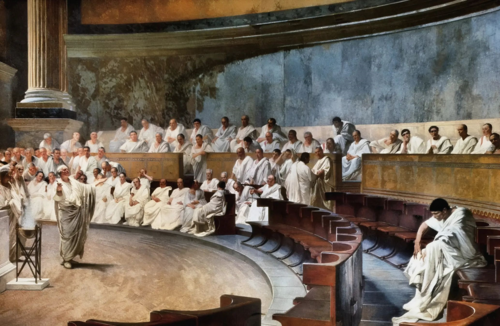
The Indic Republic has often been disparaged by outsiders, who eagerly dubbed it “tribal oligarchy”. But this is incorrect. A more apropos moniker would be Aristocratic Republic. It was by no means a Direct Democracy. Indeed, governance was restricted to the Kshathriya Aristocracy.
Rather than referring to it as a Parliament, the Santhagaara was dubbed a mere moot-hall. It is a term appropriate for tribal anglo-saxon chiefdoms perhaps, but not for mature Mahajanapaadhas which produced some of the most sophisticated philosophies in the world. The Santhagaara was akin to the monarchical Vidhatha. This national conclave was an executive assembly, akin to a Senate. It had its own rules of procedure too, which even the less rigid Samithi maintained:
“The word Samiti (sam + iti) means ‘meeting together,’ i.e., an assembly. The Samiti was the national assembly of the whole people or Visah; for we find the whole people’ or Samiti in the alternative electing and re-electing the Raajan or ‘King‘. [9, 12]
“In the Atharva-Veda, VI. 64, which is a prayer-hymn for union and concord, and also in the Rig-Veda (X.191.3) we have a prayer for a ‘common Samiti’ and ‘common policy of State’ (Samaano manthrah samitthih samaanee), a ‘common aim and a common mind’ (samaanam vratha saha vittameshaam). This indicates that matters of state (‘manthra’) were discussed in the Samiti. The King attended the Samiti, and it was thought necessary that he should do so. The Rig-Veda has ‘like a true king going to the Samiti’ (Raajaa na sathyah samitheeriyaanah). ” [9, 13]
“The Chhaandogya Upanishad, one of the youngest Vedic works, relating the visit of Svetaketu Aaruneya Gautama to the Samiti of the Panchaalas, mentions the King (Pravaahana Jaivala) as present in the Samiti.” [9, 13]
In the Jain Acharanga Sutra there are references to Dyarchy (II.3.1.10). “Do-Rajjaanee were states ruled by two rulers; similarly, Gana-Raajaani would be states where Gana or ‘numbers’ ruled. [9,22]
“Gana denoted a republic and that its interpretation as then current (‘tribe,’ by Fleet and others; ‘corporation of tradesmen or workmen,’ by Buhler) was wrong.” [9, 22]
Bauddha Dharma also makes reference to such formations: “The Buddha prescribed that the brethren should be counted on the Uposatha day by the system employed in a gana or by collecting voting tickets: –
‘I prescribe, O Bhikkhus, that you count (the Bhikkhus) on the day of Uposatha by the method of ganas (ganamaggena ganetum) or that you take the voting tickets (salaakaa).‘” [9, 22]
The Pali Canon also makes reference to ballot voting and organisation structure.
“In this connection, let us also take the term gana-pooraka of the Pali Canon. The gana-pooraka was an officer who saw whether the lawful quorum of the assembly was formed before it transacted official business. It literally means ‘the Completer of the Gana’. Gana thus was the assembly or parliament, so called because of the ‘number’ or ‘numbering’ of the members present. Gana-raajya, consequently, denoted government by assembly” [9, 23]
“The Majjhima Nikaaya (I.4.5.35) uses the terms samgha and gana side by side, taking them to mean, without the fear of the least confusion, the republics of the time of the Buddha: ‘imesom pi hi bho Gotama samghaaam ganaanam Seyatheedam Vajjinam Mallaanam‘”[9,23]
Elsewhere, elucidation between Kingship and Republican Chiefs or Presidents is apparent.
“Amarasimha, an author of the early Gupta time (very probably, under Chandra Gupta Vikramaaditya), explains in his lexicon the constitutional terms Raajaka and Raajanyaka as gana of kings and a gana of Kshatriyas (ordinary rulers) respectively.” [9, 26]
The Ganapaala was the leader of the Ganaraajya. Though often styled Raaja (or even Ganapathi), Ganapaala or Ganastha is the correct title for the chief executive officer tasked with the protection and leadership of the state. He was the embodiment of civic virtue that all citizens were expected to emulate.
Again, there is an unfortunate conflation of the term confederation with republic, part of the reason for which is that not all confederations had constitutent-kings, but were in fact confederations of constituent-republics.
“The names of republics actually mentioned by Kautilya fall into two groups; one devoted to economic pursuits and to fighting with weapons like the Kambhojas, Surashtra, Kshatriya-sreni…the others who used the title of raja, apparently for marking the status of the members of the executive body of the republic, such as Licchi-vika, Vrijjika, Mallaka, Madraka, Kukura, Kuru, Panchala, and others.” [6, 173]
Autonomy is not the same as sovereignty. Pastoral tribes such as Aabheeras & Kambhojas eventually settled to become castes/communities.
Political observer G.P. Singh provides a more comprehensive and less over-compensating reading of republicanism.
“K.P. Jayaswal has listed total eighty-two republics. But some are missing” [10, 83]
“The earliest description of the republics can be found in the Mahabharata.” [10, Xxii]
“There were different types of republics. In some republics states, the supreme power was vested in certain privileged members of the political community representing the nobility or aristocracy. The sovereign power was vested not in the populace in general but in the aristocratic leaders who were, of course, numerous. The members of the aristocratic class were undoubtedly very powerful, but they always worked together for the welfare of the state paying due regard to the general will of the people. The chiefs or heads of the ksatriya families bearing the title of the raja or their decendants called rajanyas were generally vested with the highest power or authority. They constituted the ruling class and met together in the General or central assembly.”[10, 2]
“Some states were governed by a body or class of nobles or members led by chiefs, kings or rajas. Such republics (as described above) may collectively be called either as aristocratic republics or aristocratic oligarchies or aristocractic democracies or oligarchical republics.” [10, 2]
“There were some states where the sovereignty was vested in the whole body of the citizens or whole community and their elected representatives, thus varying from most exclusive oligarchy to pure democracy. They had no king or monarch but some councillors.”[10, 2]
“Katyayana (ascribed to the fourth century BC), while commenting on Panini’s sutra (IV, 1, 168), informs that the ruling ksatriya tribes were governed by two-fold constitutions. Some were monarchies and others were samghas or republics. He takes samgha as a f[orm] of government district from ekaraja, where sovereignty was vested in one ekadhina) and not in the many as in the samgha (ganadhina).”[10,3]
Perhaps it is for this reason that there is much confusion between the terms gana & sangha.
“The popular terms, gana and samgha, appearing in some Sanskrit, Jain and Buddhist texts are two different manifestations of ancient Indian republics. The Mahabharata furnishes with valuable information in this regard. The disquisition in the text makes it clear that gana stands for the whole body politics, the entire political community, or a large number of people who managed the affairs of the state. The leaders of the ganas vested with power have also been referred to therein. The ganas generally formed samghas or confederacies. It is categorically stated that the safety of the ganas usually depended on a confederacy.” [10,3]
Whether it was the Sakya-Koliya or later Alexandrine era Kshudraka-Malla, this joining of ganas into sanghas made clear time and again.
“The noted gana states were that of the Licchavis, the Sakyas, the Mallas, the Yaudheyas and the Malavas. The states which joined a confederation or samgha were called samgha-rajya.”[10, 5]
Jaanaraajya Vyavastha

If the term Gana (group/agglomeration) is difficult to translate, Sangha is even more so, and democracy most of all. Panchanadha (Punjab) mentioned by Chanakya, provides some illustration here.
“The Ambashthas as a political community are mentioned by Patanjali and the Mahaabhaarata. The Puraanas say that Ambashtha of the House of Aila founded a dynasty in the Punjab.” [9, 63]
“The democracy of the Ambashthas had a Second House composed of elected elders. They elected their generals also. Apparently every man in the community had direct franchise, the Greeks calling the constitution a democracy.” [9, 69]
Irrespective of this controversy of whether Hindus had every governed themselves in lines similar to the Athenian polis, one finds more reliable and consistent evidence of democracy at the village level.
“The Assembly (Sabha or Mahasabha) was the supreme governing body of all these village corporations, and exercised full authority in all matter concerning the village. Its constitution differed in different localities and probably also at different times. In some cases it consisted of all the male adults of the village, in others it was a select body.” [4, 423]
“The number of men composing the Assembly varied. In one case it was 300, the total number of citizens being 400.” [4,423]
Governance models were clearly mature and comprehensive.“The following list of more important committees will indicate their nature and importance.
1.Great men elected for the year.
- Great men elected for charities.
- Great men elected for tank.
- Great men elected for gardens.
5 Great men elected for supervision of justice.
- Great men elected for gold supervision
- Great men elected for supervision of wards.
- Great men elected for supervision of fields.
- Great men elected for management of temples.
- Great men elected for the supervision of ascetics.” [4, 423-424]
This was not a simple manner of committee assignment, but had clear regulations for functioning and accountability. It was meant to be self-governance in the true sense.
“The elaborate rules laid down for the election of committees most strikingly illustrate the ultra-democratic character of these village corporations.” [4, 425]
“There was a regulation that only those who have not been on any of these committees for the last three years would be chosen. It was certainly calculated to give every villager a fair chance of serving on them and thus gaining the political training requisite for the responsible membership of the corporation to which he belonged. The method of electing members, carefully eliminating as it did all chances of corruption and personal influence, may be fairly compared with all that we know about the republican States of ancient and modern world.” [4,425]
Aristocratic Democracy
The more aristocratic formations nevertheless provide us with insight into the actual parliamentary procedures that were in place. Membership or the franchise clearly was based on certain sociological units. Domicile (nivaasa), place of origin (abhijana). [9, 100]
“Hindu literature calls such aristocratic element of Gana and Kula (literally, ‘family’). the Maha-bhaarata treats ‘the Kulas of raajaas’ as belonging to the class of ganas. The Artha-Saastra refers to the raaja-kulas, ‘ruling Kulas’ or ‘Kulas of Raajaas’ as being of the nature of Samghas (Samgha-dharmins.” [9, 72]
“Every free man in a Samgha was equal by-his birth and every family was equal, for political purposes. A passage in the Pali Canon also takes the Kula as the basis of franchise.” [9, 98]
“The Jaina Sootra also uses the form Mallak(i). The ‘Vrijikas’ included Vrijis and non-Vrijis owning a common Vriji allegiance, which would include people originally conquered by the Vrijis or people voluntarily amalgamated with the Vrijis. It is thus evident that the republics extended citizenship to outsiders. This will explain the enormous territorial growth of the Maalavas and the Yaudheyas who covered vast expanses of land in early and later centuries.” [9, 100]
Parliamentary Procedure
Voting, ballots, and ballot counting were concepts that were all clearly enunciated:
“Vote was called Chhanda. Chhanda literally means ‘wish’, ‘desire’. It connotes that in voting, a member was expressing his free will and voice.” [9, 90]
“If the Samgha adopted a resolution unanimously, the question of voting did not arise; but if a matter entailed a division in the opinion of the members, speeches were made and the Procedure-of-Majority was observed. The opinion of the greater number (bahutara) decided the matter. The procedure is called (Ye-bhuyyasikam in Paali. The Sanskrit restoration would be Ye-bhooya seeyakam, the ‘Those (who-were) -most-Procedure’). The voting was carried on with the help of voting-tickets which were coloured. The tickets were called Salaakaas or pins and the voting was called the pin-taking (salaakaagrahana). There was a Teller, ‘Salaakaagraahaka’ taker of pins (tickets) appointed by the whole Samgha who explained the significance of the colours, and took the vote either secretly or openly.” [9, 91]
Jaanaraajya
Inaccurately termed ‘loktantra’ today, democracy is more correctly termed jaanaraajya (public’s rule). It certainly existed in limited forms at the village level, and for certain important issues (electing the new King) at the provincial and central levels. However, as in ancient Athens, rule of the people did not mean every person had the vote. Votes were often exercised on behalf of a family (by householder, grhastha) or clan chief (kulapathi). These would then gather at the appropriately level.
Irrespective of whether it existed at the state or provincial level, it certainly existed at the village and even district level.
These formations, whether proper Jaanaraajyas or not, are described in detail by observers of southern village councils and assemblies.
“Whenever necessary, there was mutual consultation among these different assemblies and other local associations and the general rule was to consult all the interests concerned in a matter before a decision was taken on it. The village assembly regulated irrigation rights administered charitable endowments, maintained tanks and roads and managed the affairs of temples, either directly or by means of executive officers and committees working under it. It also made rules for regulating its own procedure. In the Deccan we come across many references to the mahajanas of villages who were in charge of the local administration under the leadership of gamundas (headmen). The royal officials stood in closer relations to the working of the village assemblies here than in the more autonomous townships of the Tamil country ”. [7, 149-150]
However, in tandem with the grand doyen of Southern History, K.A. Nilakantha Sastri, another more Anglo observer by the name of A.L. Basham weighs in—on Uttaramerur no less.
“We have no record of the composition of the village council in the North, where in later times it traditionally consisted of five of the most respected villagers, including the headman. The Southern councils had constitutions that differed according to local custom. In some villages of the Western Deccan all householders attended the village meeting, although they may have had chiefs who formed an inner council. Elsewhere villages were governed by committees, often chosen by lot….
A Uttaramerur, in the Cola kingdom, a large village inhabited by brahmans (agrahara), a number of inscriptions from the 10th century onwards throw much light on local politics. The village was divided into thirty wards or sections, each of which had a representative on the council, chosen annually by lot. The council was divided into five-subcommittees, the first three of which were responsible for gardens and orchards, tanks and irrigation, and the settlement of disputes respectively, while the functions of the last two are uncertain. Members were unpaid, and could be removed from office for misconduct. The right to sit on the council was limited by a property qualification of a house and a small plot of land. Membership was confined to men between the ages of thirty-five and seventy, and those who had served for a eyar wre ineligible for re-appointment for another three years. The two latter features of the Uttaramerur constitution are also found in the constitutions of other villages of which records have survived. All seem to have closed their councils both to youth and old age, and in some the minimum age was as high as forty. More had checks on the reappointment of retiring members, no doubt to avoid corruption and to prevent any individual from growing too influential. In one case even close relatives of a retiring member were debarred from membership for five years, and in another the retiring member could not be reappointed for ten years.” [5, 106]
“These Southern councils not only arbitrated disputes and managed social affairs outside the jurisdiction of the government, but were responsible for revenue collection, assessing individual contributions and negotiating the village’s collective assessment with the king’s representative. They had virtual ownership of the village’s waste land, with right of sale, and they were active in irrigation, road-build-ing, and other public works. Their transactions, recorded on the walls of village temples, show a vigorous community life, and are a permanent memorial to the best side of early Indian politics.” [5, 107]
Did jaanarajya—democracy—exist in Ancient India? Was there constitutional government? Tamil Nadu appears to answer both questions.
Uttaramerur is often touted as some type of “model hindu democracy”—but this is nothing but casteist kutra in the garb of “scholarship”. Its champions point to the stringent “but fair!” qualifications as emblematic of the supposedly “meritorious” nature of this style of democracy. But nothing could be further from the truth. For starters, Uttaramerur was a brahmadeya or agrahaara—meaning it was a village specifically designated for Vedic Brahmana activity. Under Dharmasaastra, such villages were permissible and would by and large be self-governing, with minimal intervention from the Raaja. The adjacent hamlets would send the taxable 1/6th share of foodgrain to the Brahmadeya instead of the King—no more, no less. Therefore, why would they be involved in the governance of this political unit? They wouldn’t.
It is also why a dharma raashtra based on the saamaanya dharma is the only real way forward.
Conclusion
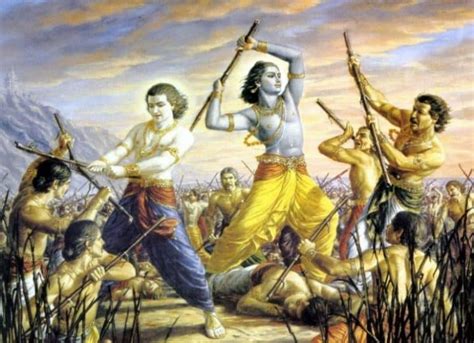
Readers might take this article’s explication of the rigidly orthodox concepts of varnashrama dharma as emblematic of what is necessary for republican governance today—this is not the case. In reality, the younger generation has become so dichotomous in its views of varnashrama, that it is either mind-numblingly marxist or nose-in-dirt casteist. Jatiwadis, and their disgusting ideology which sees other castes as a different “genus/species/race” are the greatest threat to varnashrama in our time.
We are framing what can be seen as neither an Aristocratic Republic nor the modern Democratic-Republic with its system of Universal Suffrage (which increasingly weighs whether mere school-children should also vote). What we proffer instead is the concept of the guardianate republic. Guardianates are not unknown in other nations. Arguably, both William Wallace and Oliver Cromwell (Lords Protector in their own rights) presided over Parliaments and national councils. Even the Early American Republic expressly eschewed Universal Suffrage. Direct Democracy might function well in small polities, like the Cantons of Switzerland, or even sub-polities like Panchayaths, but Republics necessitate a more qualified class to do so.
This is not a mere case of “[j]enetic merit” as touted by exam-obsessed Ahankari-Shikandis. The recent NEET controversy and long rumoured theories of Papers Leaks finally showed the problems with this. It is also not one that is obsessed with blood purity, and ethnic-tribalism like many devolved and unevolved claimants to kshathriyatha today. Instead, it is focused on civic duty—a concept alien to most jatiwadi obsessed Bhaaratheeyas, and their marxist moron counterparts on the left. This is no surprise as National Socialism (Nazis) and International Socialism (Commies) both ultimately push forms of…(gasp!)…socialism. Right-wing, Left-wing same bird.
Guardianate republics concerned less with caste purity, and more with civic duty evaluate people not on the basis of mere exams as merit, or Ancestry.com genetic blood tests, but on Qualification, Conduct, and Character. Indeed, examples need not only be found elsewhere. Arguably, the early Svaraajya of Shivaji (rather than the Sangharaajya of the Vyaapaari Shrivardhan Bhats) showed this commitment to qualification based on conduct and character, with netas and lieutenants running across the caste spectrum (whether 96K or Brahmin or CKP or Dalit).

The Peshwai is known to have developed (according to even its promoters) into a debased den of “brahmanshahi“, which the modern, adharmic Rashtriya Swayamsevak Sangh (led by Yavana Panditha Mlecchas) seeks to resuscitate. The latter corrupted varnashrama with jatiwad, while the former under Shivaji Raje elevated all communities whether Brahmin or Dalit.
Some might ask, ‘Qui custodiet ipsos custodes’—meaning, “Who will guard the guardians?” This famous question has plagued all republics, but in Bhaarathavarsha, the answer has always been Dharma. Even the most “high-born” of rulers is subject to it and to Saamanya Dharma. The history of the Sakyas and the Koliyas are also edifying to the Rajputs of the today, who again are making many the same conceited mistakes. The Sakyas and the Koliyas were themselves defeated by the born-kshathriya kingdoms of Kosala and later Panchaala.
Though given autonomy, they naturally were requested to send aristocratic women in marriage to the Imperial family. In a fit of narcissism (as they only married each other and saw themselves as higher), they sent a bonded-servant girl in royal garb. When the prince born to Prasenajit of Kosala came of age, he found out about the deceit and disgusting caste-hauteur of the Sakyas. In a fit of vengeance, he attacked the already subdued Sakyas and massacred the royal men, though some escaped. A similar pattern repeated with the Imperial Panchaalas, who then promptly destroyed both polities in revenge. This is a signal lesson to all caste and blood-purity obsessed jatiwadis.
“Dharmasya vishwasya jagath: prathishtaha” (Dharma is the firm foundation on which the entire Universe rests).
References:
- Raychaudhuri, Hemchandra. Political History of India: From the Ascension of Parikshit to the Extinction of the Gupta Dynasty. University of Calcutta. 1923
- Rangarajan, L.N. Edit, Kautilya. The Arthashastra. New Delhi. Penguin.1992
- Kangle, Edit, Kautilya. The Arthashastra. New Delhi. Penguin.1992
- Majumdar, R.C. Ancient India.New Delh: MLBD. 2003
- Basham, A.L. The Wonder that was India. New Delhi: Rupa.1999
- Sastri, Nilakantha K.A. Age of the Nandas & Mauryas. MLBD.1996
- Sastri, K.A.Nilakantha. A History of South India. New Delhi: Oxford. 2015
- History of the Punjab: Vol 1.
- Jayaswal, K.P. Hindu Polity: A Constitutional History of India in Hindu Times. Delhi: Chaukhamba Sanskrit Pratishthan. 2005
- Singh, G.P. Republics, Kingdoms, Towns, and Cities in Ancient India. New Delhi: DK Printworld. 2003
- Sardesai, D.R. India: The Definitive History. Boulder: Westview Press. 2008